Hieromartyr
Stephen Grachev
Cleric martyred for the faith of Christ.
- Feast
- January 25old style February 7
- Reposed
- 193820th century
- Order
- Martyrs
Life
Holy Hieromartyr Stephen Grachev was a priest in Oryol province (today the Bryansk region), a former novice and distinguished soldier, and received the crown of martyrdom at Bryansk on 7 February 1938. He was canonized in 2006.
Childhood and calling He was born on 30 December 1886 in the village of Trostnaya, Sevsk district, Oryol province (now the Komarichi district, Bryansk region), in a peasant family. His parents, Feodor Ivanovich and Elizabeth Prokhorovna Grachev, had four sons and four daughters. Feodor served at the altar from youth, then until his death was churchwarden of the church of the Archangel Michael in the village of Bobrik. The family was devout and spent all the fasts at the services of the Mother of God Hermitage of Plosky, five versts from home. Three children were given to monasteries: his daughter Elena to the Saints Peter and Paul convent in Bryansk, his daughter Pelagia to the Holy Trinity convent in Sevsk, and his son Stephen to the Plosky Hermitage, where he entered at ten, raised in strictness and piety by the monastery's elders, helping his father too with the village work. Having come of age, in 1904, he was received as a novice into the brotherhood. In 1914 he was called into the army, fought near Vilnius and Grodno, received a junior officer's rank and, for service and unmatched courage, two Crosses of Saint George. After demobilization, in 1918, he entered his native monastery again and did obedience until its closure in 1921. Since novices do not take monastic vows, after a time he married Anastasia Sergeevna Kirilenkova, from the village of Gavrilova Guta, who tended the hermitage's cattle.
The priest From 1924 he was a psalm-reader. In March 1929 Bishop Matthew (Khramtsev, † 1931) of Bryansk and Sevsk ordained him deacon at the church of the Great Martyr Nicetas in the village of Arkino, Komarichi district, and on 23 March 1930, in the church of the Resurrection in Bryansk, priest for the church of the Annunciation in the village of Krapivna. On 2 June 1930 he was moved to the village of Kholmetsky Khutor, Brasovo district, to a church built in 1797 by the landowner Stepan Apraksin for the inhabitants of Krupets; the central altar was dedicated to the Venerable Macarius the Egyptian, the north to the Holy Unmercenaries Cosmas and Damian, and the south to the Holy Martyrs. The landowner had given the parish an old icon of the Tikhvin Mother of God, honoured as wonderworking and carried in procession through the villages around. His niece, Pelagia Egorovna Mitina, describes him as a very strict man, yet loved, respected and a little feared by the children; he never scolded children, who climbed on the stove, played and rang the bells. At first he lived without much poverty, with plain village food, but after collectivization his cow was taken and he lived poorer, and in the time of persecution only on alms, yet his wife always fed the beggars at his urging. He refused no one who called him to give communion or anoint a sick person, not even in the time of persecution. Once he was called to Brasovo for a conversation and held there a whole day.
In 1932 Bishop Daniel (Troitsky, † 1934) of Bryansk and Sevsk gave him the epigonation "for zealous and useful service to the Church of God", and at Pascha 1935 Bishop Joasaph rewarded him with the kamilavka. The family lived in the watchman's hut. In November 1935 it became known that the church bells were to be taken down; called to the collective farm board, he was informed of the government's decision and asked for a pledge of responsibility for possible unrest. He answered that he would rather be arrested than call the people to calm; the bishop, through the deans, had sent the priests a circular letter advising them not to resist the authorities at the taking down of the bells, since it was more important not to give an occasion for closing the churches than to keep the bells. In 1936, a year of drought, the parishioners asked him several times to serve a molieben for rain, then in the fields, by an old custom, with a procession and the Tikhvin icon; the church council asked permission of the village council, the chairman agreed and then withdrew his permission, and the molieben was not served.
Martyrdom On 26 August 1936 he was arrested on a charge of anti-Soviet agitation and imprisoned at Bryansk. His family sought him, bringing parcels; after three months of interrogation he was released because the charge was not proved. In prison he had been pressed to renounce the faith, but had answered that he would bear his Cross to the end, and he said the same to his brother Egor after release, refusing to leave his parish and go to Bryansk. On 4 September 1937 Archpriest Alexis Sokolov was arrested. Learning of it, Father Stephen told his wife to prepare for his own arrest and to dry rusks for him. In the night of 5 September 1937, at half past one, they came for him; the family was locked behind a bolt, and the NKVD men took everything from the house, leaving it without means. In the morning the villagers opened the door and brought what they could. The family was driven out of the watchman's hut, the church was finally closed, and a soldier who had been transferred to serve in Belarus gave them shelter. The family lived in that house until the summer of 1943. The priest was imprisoned at Bryansk; at his first arrest, his niece and her grandfather had looked for him at the prison gate; at the second, a voice told them after two days to look elsewhere. Father Stephen rejected the charge of counter-revolutionary activity. The special troika of the NKVD of the Oryol region sentenced him to death, with confiscation of his personal property, on 29-30 November 1937. He received a martyr's end on 7 February 1938 in Bryansk. He was rehabilitated on 4 August 1989 by the prosecutor's office of the Bryansk region, and on 17 July 2006 the Holy Synod numbered him among the New Martyrs and Confessors of the Russian Church.
He is commemorated on 7 February, in the Synaxis of the New Martyrs and Confessors, and on 3 October in the Synaxis of the Saints of Bryansk, in the new style.
Commemorated the same day January 25
 Gregory the TheologianSaint · Archbishop of ConstantinopleJan 25
 Felicitas of RomeMartyrJan 25
 Vladimir of KyivHieromartyr · Metropolitan of Kyiv and HalychJan 25
- Castinus of ByzantiumSaint · Bishop of ByzantiumJan 25
 Peter ZverevHieromartyr · Archbishop of VoronezhJan 25
 Anatoly of OptinaVenerable · Elder of OptinaJan 25
 Moses of NovgorodSaint · Archbishop of Novgorod and PskovJan 25
 Constantine VeretskyHieromartyr · ArchpriestJan 25
 Andrew ArgunovMartyr · Chairman of the parish councilJan 25
- Bretanion of TomisSaint · Bishop of TomisJan 25
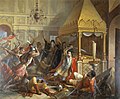 Joasaph of BorovskHieromartyr · Archimandrite of the Trinity LavraJan 25
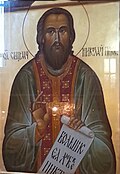 Nicholas PopovHieromartyr · ArchpriestJan 25