Martyr
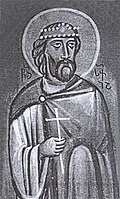
Sukia
A martyr of Kartli, honoured at the head of his sixteen companions in martyrdom.
Life
Holy Martyr Sukia was the head of sixteen Georgian nobles who received the crown of martyrdom in the second century. He is commemorated on 15 April, old style (28 April, new style), together with his companions.
Sukia and the others served at the court of the prince of Caucasian Albania and came to Artashat, the capital of Armenia, in the time of King Artaxias (88 to 123), accompanying the prince's daughter Satenik, who married the king. There Chrysos, a disciple of the Apostle Thaddeus, was preaching. The Georgian nobles became his disciples and resolved to devote themselves to the Lord's service. Chrysos took them to Mesopotamia and baptized them in the waters of the Euphrates; at the baptism they saw Christ standing on a hill. They raised a cross there, called the Cross of the Annunciation. The king's men demanded that the disciples return to Armenia; Chrysos refused, and the barbarians, angered by his firmness, killed Chrysos and four of the disciples with the sword. Sukia they did not touch, for fear of the queen, to whom he was related. Sukia and his brothers buried the slain, and he became the spiritual father of the community.
They then went to Mount Sukaketi, near the village of Bagdevand, and led a harsh life: they ate mountain herbs and drank cold spring water, and their bodies, always under the open sky, turned dark like baked clay and grew covered with hair. The new prince of Albania, Datianos, sent the courtier Barlapa to bring them with honour and, if they resisted, to cut them down with the sword. Sukia answered that they had willingly become dead for Christ and no longer sought the honour of rulers. Barlapa ordered them bound and burned. The martyrs sang Psalm 21. They were then cut with the sword, and the burned remains were scattered. This happened in the year 123 (by another tradition 130, by an eleventh-century parchment of Iveron 100). For 230 years the relics lay unburied but incorrupt. In the fourth century Christians gathered and buried them. Saint Gregory the Illuminator of Armenia built a church on the site of the martyrdom and founded a monastery; later a healing spring burst forth there.
Commemorated the same day April 15
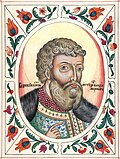 Mstislav the GreatRight-Believing · Grand Prince of KyivApr 15
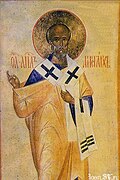 AristarchusApostle · Apostle of the SeventyApr 15
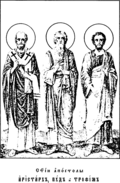 Trophimus the EphesianApostle · Apostle of the SeventyApr 15
 PudensApostleApr 15
- Felix of ByzantiumSaint · Bishop of ByzantiumApr 15
 Basilissa and AnastasiaMartyr · Martyrs of RomeApr 15
 Padarn of WalesSaint · British abbot-bishopApr 15
 Abbo II of MetzSaint · Bishop of MetzApr 15
 Maro of PicenumHieromartyr · Martyr of PicenumApr 15
 Daniel of AchinskRighteousApr 15
 Sukias the AlanVenerable MartyrApr 15
 Leonidas of AthensHieromartyr · Bishop of AthensApr 15