Hieromartyr
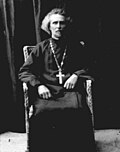
Theodore Kolerov
A Russian priest who died a martyr for his faith in Christ during the communist persecution.
- Feast
- November 16old style November 29
- Reposed
- 192920th century
- Order
- Martyrs
Life
Holy Hieromartyr Theodore Kolerov, a priest, was born in 1882 in the village of Semyonovskoe in the Tver province, in the family of the priest Xenophon Zakharievich and his wife Elizabeth Ivanovna. He received the crown of martyrdom by shooting on 29 November 1929, together with the martyrs Ananias Boikov and Michael Boldakov.
Priest at Kimry
In 1905 he finished the Tver seminary and was ordained priest in the village of Klyuchevoe. In 1911 he was moved to the village of Stolbovo, and a year later he became rector of the newly built Transfiguration church in the town of Kimry. By his zealous ministry he soon won the hearts of the faithful. Although young, he became a father to his parishioners, and in hard cases people came to him for counsel.
The Soviet authorities quickly noticed his authority. At the beginning of September 1919 the secret section of the provincial Cheka sent telegrams to all district towns ordering the arrest as hostages of all prominent inhabitants. Among the hostages Father Theodore was arrested, accused of having "organized a spiritual concert without the permission of the Soviet organs." He was soon released, but the persecution did not cease: they took his furniture and other things.
The Renovationist movement
In 1922, in the time of famine, of the confiscation of church valuables and of the organization of the Renovationist movement by the Soviet power, Father Theodore, who was always interested in church life, went to Moscow to the congress of the Renovationist clergy, held in August. Back in Kimry, he received an appointment as commissioner for the Kimry and Kashin districts. On 31 August he held a meeting with the clergy of Kimry, where he told about the congress. At the end of September, when a schism took place among the Renovationists, Father Theodore, horrified at the sight of the division, broke off all relations with them. He wrote to Bishop Peter (Zverev) of Tver in repentance, and the bishop suspended him from serving. Father Theodore suffered terribly from his separation from the Holy Altar and wrote again to the bishop, asking him to lift the suspension. The ban was lifted soon, and the priest served again in the Transfiguration church.
The closing of the church
Meanwhile persecution grew: the authorities took two rooms from the church house and told him that they would take the whole house, so that he had to build another, in 1927. In the same year the Kimry town council petitioned the All-Russian Central Executive Committee to close the Transfiguration church. In July 1928 the committee decided on the closure, and in May 1929 the decision arrived. On 19 May, at the last service, the church was full. Father Theodore read the order for closure and urged the faithful to submit, but they would not. The next day, when the commission came to take an inventory, it met a crowd that would not let it in. The faithful kept watch near the church, at times gathering up to three hundred people. Father Theodore went out several times to the people, asking them to give up the church so that the innocent would not suffer. Only after three days did the people begin to disperse. Father Theodore, the church warden Ananias Boikov and Michael Boldakov were arrested.
Twenty accused were brought to trial on 20 October, transported at night on an open barge on the Volga. In spite of the threats of the prosecutors and the hostility of a specially chosen audience, the accused conducted themselves bravely and did not admit guilt. On 27 October the sentence was read: the priest Theodore Kolerov, the warden Ananias Boikov, the members of the church council Dmitriev and Zakurin and Michael Boldakov were sentenced to death (the sentence of Dmitriev and Zakurin was later annulled, for unclear reasons). The defenders appealed. During the appeal Father Theodore was moved to Taganka in Moscow, where daily visits from relatives were allowed. His wife, Anna Mikhailovna, did all she could. On 20 November he was told that the death sentence had been confirmed. In the margin of a canonnik in his cell he wrote, "20/XI, 21/XI, 22/XI, weeping three days." He could not keep a diary, but in prayers and hymns composed by the saints he found what he felt and underlined those lines, so that there remained a diary of his feelings written by the saints.
The last days
On 29 November the morning newspapers published that the priest Theodore Kolerov, the warden Ananias Boikov and the layman Michael Boldakov had been shot. But Father Theodore was still alive, and in the evening he was given a visit with his wife and son. He came out to them thin, exhausted, but calm and enlightened. He knew he would soon be killed and that the Lord would accept his suffering and sacrifice. Laying his hand on his son's head, he spoke peacefully with Anna Mikhailovna. When the guards came to take him to be shot, on the first page of the canonnik he wrote, "29/XI, 11 at night."
Of Michael Boldakov, the page says that he was a townsman of Kimry, brother of the psalm-reader of the Transfiguration church, but not a parishioner of it, rarely in Kimry, being occupied with a vegetable garden in the Kaluga region, and was not in the town in those days. Theodore is commemorated on 29 November (new style), in the Synaxis of the New Martyrs and Confessors of the Russian Church on 7 February, in the Synaxis of the Saints of Tver on 18 July, and in the Synaxis of the Saints of Moscow on 5 September, these three being movable.
Commemorated the same day November 16
 MatthewApostle · Apostle and EvangelistNov 16
 Othmar of St. GallVenerable · First Abbot of St. GallNov 16
- Philoumenos HasapisHieromartyr · Abbot of Jacob's WellNov 16
 Fidentius of PaduaMartyrNov 16
 Sergius of Malaya PinegaVenerable · HieroschemamonkNov 16
- Africus of CommingesSaint · Bishop of CommingesNov 16
 Michael AbramovHieromartyr · ArchpriestNov 16
- Akylina of DramaVenerable · Abbess in DramaNov 16
- Aelfric of AbingdonSaint · Archbishop of CanterburyNov 16
- AfanSaintNov 16
- Ananias BoykovMartyrNov 16
 Anianus of AstiSaint · Bishop of AstiNov 16