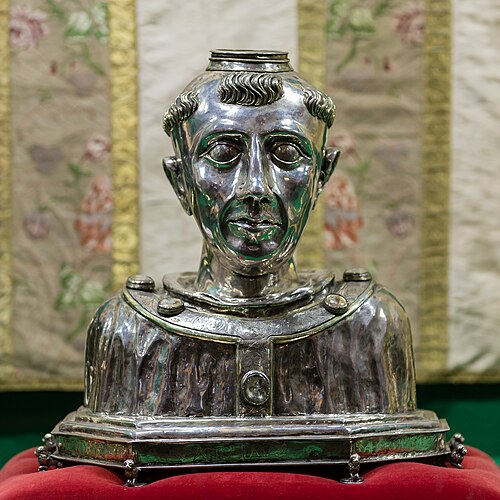
Saint
Tysilio
Welsh bishop and prince
Welsh bishop, prince and scholar who died in 640; sometimes confused with Saint Suliac.
- Feast
- November 8old style November 21
- Reposed
- 6407th century
- Place
- Kingdom of Powys
- Order
- Hierarchs
Life
Saint Tysilio was a Welsh bishop, prince and scholar, who died in the year 640, sometimes confused with Saint Suliac. He is remembered on 8 November.
He was the second son of the king of Powys, Brochwel Ysgithrog, and his wife, Arddun Penasgell, and a nephew on his mother's side of the great abbot Dunod of Bangor Iscoed. He took part in the affairs of Wales in the distressful period at the opening of the seventh century. Tysilio probably began his career at Trallwng Llywelyn (today Welshpool), then settled at Meifod, where he studied under Gwyddfarch. Around 630 he moved to an island in the Menai Strait (now called Ynys Tysilio), where he established a hermitage and preached for seven years throughout the island of Môn. He then returned to Meifod, where he talked the aging abbot out of making a pilgrimage to Rome. In time he succeeded Gwyddfarch as abbot.
King Brochwel, who was fond of hunting, spent his summers in the Vale of Meifod. On his visits to Mathrafal he often went to the shrine of Saint Gwyddfarch. Brochwel gave his son Tysilio the bishopric of that part of his kingdom. He founded the second church in Meifod, the Eglwys Tysilio. His feast day, the gwyl-mabsant, was 8 November, which was also the date of the patronal festival and wakes in the nearby parish of Guilsfield, where a holy well was dedicated to him, the Fons Tysilio. Tradition says he is the original author of the Brut Tysilio, a variant of the Welsh chronicle Brut y Brenhinedd, but the scholar Brynley F. Roberts has shown that the Brut Tysilio arose around 1500 as an amalgam of earlier versions.
His name is preserved in several church and place names in Wales: Llandysilio in Powys, Llandissilio in Pembrokeshire, Llandysiliogogo in Ceredigion and Llantysilio in Denbighshire, as well as, across the border in Herefordshire, the church of Saint Tysilio at Sellack and Llancillo Church. It also appears in the longest place name in the United Kingdom, Llanfairpwllgwyngyll...llantysiliogogogoch, where it means “church of Saint Tysilio,” a name invented, however, in the nineteenth century for tourism.
Commemorated the same day November 8
 GabrielSaint · ArchangelNov 8
 MichaelSaint · Archangel, Chief of the heavenly hostsNov 8
 Adeodatus I of RomeSaint · Bishop of RomeNov 8
 RaphaelSaint · ArchangelNov 8
 UrielSaint · ArchangelNov 8
 BarachielSaint · ArchangelNov 8
 WillehadSaint · Bishop of BremenNov 8
 SelaphielSaint · ArchangelNov 8
 The Four Crowned MartyrsHoly MartyrsNov 8
 Paul AnsimovHieromartyr · ArchpriestNov 8
 Maria ShvarnovnaRight-Believing · Grand Princess of VladimirNov 8
 Agathangelos of LerinNew Martyr · New Martyr of LerinNov 8