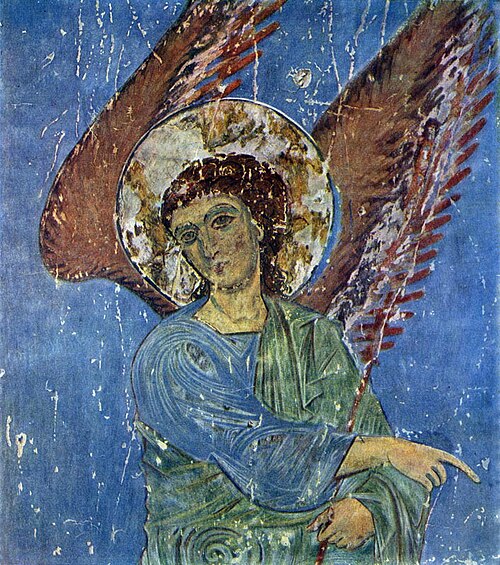
Saint
Gabriel
Archangel
The Archangel who announced to the Virgin Mary the Incarnation of the Son of God.
- Feast
- November 8old style November 21
- Era
- unknown
Life
Saint Gabriel the Archangel is one of the most prominent angels in Judeo-Christian and Islamic tradition, the messenger by whom God makes His will known to humankind. His name in Hebrew means "God is my strength" or "strength of the Lord". Christians honor him above all as the herald of the Birth of Christ from the Virgin Mary. The Orthodox Church celebrates his synaxis on 26 March, the day after the Annunciation, and on 13 July.
The name and his place in Scripture
The name Gabriel, with the forms Gavriil and Gavril, is linked in Hebrew to the sense "God is my strength". From it come names such as Gavrilă, Gabriele, Gavrilo, Gábor or Djibril, in Arabic Jibril. One of our sources notes that his name is mentioned four times in the Bible, but never with the title "archangel": twice in the Book of Daniel (8:16 and 9:21) and twice in the Gospel of Luke (1:19 and 1:26). Each time he appears as a messenger bringing weighty news. The Russian source says that in the Book of Daniel he appears to the prophet once in a vision and once in bodily form.
In the Old Testament he explains Daniel's visions: first he announces to him the return of the Jews from the Babylonian captivity, then reveals to him, in a spiritual vision, the future of the nations and the coming of the Messiah after "seventy weeks". The First Book of Enoch (for instance 20:7-8) and other ancient Hebrew writings, incompletely preserved or lost in Hebrew, mention him too. Alongside the Archangel Michael, he is described as guardian of the people of Israel, defending them against the angels of the other peoples.
In Jewish tradition
According to the Jewish tradition cited by the Russian source, Gabriel is one of the four archangels who stand on the four sides of God's throne and act as guards at the four ends of the world (Book of Enoch 9:1). The four archangels are mentioned together, and are still invoked today in the Orthodox prayer "before sleep". Every three tribes of Israel have their guardian angels in these four archangels (Bemidbar Rabbah 2:10). Michael and Gabriel defend the Jews from persecutors (Yalkut Hadash 57b) and pray before God's throne for the well-being of the human race and the deliverance of the Jewish people from captivity. The three angels who appeared to Abraham were Michael, Gabriel and Raphael.
The Romanian source adds that in Hebrew tradition Gabriel was also the angel of the divine punishment that fell on Sodom and Gomorrah. According to a midrash, in which he is portrayed as an angel of death, he comes as emissary of the "supreme court" for the righteous, with a perfectly smooth knife, and takes their souls, which is compared to a kosher slaughter; for sinners Samael comes with a notched knife. These ideas belong to Judaism, not to the teaching of the Orthodox Church.
In the New Testament and in the Church
According to the Gospel of Luke, Gabriel appeared in the Temple to the righteous Zechariah, father of John the Baptist, and announced the birth of a son. Zechariah did not believe the angel and for this was struck dumb. In the sixth month after the righteous Elizabeth conceived Saint John the Forerunner, Gabriel was sent by God to Nazareth, to the Virgin Mary, to announce the birth in the flesh, from her, of Jesus Christ (the Annunciation). The English source states that he told Mary she would conceive and bear a son by virgin birth. According to the tradition of the Church, it was also the Archangel Gabriel who brought the Virgin the news of her repose, a few days before it. Christians, among them Orthodox, Catholics, Lutherans and Anglicans, honor him as a saint.
The Russian source says that, according to Christian tradition, Gabriel reveals the secret knowledge of God. The Romanian source notes that he is, with Michael, one of the most important angels and second in rank among the archangels; the Russian source says only that he is one of the four archangels, without fixing an order.
In the Orthodox Church the synaxis of the Archangel Gabriel is celebrated with the service of six stichera, on 26 March and on 13 July. On icons the archangel is often shown with a flowering branch from paradise or with a lily; there are also images with a spherical mirror in his hand, and at times with a candle inside a lantern. He is often painted on the north doors of the iconostasis. He is one of the shield-bearers on the coat of arms of the Russian Empire. On 22 September 1972 Pope Paul VI signed an apostolic letter to the Archbishop of Vienna by which the Archangel Gabriel is patron of the post and of philately; on this basis the Austrian post issued in 1973 a stamp with the image of the archangel (1490).
In Islam
In Islam, Jibril (Jabrail) is one of the four especially "near" angels of Allah and the chief intermediary between Allah and the prophets, among them Muhammad. In the Quran he is mentioned as Muhammad's protector, who defends him, with Allah, from unbelievers. Through Jibril Allah sent Muhammad the revelation, the Quran; the first five verses of the 96th chapter, Al-Alaq, are regarded by Muslims as the beginning of these revelations. The Romanian source says Muhammad states that Gabriel, with his hundred and forty pairs of wings, dictated the Quran to him verse by verse, and that in Islamic tradition he is regarded as the divine spirit of truth. Interpreters of the Quran also assign him titles such as "the spirit", "the holy spirit", "the faithful spirit" and "the spirit from the command of Allah". Islamic tradition (the Sunna) speaks in detail of his role in the life of Muhammad: he transmitted the Quran in parts, protected and instructed him, accompanied him on the "night journey" to Jerusalem. According to tradition, Allah sent him to fetch earth for the creation of Adam; then, after the expulsion from paradise, he looked after Adam, saved Nuh (Noah) and the son of Ibrahim (Abraham), taught Yusuf (Joseph) many languages, taught Daud (David) to make coats of mail, helped Sulaiman (Solomon) and foretold to Zakariya the birth of Yahya (John the Baptist).
Other mentions
The Russian source also lists works of art and literature in which the archangel appears, but they are not part of his life: for example, in the poem "Antonias" (1437) by Maffeo Vegio, Gabriel speaks with Saint Anthony. A. S. Pushkin's poem "Gabrieliad" (1821) plays blasphemously on the story of the Annunciation; Pushkin repeatedly tried to persuade the authorities that he was not its author. The source also lists modern films and games, which have no connection with the teaching of the Church and which we do not reproduce.
Commemorated the same day November 8
 MichaelSaint · Archangel, Chief of the heavenly hostsNov 8
 Adeodatus I of RomeSaint · Bishop of RomeNov 8
 RaphaelSaint · ArchangelNov 8
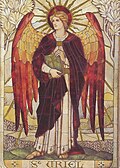 UrielSaint · ArchangelNov 8
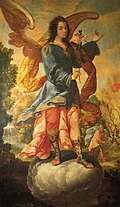 BarachielSaint · ArchangelNov 8
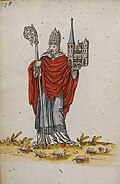 WillehadSaint · Bishop of BremenNov 8
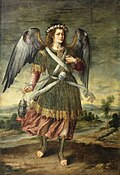 SelaphielSaint · ArchangelNov 8
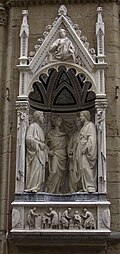 The Four Crowned MartyrsHoly MartyrsNov 8
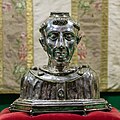 TysilioSaint · Welsh bishop and princeNov 8
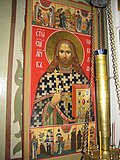 Paul AnsimovHieromartyr · ArchpriestNov 8
 Maria ShvarnovnaRight-Believing · Grand Princess of VladimirNov 8
 Agathangelos of LerinNew Martyr · New Martyr of LerinNov 8