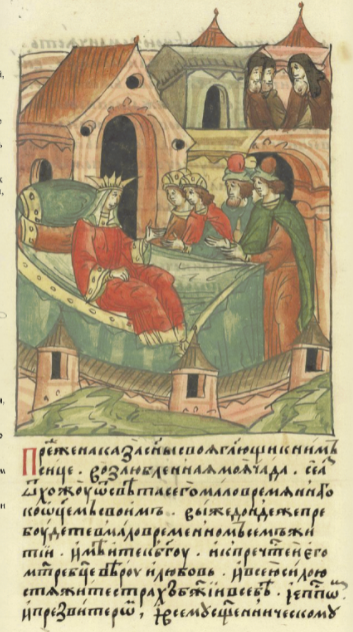
Right-Believing
Maria Shvarnovna
Grand Princess of Vladimir
First wife of Vsevolod the Big Nest, mother of at least twelve children, a nun under the name Marfa; died in 1205.
- Feast
- November 8old style November 21
- Reposed
- 120513th century
- Place
- Vladimir
Life
Saint Maria Shvarnovna, the right-believing Grand Princess of Vladimir, lived in the second half of the twelfth century. She was the first wife of Grand Prince Vsevolod III, called the Big Nest precisely because of the many children she bore him. Mother of at least twelve children, grandmother of Saint Alexander Nevsky and founder of the Dormition convent in Vladimir, later named the Princess's Convent after her, she received monastic tonsure at the end of her life and took the name Marfa in the great schema.
The Russian Orthodox Church honours her among the saints, and she is included in the Synaxis of the Saints of Vladimir and in the Synaxis of the Alanian Saints as Saint Maria of Vladimir, also called Yasynya. More than a hundred of the foremost princely and noble houses of Russia descend from her and Vsevolod, families that shaped the course of Russian history for centuries.
An uncertain origin
The year of her birth is unknown; historians place it around 1158. One chronicle says she was born on the August feast of the Saviour, during the Dormition fast, although whether that fast existed in Rus before the Mongol invasion is doubted.
Her origins have long been debated. Several chronicles call her the daughter of a Czech prince. The texts that precede the Commission copy of the Novgorod First Chronicle name her Maria, wife of Vsevolod, daughter of Shvarn, a Czech prince, and the Tver Chronicle says she was brought from Bohemia unbaptized and received baptism in Vladimir-on-the-Klyazma. The Vladimir chronicler, writing close to the princely court, also calls her the daughter of a Czech prince. The thirteenth-century Uspensky Sbornik describes her as Moravian; the scholar M. V. Shchepkina suggested that this collection was compiled for Maria herself between 1199 and 1206, which would lend weight to its testimony.
A second view holds that she was an Alan (a Yas, that is, an Ossetian). The historian Nikolai Karamzin calls her Maria, of Yas descent, renowned for piety and wisdom, and mentions a tombstone in the Dormition convent bearing the name of Marfa Shvarnovna, which some have taken to be her monastic name. The Hypatian Chronicle calls her younger sister, who married Prince Mstislav Sviatoslavich, a Yasynya, and from this some scholars conclude that all three sisters were Alans. Others, among them A. F. Litvina and F. B. Uspensky, note that at least six years separate Maria's marriage (before 1176) from that of Marfa Yasynya (1182), and that only Maria and her sister Elena are given the patronymic Shvarnovna; the sisters may therefore have been born of different mothers, the youngest taking her byname from her father's second wife.
A third hypothesis, based on the Nikon Chronicle, sees her father in the Kievan voivode Shvarn Zhiroslavich, perhaps of Czech descent or from a family of White Croats long settled in Kiev, whom the Kievans called Czechs. This Shvarn led the defence of Kiev against Yury Dolgoruky and then submitted to him, and a marriage between Dolgoruky's son and a daughter of the powerful Kievan boyars would have had a clear political purpose. The Laurentian and Nikon chronicles mention two men named Shvarn, an uncle and a nephew, the only candidates for her father named in the sources, although the nephew's existence is questioned. On the other hand, the anthropological study of her remains by S. A. Nikitin supported an Alan origin, and recent genetic study found her closest to the medieval Alans.
The chronicles also call her Maria Vsevolozhaya, that is, Vsevolod's wife, following the custom of naming married women after their husbands.
Marriage and the years in Vladimir
Maria was married, while still very young, to Prince Vsevolod, son of Yury Dolgoruky. The wedding took place between 1172 and 1174; some date it to 1173, when Vsevolod briefly held the throne of Kiev, which he and his wife were forced to leave that same year. In 1175 and 1176 the couple lived in Pereslavl-Zalessky. The first certain mention of her in the chronicles dates from 1176, when Vsevolod became Grand Prince of Vladimir after the death of his brother Mikhail, and Maria moved with him to Vladimir.
As grand princess she ordered the princely court and household and built a residence for herself, her sisters and her daughters. She was a patron of books, learning and the arts, was known for piety and wisdom, and adorned churches richly. Later chroniclers, in the Trinity Chronicle (1408-1409) and the Simeon Chronicle (late fifteenth century), compared her with the holy empresses Helen and Theodora and with Saint Olga.
On 14 August 1189 she took part in the consecration of the Dormition Cathedral in Vladimir, and she may also have shared in its renovation in 1194.
Mother of a line of princes
In the first years of her marriage Maria bore only daughters. The first, Sbyslava, was born on 26 October 1178. Then came Verkhuslava (born 1181), who in 1188, at the age of eight, was sent to Chernigov and later married her third cousin Rostislav Rurikovich, the future Grand Prince of Kiev; and Vseslava, who in 1186 married Rostislav Yaroslavich of Snovsk, nephew of Grand Prince Sviatoslav III of Kiev.
Her first son, Konstantin, was born on 18 May 1186. After him came Boris, who died of plague in 1188, Gleb, who died in 1189, Yury (George), Yaroslav, Vladimir, Sviatoslav and, last, Ivan, born in 1197. There was also a daughter, Elena, who died young and was buried in 1203 in the convent her mother founded.
Four of her sons, Konstantin, Yury, Yaroslav and Sviatoslav, each in turn became Grand Prince of Vladimir, and Yaroslav also became Grand Prince of Kiev around the time of the Mongol conquest. Through Yaroslav, Maria is the grandmother of Saint Alexander Nevsky, whose son Daniel of Moscow founded the Muscovite branch of the Rurikid dynasty. Yury, who fell fighting the Tatars in 1238, is likewise venerated as a saint; scholars count several dozen saints of the Russian Church among her children, grandchildren and great-grandchildren.
Illness and the founding of the convent
After the birth of her last son, Ivan, her health, worn down by frequent childbirth, failed, and she fell gravely ill. She then vowed to found a monastery. Between 1198 and 1200 she bought a plot of land, and in 1200, at her urging, the Convent of the Dormition of the Mother of God was founded in Vladimir, later called the Princess's Convent in her honour. A later chronicle records that the convent was built by the grand princess, the blessed Vsevolozhaya. Under her care and protection the community grew and was built up quickly. Tradition also credits her with founding several other convents.
Tonsure and repose
Sensing that her end was near, Maria asked to be tonsured. The sources speak of eighteen days or of three weeks before her death; a Ukrainian account places the tonsure on 1 March. She took the name Maria as a nun and Marfa in the great schema. She was accompanied to the convent by the grand prince, her son Yury, her daughter Vseslava, Bishop John of Rostov, Suzdal and Vladimir, her confessor Abbot Simon of the Nativity monastery in Vladimir, the boyars and their wives, and the whole people of the city.
Before her death she called her sons and begged them to be meek and not to start quarrels among themselves. Karamzin relates that she urged them to live in love, recalling the wise saying of Yaroslav the Great that strife among kinsmen destroys princes and the fatherland raised up by the labours of their forebears, and advised them to be devout, sober and kindly to all, and above all to honour the elderly.
The day of her death is uncertain. Many sources give 19 March, in 1205 or 1206. The Novgorod First Chronicle records her death under 1205 without a day, but only after the arrival of her son Konstantin in Novgorod on 20 March, so some think she died later, perhaps in May.
Her counsel to her sons
When she sent her eldest son Konstantin to rule in Novgorod, Maria gave him and his brothers a mother's instruction, which scholars set beside the Instruction of Vladimir Monomakh for its historical weight and spiritual depth.
In it she tells them that she is gravely ill and will soon depart this passing world to join her fathers. She urges them above all to love God and His most pure Mother and to keep the fear of God; not to be ashamed to bow their heads before bishops, priests and the whole clergy; to be quiet, meek, humble, loving and merciful; to feed the hungry, give drink to the thirsty, clothe the naked, visit the sick, keep themselves pure and give alms always, passing no one without a kind word.
She asks them to have unfeigned love for one another, for if they live in hatred, quarrels and enmity they will perish and lose the blessed inheritance of their homeland, won with great toil by their ancestors and their father. She bids the brothers to regard Konstantin as father and head, and Konstantin to treat his brothers as his sons and guard them as members of his own body, recalling the word of Saint John the Evangelist about the one who claims to love God yet hates his brother. She ends by asking them to pass no monk without a bow, to bow before their elders, not to let the strong wrong the weak, to defend the orphan and the widow, to be sober and to hate pride, which cast even angels down from heaven.
Her tomb and veneration
Maria was buried in the Dormition church of the convent she had founded. The Book of Royal Degrees records that in the chapel of the Annunciation, on the right side toward the north, lay the grand princess, the nun Marfa Shvarnovna, and the grand princess Anna, and on the left side the martyr Abraham. Until the grand princely throne moved to Moscow, the convent remained the burial place of the princesses of the grand princely house of Vladimir. Vsevolod married again in 1209, taking a daughter of the Prince of Polotsk.
The descendants of Yaroslav Vsevolodovich kept close ties with the convent and often named their daughters Maria; Saint Eudoxia, Grand Princess of Moscow, was especially attached to it. In the mid-fifteenth century the convent fell into decline, and the memory of its founder faded with it. Its restoration in the early sixteenth century renewed interest in Maria as a member of the ruling house and founder of the convent, particularly under Metropolitan Macarius of Moscow.
Today the reliquary with her holy relics stands in the Dormition church of the convent, near the iconostasis. The remains attributed to her have also been studied genetically: her mitochondrial haplogroup was identified as U4b1a4, her kinship with her great-grandson Prince Dmitry Alexandrovich was confirmed, and her closeness to medieval Alan populations was shown.
In recent years she has often been remembered as a sign of the bond between Russia and Ossetia (Alania), one of the oldest Christian lands. In 2014 a section of the eighteenth World Russian People's Council was devoted to her; in 2017 the readings held at the church of Saint Euphrosyne of Moscow in Kotlovka were dedicated to her; in 2019, ahead of the 1100th anniversary of the baptism of Alania, a collective monograph about her was published; and in 2022 a conference on her place in the history and spiritual life of both peoples was held in the Hall of Church Councils of the Cathedral of Christ the Saviour in Moscow. Saint Maria is commemorated in the Synaxis of the Saints of Vladimir and in the Synaxis of the Alanian Saints.
Commemorated the same day November 8
 GabrielSaint · ArchangelNov 8
 MichaelSaint · Archangel, Chief of the heavenly hostsNov 8
 Adeodatus I of RomeSaint · Bishop of RomeNov 8
 RaphaelSaint · ArchangelNov 8
 UrielSaint · ArchangelNov 8
 BarachielSaint · ArchangelNov 8
 WillehadSaint · Bishop of BremenNov 8
 SelaphielSaint · ArchangelNov 8
 The Four Crowned MartyrsHoly MartyrsNov 8
 TysilioSaint · Welsh bishop and princeNov 8
 Paul AnsimovHieromartyr · ArchpriestNov 8
 Agathangelos of LerinNew Martyr · New Martyr of LerinNov 8