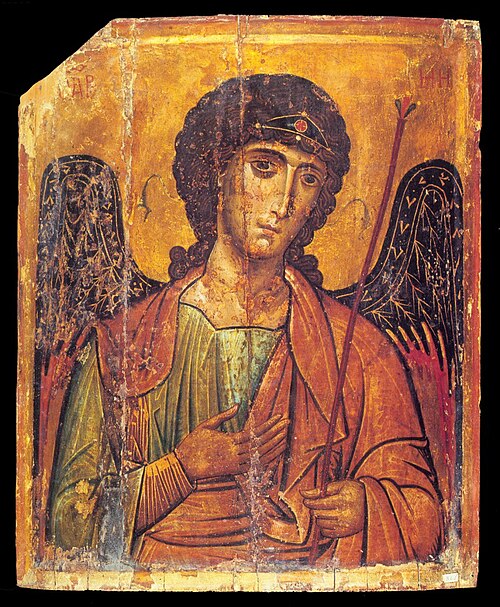
Saint
Michael
Archangel, Chief of the heavenly hosts
Chief of the angelic powers, honored as protector of the Church and victor over evil.
- Feast
- November 8old style November 21
- Era
- unknown
Life
The Holy Archangel Michael is the first among the angels, the chief of the heavenly hosts, whom the Orthodox Church calls the Archistrategos, the commander of the angelic ranks. Holy Scripture names him in the Book of the Prophet Daniel, in the Epistle of the Apostle Jude and in the Revelation, and the tradition of the Church honours him as the victor over the devil, the protector of God's people and of the Church, a healer and a guide of souls. He is celebrated on 8 November, in the Synaxis of the Archangels Michael and Gabriel and all the Bodiless Powers, and on 6 September, the commemoration of the miracle at Chonae.
The name
The name Michael comes from Hebrew and means “Who is like God?”. The question expects the answer that no one is like God, and so the name has been understood as a confession of humility before Him. The word “angel” translates the Hebrew “malakh”, a messenger, and “archangel” means the first among the messengers. In Greek his name is Michael, in Latin Michael, and in Arabic Mikail.
The fall of Lucifer
According to the tradition of the Church, God created in the beginning a countless multitude of angels, ordered in ranks. At their head stood Lucifer, the Morning Star, the most powerful, wise and beautiful of them. He grew proud of his high place, ceased to do God's will and stirred up the angels subject to him to rebel. Then one of the angels remained faithful to God and cried out, “Who is like God?”. At the head of the angels who stayed faithful he went into battle and cast Lucifer, henceforth called the devil and Satan, out of heaven together with the fallen spirits. So his cry became his name.
Since then, according to tradition, the holy host of angels has been led by the two archistrategoi, Michael and Gabriel. The Church adds that above all the angelic ranks the Mother of God was later exalted, “more honourable than the cherubim and beyond compare more glorious than the seraphim”.
In the Old Testament
The names of angels rarely appear in the Old Testament, but Michael's name occurs three times at the end of the Book of Daniel. The angel speaking with the prophet says that the guardian prince of Persia withstood him for twenty-one days, but Michael, “one of the chief princes”, came to help him. Further on he calls Michael “your prince”, the only one who stands with him. And in the prophecy of the last times Daniel announces that then Michael shall stand up, “the great prince which standeth for the children of thy people”. From this came the belief that Michael is the protector of God's people.
Christian tradition also sees the work of the Archangel Michael in other appearances of the angel of the Lord, even where the name is not spoken: the angel who stood in Balaam's way; the man with a drawn sword who appeared to Joshua near Jericho and called himself the captain of the Lord's host; the angel who destroyed the 185,000 soldiers of the Assyrian king Sennacherib besieging Jerusalem; and the angel sent by God to deliver the three youths from the fiery furnace in Babylon.
Tradition also holds that Michael is the cherub with the flaming sword whom God set to guard the way to the tree of life after Adam was driven from paradise. For this reason on some icons his halo is adorned with plant motifs, as a sign of the guardian at the gates of paradise, and the scene appears among the border panels of icons showing his miracles. A medieval collection of the Archangel's miracles, attributed to the deacon Pantoleon, chartophylax of the Great Church, calls him the great protector of Christians.
In the New Testament
In the New Testament Michael is mentioned twice. The Epistle of Jude says that the Archangel Michael, when contending with the devil and disputing about the body of Moses, did not dare to bring against him a railing accusation, but said, “The Lord rebuke thee”. This is the only place in Scripture where Michael is called an archangel. The apostle draws here on an ancient story, which Clement of Alexandria, Origen and Saint Athanasius the Great knew from a work called the Assumption of Moses: the devil sought to prove his claim over Moses' body because Moses had killed the Egyptian who was striking a Hebrew.
In the twelfth chapter of Revelation, Saint John the Theologian sees war in heaven: Michael and his angels fight against the great dragon with seven heads and ten horns, who was persecuting the Woman clothed with the sun and her Child. The dragon, “that old serpent, called the Devil, and Satan”, is cast down to the earth with his angels.
The Archangel and the Last Judgement
This image of Michael in the struggle between good and evil influenced many Christian writings about the end of the world. Tradition ascribed to him not only victory over Satan but also a role at the Last Judgement, when he will call the dead from their graves with the sound of the trumpet. The archangel weighing souls at the Judgement became a standard motif in the iconography of the Last Judgement, and Michael came to be honoured as the protector of the departed. The hymns of the Church ask him to defend us in battle and not let us perish at the dread Judgement.
A Coptic homily of the tenth century tells at length how Michael will call the dead with the trumpet, weep over the fate of sinners, and how Christ, at his prayers, will forgive them. Tradition also says that God entrusted to him the souls of Abraham and of the Mother of God, to carry them to heaven.
In ancient non-canonical writings
The image of the Archangel appears in many ancient writings outside the canon of Scripture. In the Book of Enoch the Lord commands Michael to take off Enoch's earthly garments, anoint him with oil and clothe him in the garments of glory. In one of the Qumran scrolls, the War of the Sons of Light against the Sons of Darkness, Michael leads the forces of light against the darkness led by Belial. In Jewish tradition Michael is one of the four angels, with Gabriel, Uriel and Raphael, who stand before the throne of God, and the one who receives the souls of the righteous and escorts them to heaven.
Christian apocryphal writings develop the same themes. The Gospel of Nicodemus (fourth century) says that Christ, after His descent into Hades, entrusted to Michael the souls of the righteous to lead them into paradise. The Apocalypse of Paul (late fourth century) ascribes to him the washing of the souls of the repentant in the Acherusian Lake before they enter the heavenly Jerusalem. In the Descent of the Mother of God into Hell (tenth century), Michael guides the Virgin through hell and explains to her the causes of the sinners' torments, and she greets him with honour as the servant of the invisible Father and the first before the throne of God. An apocryphal Apocalypse of John says that Michael and Gabriel will sound their trumpets, and at their voice all human nature will rise for the Judgement.
The Qur'an also mentions Mikail as one of the highest angels, an angel of mercy who distributes sustenance to creatures.
Veneration in the Church
In Orthodoxy Michael is called the Archistrategos, the commander of the holy host of angels who guard the law of God, an image present since apostolic times. Metropolitan Macarius of Moscow wrote in his Great Menaion Reader that God set the Archistrategos Michael as an all-powerful weapon and safeguard against the power of the devil. He is therefore honoured as the protector and fellow-warrior of the Church militant, that is, of all those faithful to God who stand against evil.
Shrines dedicated to him appeared in the fourth century, when he was honoured above all as a healing angel, and later as protector and leader of God's host. The faithful pray to him for healing, because he is the conqueror of evil spirits. In many places in Asia Minor there were healing springs dedicated to him. In Constantinople he was honoured as a great heavenly healer, and his most famous shrine, the Michaelion, stood outside the capital, where according to tradition he had appeared to Emperor Constantine. By the sixth century his veneration had spread throughout East and West.
The Coptic Christians dedicated the Nile to the Archangel. They celebrate him on 12 November, on the twelfth day of every month, and on 12 June, when the Nile floods, in thanksgiving for the rising waters. In the West Michael was regarded as the patron of the Holy Roman Empire and then of Germany, and the Roman Catholic Church also celebrates him on 8 May.
The miracle at Chonae
In Phrygia, in the city of Colossae near Hierapolis, a local man built a church of the Archangel Michael in thanksgiving for the healing of his daughter by the water of a healing spring there. In this church Saint Archippus served as sacristan for sixty years, renowned for his pure life. The pagans, who hated him, resolved to destroy the church and kill Archippus. They joined two mountain rivers into a single torrent and directed it at the church. Archippus prayed to the Archangel to turn the disaster aside. Then Michael appeared beside the church, struck the mountain with his staff and opened a wide cleft into which the waters plunged, and the church remained untouched. The place was henceforth called Chonae, meaning “cleft” or “opening”. The Orthodox Church commemorates this miracle on 6 September.
Other appearances
In 590 Rome was ravaged by plague. Pope Gregory the Great led a procession of prayer for the city's deliverance and saw the Archangel Michael on the top of the mausoleum of Hadrian, sheathing his sword. After this the plague began to abate. In memory of this miracle a statue of the Archangel was set on the mausoleum, and from the tenth century the building was called the Castle of the Holy Angel.
In 630, when the Lombards besieged the city of Siponto in Italy, the Archangel appeared in a vision to the bishop of the city and encouraged the frightened inhabitants, promising to help them defeat the enemy. Tradition says that the Lombards heard a great thunder and saw a cloud descending on Mount Gargano with fire, smoke and lightning, and terror put them to flight.
Commemoration
The Orthodox Church celebrates the Archangel Michael on 8 November, together with the Archangel Gabriel and all the angelic ranks, and on 6 September, the commemoration of the miracle at Chonae. Countless churches and monasteries are dedicated to him throughout the Orthodox world. He is the patron of all who bear the names Michael and Michaela and of soldiers, and icons show him in armour, with sword or spear, trampling the dragon.
Commemorated the same day November 8
 GabrielSaint · ArchangelNov 8
 Adeodatus I of RomeSaint · Bishop of RomeNov 8
 RaphaelSaint · ArchangelNov 8
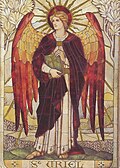 UrielSaint · ArchangelNov 8
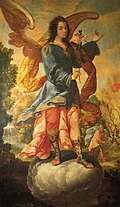 BarachielSaint · ArchangelNov 8
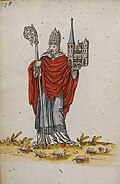 WillehadSaint · Bishop of BremenNov 8
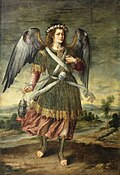 SelaphielSaint · ArchangelNov 8
 The Four Crowned MartyrsHoly MartyrsNov 8
 TysilioSaint · Welsh bishop and princeNov 8
 Paul AnsimovHieromartyr · ArchpriestNov 8
 Maria ShvarnovnaRight-Believing · Grand Princess of VladimirNov 8
 Agathangelos of LerinNew Martyr · New Martyr of LerinNov 8