Right-Believing
Vladimir of Rzhev
Prince of Rzhev
Prince of Rzhev, venerated as a right-believing ruler.
- Feast
- July 15old style July 28
- Era
- 16th century
Life
Holy Right-Believing Prince Vladimir of Rzhev was a prince, a son of Mstislav the Brave and brother of Mstislav Mstislavich the Daring, and the founder of the town of Rzhev, called in ancient times Rzheva Vladimirova after his name.
He has been venerated from antiquity at Rzhev, together with his wife, the right-believing Agrippina. They were buried in the cathedral of the town, side by side, and until 1745 their graves had a tomb. According to tradition, the well beside the cathedral was dug by the prince. Other sources give him as a son of Vsevolod Big Nest.
The chronicles say little. In 1180, dying, his father entrusted the young prince to the voivode Boris Zakharich. In 1208 Vladimir was prince at Pskov, leading the men of Pskov and Novgorod in battles with the Lithuanians and, at the order of his elder brother Mstislav, defending Velikiye Luki, which afterwards counted him as its prince. In 1213 he was driven out of Pskov and for a time governed a small domain in Latvia, where the city of Valmiera was named in his honor. By his influence peace was made between the bishop of Livonia and the prince of Polotsk. From 1214 he ruled again at Pskov. The Mstislavichi showed, besides military skill and bravery, also mercy toward the vanquished. In 1216 he fought beside Mstislav, among other things in the expedition toward Rzhev and at the battle of Lipitsa. In 1217, after Mstislav left Novgorod for the south, to Galich, the inheritance of Toropets was divided, and Vladimir received its eastern part, with Rzhev. In 1226 he again defended the lands of Toropets and Smolensk, and thus Rzhev, from the Lithuanians, in the battle of Usvyat. This is his last mention in the chronicles.
In the sixteenth century the town began to be called Rzheva Vladimirova, to distinguish it from Rzheva Pustaya to the northwest, and perhaps the local veneration of the prince and princess dates from then. The ancient veneration is proved also by the name of the town and by the tradition that, even after death, the saint appeared on a white horse and defended the city from foreign armies. On icons Prince Vladimir and Princess Agrippina are painted together, standing in prayer before the Savior on the cloud. The prince is bareheaded, with curly hair on his shoulders and a short beard, and wears a red feryaz lined with fur; the princess wears a red mantle and a white kerchief, and under them green garments adorned with gold.
The saint is commemorated on 18 July (a movable date, new style) in the Synaxis of the Saints of Tver.
Commemorated the same day July 15
 Vladimir of KievEqual-to-the-Apostles · Grand Prince of KievJul 15
 Swithun of WinchesterSaint · Bishop of WinchesterJul 15
 Cyricus and JulittaHoly MartyrsJul 15
 Donald of OgilvySaintJul 15
- Abudimus of TenedosMartyr · Martyr of TenedosJul 15
 Job KundriaVenerable · Archimandrite in TranscarpathiaJul 15
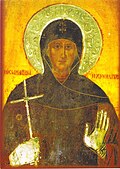 Matrona of ChiosVenerableJul 15
- Edith of PolesworthVenerable · Abbess of PolesworthJul 15
 Jaglika AdžićMartyrJul 15
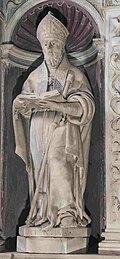 Terentius of LuniSaint · Bishop of LuniJul 15
- 28 Child Martyrs of PlavHoly New MartyrsJul 15
- Aeternus of ÉvreuxSaint · Bishop of ÉvreuxJul 15