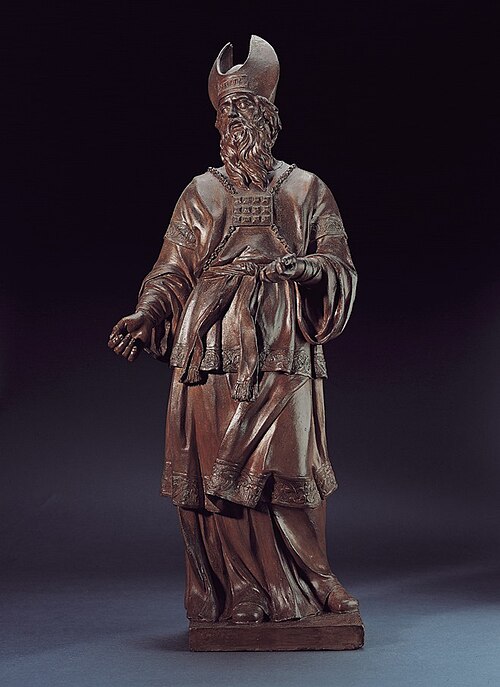
Prophet
Aaron
The High Priest
Elder brother of Moses and first high priest of Israel.
- Feast
- January 19old style February 1
- Reposed
- 144513th century BC
- Place
- Mount Haroun
- Order
- Prophets
Life
The righteous Aaron was the elder brother of Moses and the first high priest of Israel. He lived at the time of the Exodus, and the Church honours him as the one through whom God established the priesthood of the Old Testament, a figure of the priesthood of Christ. The books of Exodus, Leviticus and Numbers speak of him. The Synaxarion published by the Orthodox Church in America places his repose in 1445 before Christ, but the dates of his life cannot be fixed with certainty.
The mouth of Moses
Aaron was of the tribe of Levi, the son of Amram and Jochebed, brother of Moses and Miriam, and three years older than Moses. He remained with his kinsmen in the land of Goshen. When God sent Moses to Pharaoh, and Moses complained that he was not eloquent, the Lord gave him Aaron to speak in his place. The two brothers stood before Pharaoh together. Aaron's staff, cast to the ground, became a serpent, and with it the first three plagues of Egypt were brought.
In the wilderness, when Israel fought Amalek, Aaron and Hur held up the hands of Moses as he prayed, until victory was won. When Moses went up Mount Sinai, Aaron stayed below with Hur to look after the people.
The high priest
At God's command Moses anointed Aaron high priest and his sons priests, clothed them in the holy vestments and appointed their service at the tabernacle of witness. Aaron offered sacrifices and incense and blessed the people. His wife, Elisheba, bore him Nadab, Abihu, Eleazar and Ithamar. Nadab and Abihu offered strange fire before the Lord and died on the day of Aaron's consecration. When Korah and his company rose against Aaron's priesthood, the earth swallowed them, and when the wrath of God struck the people with plague, Aaron took the censer and stood between the dead and the living, and the plague was stayed.
Aaron had his falls too. While Moses was on Mount Sinai, he yielded to the people's demand and made the golden calf. Later, with Miriam, he murmured against Moses. Each time he acknowledged his fault and humbled himself.
The rod that blossomed
When some challenged his priesthood, Moses laid twelve rods in the tent of witness, one from each chief of a tribe. The next day Aaron's rod had budded, blossomed and borne almonds, and it was kept before the Ark as a sign of his right to the priesthood.
Repose and commemoration
Aaron died on Mount Hor, at the age of a hundred and twenty-three, in the fortieth year after the Exodus. Moses stripped him of the priestly vestments and put them on his son Eleazar, and the people mourned him thirty days. Like Moses, he did not enter the Promised Land, because he had murmured against the Lord at the waters of Meribah. According to the teaching of the Apostle Paul in the epistle to the Hebrews, Aaron is a type of Christ, the new High Priest, and the high priesthood stayed in his line until the coming of the Saviour.
The Church commemorates him on 20 July, and in Greek practice on 12 March. He is also remembered on Bright Wednesday, in the synaxis of the saints of Sinai, on the Sunday of the Holy Fathers and on the Sunday of the Holy Forefathers before the Nativity of the Lord.
Commemorated the same day January 19
 JosephRighteous · Betrothed of the Virgin MaryJan 19
 Macarius of EgyptVenerable · Father of the Scetis DesertJan 19
 Mark of EphesusSaint · Metropolitan of EphesusJan 19
 Anastasius of SinaiVenerable · Abbot on Mount SinaiJan 19
 Marius, Martha, Audifax and AbachumHoly MartyrsJan 19
 Agricius of TrierSaint · Bishop of TrierJan 19
 Pontianus of SpoletoMartyr · Martyr of SpoletoJan 19
 Contentius of BayeuxSaint · Bishop of BayeuxJan 19
 Euthymius the Confessor of GeorgiaConfessor · Georgian ascetic monk and scholarJan 19
 Anton of MartqopiStylite · One of the Syrian FathersJan 19
- Arsenius of CorfuSaint · Archbishop of CorfuJan 19
 Euphrasia of NicomediaMartyrJan 19