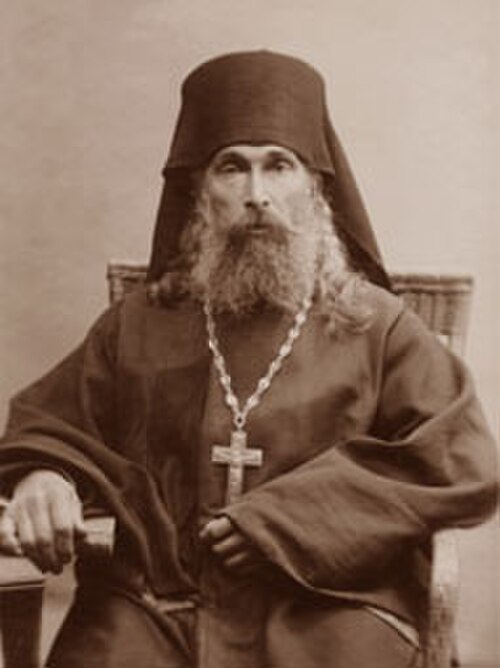
Confessor
Euthymius the Confessor of Georgia
Georgian ascetic monk and scholar
Georgian ascetic monk and scholar, 1865 to 1944, who died at Zedazeni; canonized in 2003.
- Feast
- January 19old style February 1
- Reposed
- 194420th century
- Place
- Racha-Lechkhumi and Kvemo Svaneti
- Order
- Confessors
Life
Venerable confessor Euthymius (born Eustathius Solomonovich Chereselidze, 1865 to 1944) was a Georgian monk, ascetic and scholar who saved the ancient Georgian church chant and died in the Zedazeni monastery. He was numbered among the saints by the Holy Synod of the Georgian Orthodox Church on 18 September 2003, with the name "Venerable Euthymius the Confessor". He is commemorated on 19 January in the Russian Church and on 20 January in the Georgian.
Beginnings
He was born in 1865 in the village of Sameli, in the Racha region, to the pious Solomon and Martha Chereselidze, with the name Eustathius. After parish school, at fifteen he went to Kutaisi, then to Tbilisi, in search of work. Together with another pious youth he formed at Tbilisi a kind of theological book club, with the aim of understanding better the ancient church chants, spreading knowledge of them among the public and strengthening the Orthodox faith in the Georgian people. In the 1890s, with the help of the righteous Elias, the circle acquired printing presses and, in the next twenty-five years, zealously printed theological texts and distributed them free to the people.
In time Eustathius resolved to take on the burden of monasticism, for which he had prepared from youth, with the approval of his spiritual father, Venerable Alexis (Shushania). In 1912, with the blessing of Bishop George (Aladashvili) of Imereti, he began his struggle as a novice at the Gelati monastery. On 23 December 1912 he was tonsured a monk by Abbot Anthimus, with the name Euthymius, after Saint Euthymius the Athonite; in May 1913 he was ordained hierodeacon, and in 1917 priest, by the same bishop.
The chants
In 1921 the communists seized Kutaisi, regarded him as unreliable and arrested him, but he was released for lack of evidence. In the godless time, every day the clergy and monks of Gelati awaited insult and oppression, but Father Euthymius continued his work of gathering ancient chants, finding over a hundred for later publication in Western notation. In 1924 the communists demolished the cathedral of King David the Builder in Kutaisi, shot Metropolitan Nazarius of Kutaisi and the clergy serving with him, and the persecution grew harsher. Father Euthymius left Gelati with the manuscripts he was working on. On the road from Kutaisi to Tbilisi thousands of travellers were being killed, but he arrived safely at Mtskheta, with a cart full of manuscripts, put in safekeeping in the Svetitskhoveli cathedral, and he was appointed abbot of that church. There he continued to study the old manuscripts and to transcribe the chants from the ancient neumatic notation into the modern, and was also spiritual father of the nuns of the Samtavro monastery. In 1929 he was moved to the Zedazeni monastery, near Mtskheta, put the manuscripts in metal cases and buried them in the ground. In November 1935 he handed over to the Georgian National Museum thirty-four collections, with 5,532 chants, and several theological manuscripts.
Last years
In the Second World War life in the Georgian monasteries was especially hard. The abbot of Zedazeni, Archimandrite Michael (Mandaria), gone to Saguramo for provisions, did not return before curfew and was shot by the communists. Shortly afterwards a young monk, Parthenius (Artsiauri), was unjustly arrested, and the elder Sabbas (Pulariani) passed to the Lord. So Father Euthymius remained the only monk in the monastery, cared for, now old, by his spiritual daughters, the nuns of Samtavro. In the winter of 1944 the nun Zoilus (Dvalishvili) and several sisters went to Zedazeni to see him and found him lying exhausted in bed. After a little time the venerable one gave his soul into the Lord's hands and was buried in the courtyard of the Zedazeni monastery, near the altar. He was an ascetic monk and scholar who prayed unceasingly and from youth was an example of chastity, humility and patience. The ancient school of Georgian chant has been preserved in great part through the labour of Abbot Euthymius; part of his library was taken to Samtavro, where some manuscripts written by him, with the chants transcribed in linear notation, are still kept. The Synod decided that the saint be named "Venerable Euthymius the Confessor", to show his confession of the faith and his role in preserving the great heritage of Georgian liturgical chant.
Commemorated the same day January 19
 JosephRighteous · Betrothed of the Virgin MaryJan 19
 AaronProphet · The High PriestJan 19
 Macarius of EgyptVenerable · Father of the Scetis DesertJan 19
 Mark of EphesusSaint · Metropolitan of EphesusJan 19
 Anastasius of SinaiVenerable · Abbot on Mount SinaiJan 19
 Marius, Martha, Audifax and AbachumHoly MartyrsJan 19
 Agricius of TrierSaint · Bishop of TrierJan 19
 Pontianus of SpoletoMartyr · Martyr of SpoletoJan 19
 Contentius of BayeuxSaint · Bishop of BayeuxJan 19
 Anton of MartqopiStylite · One of the Syrian FathersJan 19
- Arsenius of CorfuSaint · Archbishop of CorfuJan 19
 Euphrasia of NicomediaMartyrJan 19