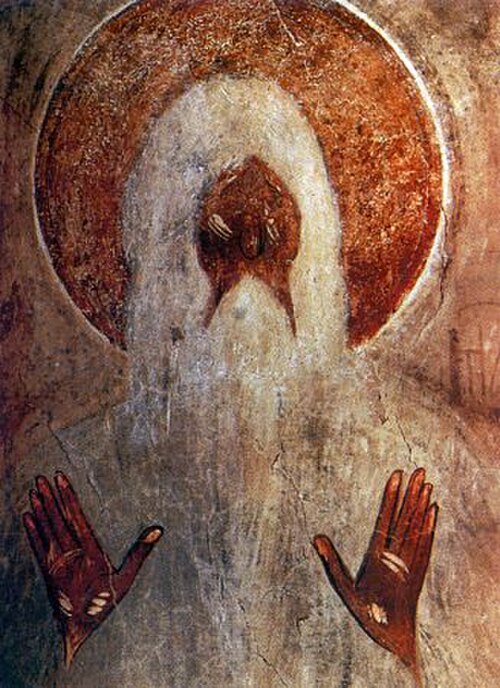
Venerable
Macarius of Egypt
Father of the Scetis Desert
Hermit of Egypt, also called Macarius the Great, spiritual father of the hermits of Scetis.
- Feast
- January 19old style February 1
- Reposed
- 3914th century
- Place
- Wadi El Natrun
- Order
- Venerables
Life
Saint Macarius of Egypt, called also Macarius the Great or Macarius the Elder, was a hermit and father of the desert of Scetis, founder of a monastic community that he led until his death. He is commemorated on 19 January.
Early life
He was born around 300, in Lower Egypt, according to some in the village of Shabsheer. A late tradition says he was the son of a priest. In childhood he tended cattle. As a young man he felt a strong call to solitude and built near his home a small cell, where he prayed unceasingly and wove mats. Before this he had earned his living carrying saltpeter in the neighbourhood of Nitria, which taught him to cross the desert. He was known for wisdom, and his friends called him the old young man, that is, the young man with the wisdom of the elders. At the wish of his parents he married, but soon became a widower, and his parents died as well. Then he distributed all his wealth to the poor and needy. He found a teacher in a seasoned elder, who lived in the desert near the village, and who received him, guided him in the science of watchfulness, fasting and prayer and taught him to weave baskets.
In the desert
Sometime later, a pregnant woman accused him of having defiled her. Macarius did not defend himself and accepted the accusation in silence. When her time drew near, she had a very hard labour and could not give birth until she confessed his innocence. The crowd came to ask his forgiveness, and he fled to the Nitrian desert, to escape the glory of the world. As a hermit he lived seven years on pulse and raw herbs only, then three years on four or five ounces of bread a day and one vessel of oil a year. He went to Saint Anthony the Great, from whom he learned the monastic rules. At forty, returned to the desert of Scetis, he was ordained priest. The fame of his holiness gathered many disciples. Their community was semi-eremitical, with no fixed rule, with cells close together, and they met for divine worship on Saturday or Sunday. He was the guide of this community all his life.
Exile
The Arian emperor Valens sent him, together with Macarius of Alexandria, to an island of the Nile, in a dispute about the Nicene Creed. On the island the daughter of a pagan priest had fallen ill, and the people believed she was possessed by an evil spirit. The two saints prayed for her and healed her. The inhabitants marvelled, gave up worship of the gods and built a church. When the emperor and the Arian bishop Lucius learned of it, they let them return. On their return they were met by a multitude of monks from the Nitrian desert, fifty thousand, according to the Coptic tradition, among them Pishoy and John the Dwarf.
Writings and repose
Fifty spiritual homilies, seven exhortations and two epistles are preserved under his name. Of these the Epistle to His Children, an ascetic treatise in seventeen chapters, some scholars regard as his only certain work. He reposed in 391. After his death the people of his village stole his body and built a church for him, but the relics were later brought back to the Nitrian desert, to his monastery, where they are today. The Monastery of Saint Macarius the Great in Scetis has been continuously inhabited by monks since the fourth century and belongs today to the Coptic Church. The entire Nitrian desert is sometimes called the desert of Macarius.
Commemorated the same day January 19
 JosephRighteous · Betrothed of the Virgin MaryJan 19
 AaronProphet · The High PriestJan 19
 Mark of EphesusSaint · Metropolitan of EphesusJan 19
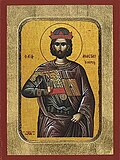 Anastasius of SinaiVenerable · Abbot on Mount SinaiJan 19
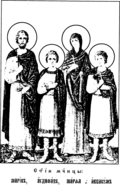 Marius, Martha, Audifax and AbachumHoly MartyrsJan 19
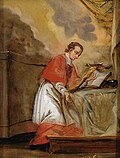 Agricius of TrierSaint · Bishop of TrierJan 19
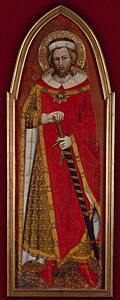 Pontianus of SpoletoMartyr · Martyr of SpoletoJan 19
 Contentius of BayeuxSaint · Bishop of BayeuxJan 19
 Euthymius the Confessor of GeorgiaConfessor · Georgian ascetic monk and scholarJan 19
 Anton of MartqopiStylite · One of the Syrian FathersJan 19
- Arsenius of CorfuSaint · Archbishop of CorfuJan 19
 Euphrasia of NicomediaMartyrJan 19