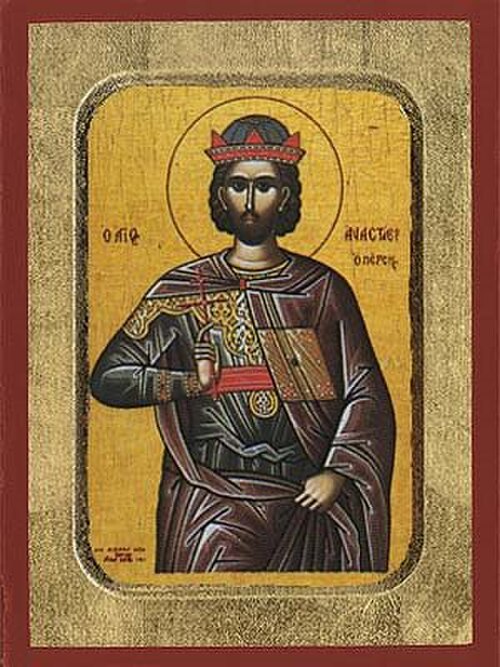
Venerable
Anastasius of Sinai
Abbot on Mount Sinai
Priest, writer and abbot of St. Catherine's Monastery on Sinai, who died after the year 700.
- Feast
- January 19old style February 1
- Reposed
- 7018th century
- Place
- Saint Catherine Monastery
- Order
- Venerables
Life
Saint Anastasius of Sinai was a priest, church writer and abbot of the monastery of Saint Catherine on Mount Sinai in the seventh century. Little is known of his life, chiefly from his own writings, and in antiquity he was often confused with Patriarch Anastasius I of Antioch. He died around 700 or shortly after. The Church also remembers him in the synaxis of the saints who shone forth in the land of Egypt.
Life
According to the Russian tradition, he was born around 640 on the island of Cyprus, in the city of Amathus, and received a good secular education, which he completed by the study of theology. From youth he took the monastic habit, then went to Jerusalem, from there to Egypt, and settled on Mount Sinai. The abbots of Saint Catherine's were then the venerable John Climacus and, after him, his brother George. After George, Anastasius became abbot, whence he was called the Sinaite.
The seventh century was an age of great doctrinal disputes, and Anastasius took a direct part in them. He made great missionary journeys through Egypt, Palestine, Arabia and perhaps Syria, where he fought by his preaching the monophysites, especially the sect of the Acephali, the monothelites, the Severians, the Theodosians and other heretics. He also wrote notes on how to discuss with the Muslims, who had only just appeared. He spent his whole long life in prayer and ascetic labours. The year of his death is not certainly known: near 686 or 700, or even at the beginning of the eighth century; it is known only that he lived to see the victory of Orthodoxy over monothelitism, condemned at the Sixth Ecumenical Council (680 to 681). Recent research shows that he died in 701 at the earliest.
Writings
Many of his writings are preserved, gathered in volume 89 of the Patrologia Graeca. He is best known for the Guide (Hodegos), composed for his disciples to help them in disputes with the monophysites, in twenty-four chapters. It defends the Council of Chalcedon and shows not only the content of the debates but also the spiritual conditions and method of such a dispute. He also wrote Questions and Answers, a kind of pastoral theology for the faithful, with advice on spiritual matters and the sacraments, on almsgiving and marriage; they are also direct testimony to the spread of Islam in Sinai and Egypt and to the effects of Muslim rule on Christian life. He left homilies, narratives, lives of some ascetics and commentaries on many passages of Scripture. In a sermon for Thomas Sunday he wrote that those who saw Christ in the flesh took Him for a prophet, whereas we, who have not seen Him with bodily eyes, have known Him as God, and honour His likeness in the icon.
A Hexaemeron in twelve books is also attributed to him, though its authorship is disputed, many scholars considering it later. For that reason, for every work attributed to Anastasius of Sinai it must be examined whether it truly belongs to him.
Commemorated the same day January 19
 JosephRighteous · Betrothed of the Virgin MaryJan 19
 AaronProphet · The High PriestJan 19
 Macarius of EgyptVenerable · Father of the Scetis DesertJan 19
 Mark of EphesusSaint · Metropolitan of EphesusJan 19
 Marius, Martha, Audifax and AbachumHoly MartyrsJan 19
 Agricius of TrierSaint · Bishop of TrierJan 19
 Pontianus of SpoletoMartyr · Martyr of SpoletoJan 19
 Contentius of BayeuxSaint · Bishop of BayeuxJan 19
 Euthymius the Confessor of GeorgiaConfessor · Georgian ascetic monk and scholarJan 19
 Anton of MartqopiStylite · One of the Syrian FathersJan 19
- Arsenius of CorfuSaint · Archbishop of CorfuJan 19
 Euphrasia of NicomediaMartyrJan 19