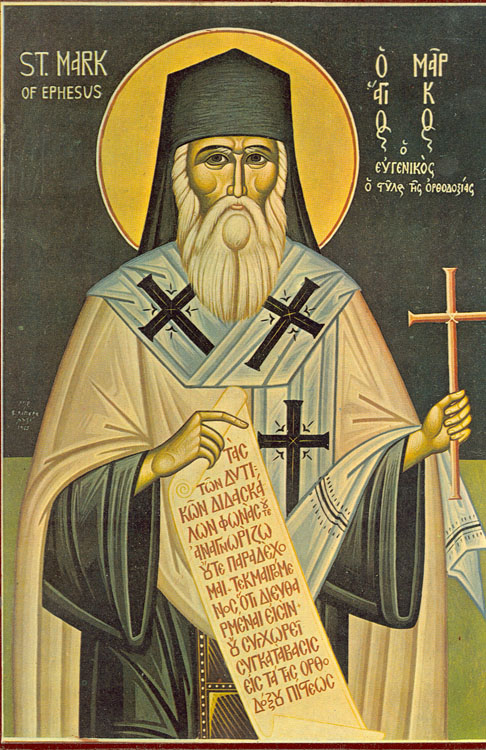
Saint
Mark of Ephesus
Metropolitan of Ephesus
Hesychast theologian and defender of Orthodoxy who rejected union with Rome at the Council of Ferrara-Florence.
- Feast
- January 19old style February 1
- Reposed
- 144515th century
- Place
- Constantinople
- Order
- Hierarchs
Life
Saint Mark Eugenikos, hierarch and metropolitan of Ephesus, was a hesychast theologian of the last years of the Byzantine Empire, and the Church remembers him as the defender of Orthodoxy at the Council of Ferrara-Florence. He is commemorated on 19 January.
Youth
He was born around 1392 in Constantinople, with the name Manuel Eugenikos. His father, George, was a deacon and sakellarios of the Cathedral of Hagia Sophia, and his mother, Maria, was the daughter of a devout physician named Luke. He learned first from his father, who died while Manuel and his younger brother John were still children. He went on to study at Constantinople, rhetoric under John Chortasmenos and philosophy and mathematics under George Gemistos Plethon. From youth he was drawn to theology and to the hard life of asceticism, and the emperor Manuel II received him into his circle.
The monk
Around 1418 he became a monk on one of the Princes’ Islands and took the name Mark. When the Turkish danger forced the monks to leave the monastery, he returned to Constantinople and settled at the monastery of Saint George of the Mangana. There he lived in labour and fasting, read widely in the holy Fathers, and wrote hymns and works in defence of the teaching of Saint Gregory Palamas. The emperor John VIII Palaiologos, who valued his virtue, made him metropolitan of Ephesus in 1437 so that he might take part in the council with the Latins.
At Ferrara and Florence
At Ferrara-Florence (1438-1439) he was one of the foremost theologians of the East. At first he was ready to accept the union, but as the work went on he became convinced that the teaching of the Latin Church, above all the Filioque added to the Creed and the doctrine of purgatory, was not consistent with the decrees of the ecumenical councils. He then wrote several works, among them the ten arguments against purgatory and a Confession of Faith. Of the Eastern bishops he alone refused to sign the act of union. Even so, he remained courteous in his dialogue with the Latins. On his return the crowd in Constantinople acclaimed him because he had not signed. He was exiled for some years on the island of Lemnos (1440-1442), yet he stayed unmoved in his opposition to the union.
His end
He fell asleep in the Lord in 1444, aged about fifty-two, after two weeks of intestinal illness; some sources give the year 1445. On his deathbed he begged George Scholarios, his former pupil and later Patriarch Gennadius, to guard the true faith and to beware of ties with the West. His last words are said to have been: “Jesus Christ, Son of the living God, into Thy hands I commit my spirit.” He was buried at the Mangana.
Veneration
The Eugenikos family marked the day of his death each year, and veneration of him spread chiefly through the efforts of Patriarch Gennadius Scholarios. His life was written by his brother John. In 1734 Patriarch Seraphim I of Constantinople solemnly proclaimed Mark a saint and added six services to the two older ones. A miracle after his death is told: the sister of a certain Demetrios Zourbaios, given up by the doctors, lay three days unconscious, then woke up drenched in water and related that a bishop had led her to a fountain, washed her and said, “Return now; you no longer have any illness.” When she asked who he was, he answered that he was the metropolitan of Ephesus, Mark Eugenikos. The woman made an icon of the saint and lived devoutly for another fifteen years. The Church counts him, together with Saint Photios the Great and Saint Gregory Palamas, among the Pillars of Orthodoxy, and Saint Nikodimos of the Holy Mountain called him the Atlas of Orthodoxy.
Commemorated the same day January 19
 JosephRighteous · Betrothed of the Virgin MaryJan 19
 AaronProphet · The High PriestJan 19
 Macarius of EgyptVenerable · Father of the Scetis DesertJan 19
 Anastasius of SinaiVenerable · Abbot on Mount SinaiJan 19
 Marius, Martha, Audifax and AbachumHoly MartyrsJan 19
 Agricius of TrierSaint · Bishop of TrierJan 19
 Pontianus of SpoletoMartyr · Martyr of SpoletoJan 19
 Contentius of BayeuxSaint · Bishop of BayeuxJan 19
 Euthymius the Confessor of GeorgiaConfessor · Georgian ascetic monk and scholarJan 19
 Anton of MartqopiStylite · One of the Syrian FathersJan 19
- Arsenius of CorfuSaint · Archbishop of CorfuJan 19
 Euphrasia of NicomediaMartyrJan 19