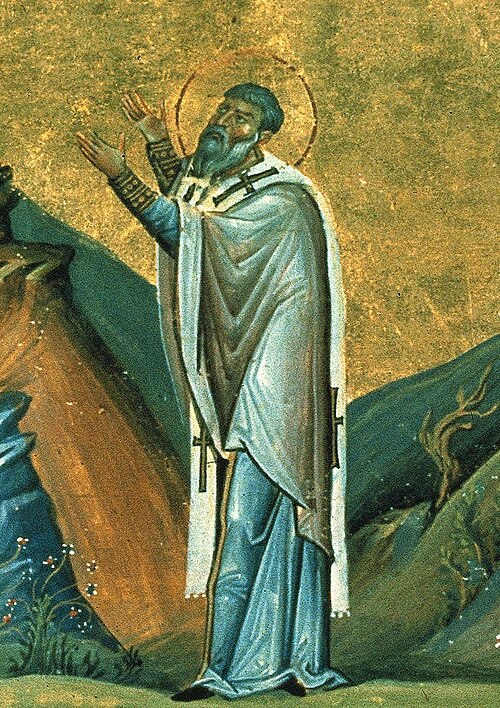
Saint
Abercius of Hierapolis
Bishop of Hierapolis
Bishop of Hierapolis in Phrygia in the time of Marcus Aurelius, who died around 167.
- Feast
- October 22old style November 4
- Reposed
- 1672nd century
- Place
- Hieropolis
- Order
- Hierarchs
Life
Saint Abercius of Hierapolis, called Equal to the Apostles, was a bishop in Phrygia in the time of Emperor Marcus Aurelius, in the second half of the second century. The Church remembers him for his preaching in Syria and Mesopotamia and for his epitaph, one of the oldest surviving Christian inscriptions. His feast is on 22 October (4 November in the new calendar).
Bishop in Phrygia
Abercius lived in the time of Marcus Aurelius (161 to 180) and is regarded, though not beyond doubt, as bishop of Hierapolis in Phrygia and successor of Papias. He may be the same as the writer later sources call Avircius Marcellus, who according to Eusebius wrote against Marcion.
His Life, written in the fifth or sixth century and preserved in at least fifty Greek manuscripts, tells that while he prayed for the salvation of his fellow citizens, largely pagans, an angel appeared to him and commanded him to break the idols in the pagan temple. He did so with zeal. Hearing that the pagans meant to kill him, he went to the assembly of the people and exposed their sins. The crowd tried to seize him, but at that moment three young men possessed by spirits began to cry out. The saint healed them by prayer, and the townspeople asked him to teach them the faith and were baptised.
Preaching
From there he travelled through the neighbouring towns and villages, healing the sick and proclaiming the Gospel. According to the Life, he journeyed through Syria, Cilicia and Mesopotamia and visited Rome, bringing many souls to Christ. For these labours he was called Equal to the Apostles. He defended the Church against heresies and strengthened Christians in the faith. His epitaph says that in Rome he saw a people bearing the splendid seal, that is, baptism, and that beyond the Euphrates he found fellow believers everywhere. It also bears witness to the use of bread and wine at the Eucharist.
Death and dating
He is said to have died in peace at the age of seventy-two, as the epitaph shows. The sources disagree on the date: some say he died about 167, in the time of Marcus Aurelius, others place him between 190 and 216.
The epitaph and the see
The epitaph, which he is said to have set up himself over his tomb, is kept in the Vatican Museums. William Ramsay found in 1881 to 1883, at Kelendres near Synnada, a fragment of a stele dated to the year 216, repeating almost word for word the beginning and end of the epitaph. He then found two more fragments in the public baths of Hieropolis, which completed the text. Ramsay showed that in Phrygia there were two cities named Hierapolis: the one at Pamukkale and another further north-east, near Koçhisar, in the valley of Sandukli. Abercius would have been bishop of the second.
Veneration
The Church honours him as a hierarch equal to the apostles, on 22 October. On Santorini he is regarded as the patron of wine, because his feast coincides with the opening of the barrels, and every year on 22 October a great festival is held in the village of Emporio.
Commemorated the same day October 22
- Marcus of JerusalemSaint · Bishop of JerusalemOct 22
 Paul of RostovVenerable · Abbot of Boris and Gleb MonasteryOct 22
- Theodore of RostovVenerable · First abbot of Boris and Gleb MonasteryOct 22
 Abib and ApolloHoly Martyrs · Ascetics of AkhmimOct 22
 Seraphim SamoylovichHieromartyr · Archbishop of UglichOct 22
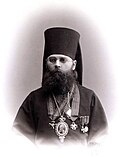 Nicodemus KononovHieromartyr · Bishop of BelgorodOct 22
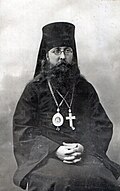 Gregory LebedevHieromartyr · Bishop of ShlisselburgOct 22
- Solarius of LuniHieromartyr · Bishop of LuniOct 22
- Symmachus of CapuaSaint · Bishop of CapuaOct 22
- Alexander AndreyevHieromartyr · ArchpriestOct 22
- Mina ShelaevVenerable Martyr · ArchimandriteOct 22
- Nicholas BogoslovskyHieromartyr · ArchpriestOct 22