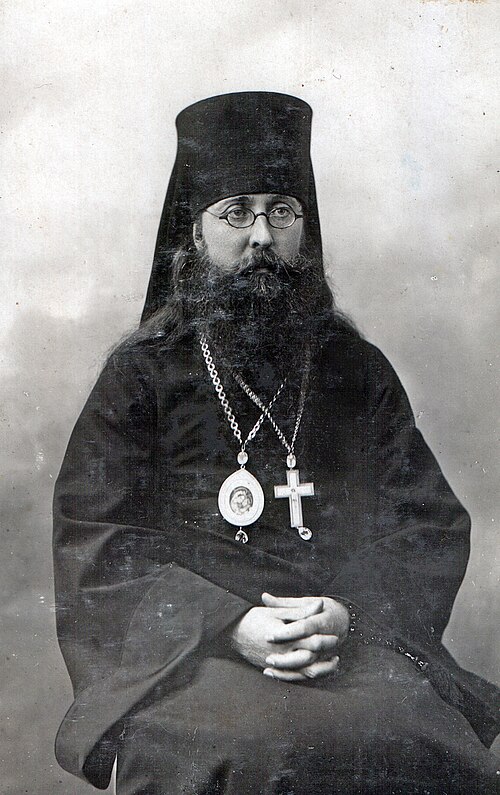
Hieromartyr
Gregory Lebedev
Bishop of Shlisselburg
Bishop of Shlisselburg and vicar of the Leningrad diocese, who died a martyr in 1937; canonized in 2005.
- Feast
- October 22old style November 4
- Reposed
- 193720th century
- Place
- Tver
- Order
- Martyrs
Life
Saint Gregory Lebedev, Hieromartyr, was Bishop of Shlisselburg, vicar of the Leningrad diocese and superior of the Alexander Nevsky Lavra, a preacher of pure life who proclaimed the faith in the hard years of the Church. Born in 1878 at Kolomna, he was shot on 17 September 1937 at Kalinin (Tver). The Russian Church canonized him on 16 July 2005 as hieromartyr. He is commemorated on 22 October.
Youth and studies
Born Alexander Alexeyevich Lebedev at Kolomna, into the family of Archpriest Alexei Mikhailovich Lebedev and Maria Fyodorovna, he had four brothers and three sisters. In 1885 his mother died; his father raised him and often left his children at the convent in the care of the nuns. He studied at the ecclesiastical school at Kolomna, where each year he received prizes for study and conduct, then at the Moscow seminary, where the rector named him typikon-keeper and canonarch until the end. In his free time he made long walks: every summer he walked from Moscow to the Trinity-Sergius Lavra, to the Golutvin monastery at Kolomna and from Kolomna to the Spassky monastery in the Ryazan diocese. He graduated from the seminary in 1898, in the first category, and, with his father's blessing, entered the Bobrenev monastery as a novice, where he read and sang at all services. At the entrance examinations to the Moscow Theological Academy he broke off the tests, thinking himself unprepared, and returned to Kolomna, then went to Kazan, as a novice at the Transfiguration monastery, and was accepted as a free auditor at the Kazan Academy; in 1899 he passed the examinations and became a student. He graduated in 1903 as candidate of theology, with the right to teach at a seminary and to take the master's degree without another oral examination.
Teacher
On 5 August 1904 he was named teacher of homiletics at the Simbirsk seminary, and from 1905 also third assistant inspector. In 1907 he moved to Moscow, where he taught at the Cadet Corps, at the third gymnasium and then at the Nicholas Orphans' Institute. Then he lived through a drama: he loved a former pupil, of a merchant family, whose parents would not give her to a teacher; this story was one of the reasons that led him to take monasticism, toward which he had had an inclination since youth. In 1918 the institute was transformed into labour school no. 165, which he headed for a time. In 1919 and 1920 he headed the postal sector of the Main Forestry Committee.
At the end of 1920 he entered the Zosimova Hermitage in Smolensk, in the Vladimir diocese, where, shortly before Christmas, Bishop Bartholomew Remov tonsured him a monk with the name Gregory. The first months of obedience he spent under Elder Mitrofan. In summer 1921 he moved to the Danilov monastery in Moscow, where his guide was Bishop Theodore Pozdeevsky; he was ordained hierodeacon, hieromonk and later archimandrite. Konstantin Matsan noted that, though from birth his life had been tied to the Church, he felt the priestly vocation only around forty, when the new authorities considered the clergy a "class enemy".
Bishop of Shlisselburg
On 11 November 1923 Bishop Manuil Lemeshevsky of Luga reported that the Alexander Nevsky Lavra, in full, had entered on 28 October into communion with the patriarch and asked that a new vicariate, of Shlisselburg, be opened, headed by Archimandrite Gregory, "the most worthy and desired by the Petrograd diocese". The patriarch decided on 14 November to open the see, to appoint Gregory and to give him temporarily the leadership of the Lavra. On 2 December 1923 he was consecrated Bishop of Shlisselburg, vicar of the Petrograd diocese, superior of the Lavra, by Patriarch Tikhon, who said to the faithful of Petrograd: "I send you a pearl."
As superior of the Lavra he cared above all for keeping the monastic tradition of piety and, by witnesses, "breathed life" into the Lavra: he brought back many brethren who had lived in the world since the beginning of the Renovationist schism. One of his closest advisers was the monastery's confessor, Hieromonk Barnabas Muravyov, later known as Seraphim of Vyritsa. He had the gift of preaching; his deep sermons, which inspired faith in the victory of divine justice over evil, spread in manuscript copies. From February 1924 to December 1925 he sat on the diocesan council of bishops. In December 1924 he was arrested "for non-payment of taxes" and "sale of the Lavra's sacristy"; according to Archpriest Mikhail Cheltsov, at the trial "he conducted himself unexpectedly, to everyone's surprise, manfully, answering without fear but kindly"; he received a small sentence and was released on 17 April 1925. In December 1925, after the arrest of Bishop Venedikt, he governed the diocese temporarily until June 1926. On 5 March 1926 he was sentenced to a year in prison, reduced to three months "as a first conviction". He prepared the solemn services of Metropolitan Joseph on 11 and 12 September 1926 at the Trinity cathedral of the Lavra.
He was arrested a second time on 31 March 1927, in the case of the Pastoral School, accused of founding a circle of "Zealots of True Orthodoxy", and was released on 19 November 1927; the case was closed a year later for lack of compromising material. He received Metropolitan Sergius's Declaration of 29 July 1927 with criticism. He was close to the Josephites but did not join them; according to Cheltsov, in the quiet of his cell he became the true unifier of all those dissatisfied with Bishop Nicholas Yarushevich, with Sergius and his Synod, without showing himself, remaining as if in the shadow, but everything gathered around him. On 30 December 1927 he was named temporary head of the Detskoe Selo vicariate. He stopped commemorating Sergius at services, commemorating only the locum tenens Peter, and received on 25 January 1928 a warning, which he disregarded. He refused to cooperate with Metropolitan Seraphim Chichagov, newly appointed to Leningrad. He went to Moscow to explain his position to Sergius and asked to be retired, in a letter full of pain: "Four and a half years of service here, four and a half years of almost unbroken suffering have taught me to be guided only by the state of my conscience before God. Now my conscience is at peace. Let the Lord judge me... I leave the Lavra to which I gave my soul, where so many tears were shed, where the unseen and merciful hand of God was felt." The request was not accepted and he returned to Leningrad, holding by his authority part of the dwellers of the Lavra back from passing to the Josephites.
Retirement and martyrdom
In May 1928 Sergius named him Bishop of Feodosia, vicar of Taurida; he regarded it as a form of exile and did not accept. On 5 August 1928 he served for the last time in the Lavra and on 29 August he left Leningrad for Kolomna. From 1931 he lived in Moscow, from 1932 at Zhavoronki, from 1933 at Kashin. He worked on theological writings, among them commentaries on the Gospels ("Gospel Images"; the best known is "The Good News of Saint Mark the Evangelist"), and wrote letters to his spiritual children. He remained in opposition to Sergius.
On 16 April 1937 he was arrested at Kashin and taken to the Kalinin prison, accused of having led a counter-revolutionary group of a fascist-monarchist organization. He did not admit guilt; at the interrogation he said that he had never had political conversations. On 13 September he was sentenced by an NKVD troika to death and was shot four days later.
Canonization
His name was entered in the provisional list of the new martyrs in preparing the canonization made by the Russian Church Outside Russia in 1981, and on 16 July 2005 the Holy Synod of the Russian Church numbered him in the Synaxis of the New Martyrs and Confessors of Russia. His brothers were also servants of the Church: Victor (1871 to 1943), Nikolai (1875 to 1936), who died in the camp, Sergei (1876 to 1946) and Konstantin (1882 to 1966), a mitred archpriest.
Commemorated the same day October 22
 Abercius of HierapolisSaint · Bishop of HierapolisOct 22
- Marcus of JerusalemSaint · Bishop of JerusalemOct 22
 Paul of RostovVenerable · Abbot of Boris and Gleb MonasteryOct 22
- Theodore of RostovVenerable · First abbot of Boris and Gleb MonasteryOct 22
 Abib and ApolloHoly Martyrs · Ascetics of AkhmimOct 22
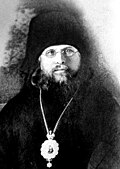 Seraphim SamoylovichHieromartyr · Archbishop of UglichOct 22
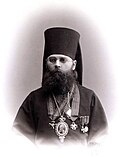 Nicodemus KononovHieromartyr · Bishop of BelgorodOct 22
- Solarius of LuniHieromartyr · Bishop of LuniOct 22
- Symmachus of CapuaSaint · Bishop of CapuaOct 22
- Alexander AndreyevHieromartyr · ArchpriestOct 22
- Mina ShelaevVenerable Martyr · ArchimandriteOct 22
- Nicholas BogoslovskyHieromartyr · ArchpriestOct 22