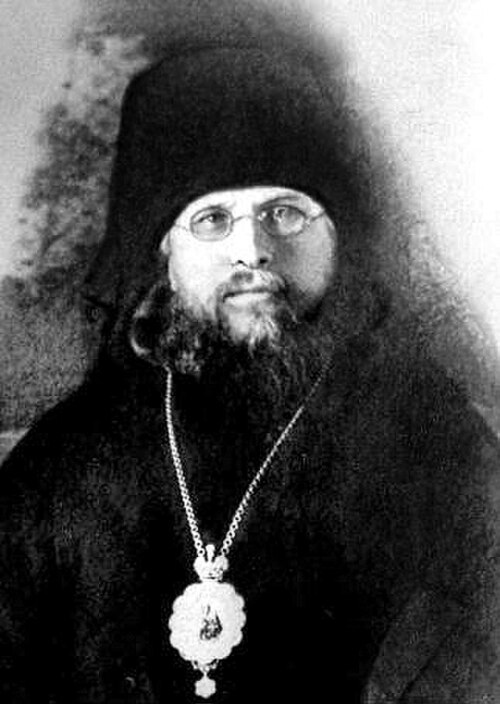
Hieromartyr
Seraphim Samoylovich
Archbishop of Uglich
Archbishop of Uglich and vicar of the Yaroslavl diocese, who died a martyr in a Siberian camp in 1937.
- Feast
- October 22old style November 4
- Reposed
- 193720th century
- Place
- Kemerovo Oblast
- Order
- Martyrs
Life
Saint Seraphim Samoylovich, Archbishop of Uglich and vicar of the diocese of Yaroslavl, was a missionary in Alaska, a capable abbot, and one of the confessing hierarchs of the Russian Church in the years of Soviet persecution. From December 1926 to April 1927, while the other leading hierarchs were imprisoned, he himself led the Russian Church as deputy of the Patriarchal Locum Tenens. After years of arrests and exile, he received the crown of martyrdom in the autumn of 1937 in a Siberian camp.
Origins and studies
Simeon Nikolayevich Samoylovich was born on 19 July 1881, Old Style, in Mirgorod in Poltava province, the son of a church reader. The family descended from Hetman Ivan Samoylovich. He finished the theological school in Lubny in 1896 and the Poltava seminary in 1902.
Missionary in Alaska
Straight after seminary he went to the diocese of the Aleutians and Alaska, then headed by Bishop Tikhon (Bellavin), the future holy Patriarch. On 1 August 1902 he became a teacher at the missionary school in Unalaska, and from July 1905 at the two-class missionary school in Sitka.
On 25 September 1905 Bishop Innocent (Pustynsky) of Alaska tonsured him a monk with the name Seraphim, and on 2 October ordained him hierodeacon. On 25 March 1906 he was ordained hieromonk, and in August of that year he was given the parish and the leadership of the mission at Nuchek.
The historian Michael Polsky wrote that Saint Tikhon valued this zealous missionary highly, for he joined personal asceticism with a skilful approach both to his Aleut flock and to the American administration in Alaska. In March 1908 he was appointed teacher of Holy Scripture and fundamental theology at the Sitka seminary and was awarded the nabedrennik for his zeal.
Return to Russia
Broken health and the harsh climate led him to ask to return home, and in October 1908 he was released from his duties. In 1909 he served as assistant to the diocesan missionary in Vladikavkaz, and from September as confessor and for a time inspector at the Alexandrovsky seminary in Ardon, Ossetia.
In April 1910 he was appointed vicar of the Brotherhood Monastery in Mogilev, but apparently never took up the post. Saint Tikhon, now Archbishop of Yaroslavl, secured from the Synod Hieromonk Seraphim's appointment in place of the late Archimandrite Porphyrius at the Tolga Monastery, one of the most important in the diocese.
Abbot of Tolga
In May 1910 Father Seraphim arrived at Tolga and took charge of the monastery, and in June his appointment was confirmed. His main concern became preparing for the six hundredth anniversary of the monastery's founding in 1914. He put the household in order, brought in the telephone, repaired the landing stage, and from 1911 began major repair and restoration work.
In May 1912 he was raised to the rank of hegumen. By the tercentenary of the Romanov dynasty in 1913 the monastery had been beautifully restored, and on 21 May 1913 Tsar Nicholas II and his family visited it. Hegumen Seraphim greeted them at the landing stage.
In September 1913 he opened at the monastery a school of beekeeping and gardening for twenty-five boys from the surrounding villages, dedicated to Saint Alexis of Moscow, patron of the Tsarevich, with an orphanage attached. Under his guidance a history of the monastery was also written for the jubilee.
The six hundredth anniversary was celebrated in August 1914 under Archbishop Agathangel of Yaroslavl, and Hegumen Seraphim received the Order of Saint Anna. The joy was overshadowed by the outbreak of the First World War. Together with the brethren he at once asked to open a ten-bed infirmary for the wounded at the monastery and gave money for the needs of the war.
Abbot in Uglich
In September 1915 he was appointed abbot of the Protection Monastery, also called the Monastery of Saint Paisius, in Uglich. According to some sources, the following year he was also given the Monastery of Saint Alexis in the same town. In June 1916 he was raised to archimandrite, and in July 1917 he took part in the assembly of learned monastics at the Moscow Theological Academy.
Bishop of Uglich
On 15 February 1920 he was consecrated Bishop of Uglich, vicar of the diocese of Yaroslavl. In July 1922 he was arrested for the first time and held for a while in Yaroslavl.
The faithful of Kharkov wrote in December 1923 that a short visit by him had returned to Orthodoxy six churches taken by the Renovationists, and they asked that he be given to them as bishop. He administered the diocese of Kharkov temporarily until January 1924. Early in 1924 he was placed in charge of the diocese of Yaroslavl, and Saint Patriarch Tikhon raised him to the rank of archbishop.
In these years he belonged to the circle of traditional-minded hierarchs gathered around Archbishop Theodore (Pozdeevsky) of the Danilov Monastery. In April 1925 he signed the act entrusting supreme church authority to Saint Metropolitan Peter of Krutitsy. In 1925 and 1926, while Metropolitan Agathangel was in exile at Narym, he again administered the diocese of Yaroslavl. Early in 1926 he supported Metropolitan Sergius against the Gregorian schism.
At the head of the Church
After the arrest, one after another, of Metropolitan Peter and of his deputies, Metropolitans Sergius (Stragorodsky) and Joseph (Petrovykh), the leadership of the Church fell to Archbishop Seraphim. Metropolitan Joseph had written that, if he were arrested, the rights of deputy would pass to Archbishop Cornelius (Sobolev), then to Archbishop Thaddeus (Uspensky), and thirdly to Archbishop Seraphim. The authorities did not allow the first two to take up the office, and so on 29 December 1926 it passed to the young and little-known Archbishop of Uglich.
In a letter to the bishops he asked them to keep correspondence with the centre to a minimum and to settle all matters locally, except those concerning the whole Church, such as the election and consecration of bishops. He suspended Archbishop Dimitry (Belikov) of Tomsk, who had declared his diocese autocephalous.
Confession before the GPU
In March 1927 he was summoned to Moscow by Yevgeny Tuchkov, the secret police official in charge of church affairs, and held in the GPU's internal prison. Tradition says he was asked whom he would leave as successor if he were arrested. Knowing that whoever he named would soon be in prison, he answered that he left the Church in the care of the Lord Jesus Christ. After three days he was released and sent back to Uglich.
He rejected the authorities' interference in church life and refused the membership of a synod that they proposed. He declined to decide matters of principle without the consent of the senior hierarchs in prison. In April 1927, after Metropolitan Sergius was released, he handed over his powers as deputy to him without reservation and in trust. He had carried this obedience for about a hundred days.
Opposition to Metropolitan Sergius
In July 1927 Metropolitan Sergius issued his well-known declaration of loyalty to the Soviet state, which deeply troubled clergy and faithful. On 6 February 1928 Archbishop Seraphim signed, together with Metropolitan Agathangel, Archbishop Varlaam (Ryashentsev), Bishop Eugene (Kobranov), and Metropolitan Joseph, the so-called Yaroslavl declaration. They condemned the new course, affirmed their loyalty to Metropolitan Peter, and declared that the diocese of Yaroslavl would govern itself.
On the same day he wrote Metropolitan Sergius a personal letter full of goodwill, trying to persuade him that Christ cannot be reconciled with the atheist power. He pointed out how many new sufferers had appeared and how their suffering was increased by knowing that it was the result of the new church policy.
Arrest and exile
On 17 February 1928 he was arrested and exiled to Mogilev, where he was held in the Holy Spirit Monastery at Buinichi, a few kilometres from the town. In April 1928 Metropolitan Sergius and his synod removed him from the Uglich vicariate, and in May they placed him under canonical trial and suspended him from serving.
Metropolitan Sergius nevertheless valued him. According to contemporaries, he was offered the rank of metropolitan and any diocese he wished if he would be reconciled, and he replied that he preferred to suffer for the Church. Some sources say that in May 1928 he attempted a rapprochement with Metropolitan Sergius, but in any case he accepted no appointment from him and held to his convictions.
On 20 January 1929 he wrote an epistle to the pastors and faithful of the Russian Church declaring unlawful all the suspensions imposed by Metropolitan Sergius and his synod. The epistle was published by the Russian Church Abroad. He also kept a diary, something rare and dangerous in those years, which is today a valuable source on church life.
Martyrdom
From 1928 his life was an almost unbroken chain of arrests, exiles, and camps. In the autumn of 1937, during the Great Terror, the NKVD troika of the Novosibirsk region sentenced him to death. He was shot in early November 1937 at the Suslovo section of the Siblag camp in the Mariinsk district, in what is now the Kemerovo region. Some sources give the date of execution as 4 November, others as 9 November.
Veneration
In 1989 the state rehabilitated him. The Russian Church Outside Russia numbered him among the New Martyrs in 1981, and the Council of Bishops of the Russian Orthodox Church glorified him as a hieromartyr in August 2000. He is commemorated on 22 October (4 November New Style), the day of his martyrdom, and on the Sunday of the Synaxis of the New Martyrs and Confessors of the Russian Church.
Commemorated the same day October 22
 Abercius of HierapolisSaint · Bishop of HierapolisOct 22
- Marcus of JerusalemSaint · Bishop of JerusalemOct 22
 Paul of RostovVenerable · Abbot of Boris and Gleb MonasteryOct 22
- Theodore of RostovVenerable · First abbot of Boris and Gleb MonasteryOct 22
 Abib and ApolloHoly Martyrs · Ascetics of AkhmimOct 22
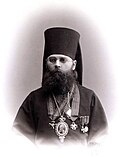 Nicodemus KononovHieromartyr · Bishop of BelgorodOct 22
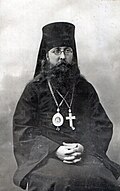 Gregory LebedevHieromartyr · Bishop of ShlisselburgOct 22
- Solarius of LuniHieromartyr · Bishop of LuniOct 22
- Symmachus of CapuaSaint · Bishop of CapuaOct 22
- Alexander AndreyevHieromartyr · ArchpriestOct 22
- Mina ShelaevVenerable Martyr · ArchimandriteOct 22
- Nicholas BogoslovskyHieromartyr · ArchpriestOct 22