Venerable Martyr
Mina Shelaev
Archimandrite
Russian archimandrite and missionary of the Edinoverie, who died in 1937 in the Novosibirsk region; canonized in 2000.
- Feast
- October 22old style November 4
- Reposed
- 193720th century
- Place
- Novosibirsk Oblast
- Order
- Martyrs
Life
Venerable Martyr Mina Shelaev was an archimandrite, a missionary of the Edinoverie (the community of those of the same rite), a self-taught man of letters who worked all his life for the reconciliation of the Old Believers with the Russian Church. Born on 15 September 1882 in the village of Peresvetovo near Moscow, he was shot in autumn 1937 in the Novosibirsk region. The Council of Bishops in August 2000 glorified him as venerable martyr. He is commemorated on 22 October.
Childhood and learning
Born Ivan Vlasovich Shelaev, into a family in which the father, of peasant stock, became a skilled craftsman in Moscow and opened a small factory for fringes. His parents' marriage broke down in 1885, when Ivan was three and his sister six; his mother became a servant in a rich Moscow household in order to raise them and give them an education. On 23 March 1896, at fourteen, he successfully finished the four-year course of the Petrovsko-Pyatnitskoe city school. Until 1906 he worked in various places; between 1902 and 1906 he was a copper founder at a Moscow factory. His mother, deeply believing and humble, planted in him love of God and of the Church, and he taught himself Holy Scripture, the heritage of the Holy Fathers, Orthodox dogmatic theology and church history, and made himself a personal library, which he counted all his life his great wealth.
Teacher and missionary
He saw his calling in teaching and in preaching the saving commandments; he passed examinations as an external student at the ecclesiastical school beside the Zaikonospassky monastery in Moscow and on 11 November 1906 received the certificate of parish school teacher, and from 1906 to 1910 was teacher at the monastery school. A firm supporter of healing the Old Believer schism through Edinoverie, he resolved to devote his life to this aim: from 23 August 1910 to 1913 he was teacher at the school of the Saint Nicholas Edinoverie monastery in Moscow, where in vacations he held public discussions with the Old Believers, with success, thanks to the soundness of his knowledge. A decisive role was played by his closeness to the monastery's superior, Hegumen Mina Shustov, himself come from the Old Believers, who left several missionary works. His death, on 17 April 1911, was a great loss for Ivan Vlasovich, who became a worthy successor of his work and received in monasticism the same name, Mina.
In 1914 he received three appointments from Bishop Ambrose Smirnov, vicar of Ryazan: on 19 August, reader at the church of the Sign icon in the village of Znamenskoe, then missionary in two districts of Yegoryevsk, and member of the Saint George missionary brotherhood of Yegoryevsk. On 11 February 1915, for his work among the Old Believers, Bishop Dimitry Sperovsky thanked him. On 5 April 1915 he was received as a novice at the Saviour monastery in Ryazan, and on 12 April, the day of the holy martyr Menas of Palestine, he was tonsured a monk with the name Mina. On 15 April he was ordained hierodeacon, on 26 April named district missionary of Ryazan, and on 20 September 1915 ordained hieromonk. On 10 June 1916, "for zeal and fervour in the missionary work", he received Bishop Dimitry's blessing. The chief fruit of his work he saw in the reconciliation of the Old Believers with the Russian Church, and by the assessment of the Ryazan chief pastors he largely succeeded. On 1 January 1917 he was named diocesan missionary, and on 23 January received the belt. In 1919 the abbess of the Alexandro-Mariinsky monastery of the Yegoryevsk district, Anatolia, asked for him as priest of the monastery, in place of Archpriest John Skvortsov, retiring, and he asked to serve at the monastery, coming from there to Ryazan for missionary work; the request was approved on 8 October 1919. He served there until 1921, when the monastery was closed and the post of missionary abolished.
Years of persecution
After the monastery's closing he settled at Ryazan, in the watchman's lodge of the church of Saint Nicholas in Yam, and, as hegumen and then archimandrite, sometimes served as priest in the parishes of Dyagilevo, Bereznikov and Nikulichi. His last parish service was at the Tikhvin church at Nikulichi, closed in 1935. He did not give up missionary work: in December 1935 Old Believers of the "runaway priest" group from the village of Kaverino came to invite him as priest to their church, and he answered that it was possible only if they united with the Patriarchal Church on the basis of Edinoverie. Archbishop Juvenal Maslovsky received the news gladly and blessed the beginning, saying that the union of all currents of the Old Believers with Orthodoxy is desirable for the whole Church, divided artificially into currents, with the sole aim of destroying it. He could not carry this work to its end, since he was soon arrested. Left without parish service, he continued preaching in the guise of begging, not only among Old Believers but also among peasants and collective farmers in Dyagilevo, Nikulichi, Khambushevo and Golenchino, urging people not to forget God and the Church, to honour feasts and not to be frightened by persecution. The faithful of these villages helped him in secret, and with Archbishop Juvenal's blessing he performed services in people's homes. He also had the gift of healing; this gift later became one of the counts of accusation. Until his arrest he kept his great wealth, his spiritual library, from which he lent generously to the faithful.
On 5 January 1936 he was arrested, among twenty-seven clergy, in the case of the "counter-revolutionary activity of Archbishop Juvenal Maslovsky". He was charged that he "systematically visited Maslovsky", conducted anti-Soviet agitation among the people about the persecution of the Church, gave out books from his religious library to read and engaged in healing diseases. He was in the Ryazan prison until 6 April 1936. At the interrogations he stayed firm, slandering no one, and stated his view without guile. On 4 April 1936 all twenty-seven received various sentences; he five years of camp. On 6 April he was sent to Mariinsk and, together with Hieromartyr Alexander Andreev, former rector of the church of the Joy of All Who Sorrow in Ryazan, was sent to the Suslovo branch of the camp in West Siberia.
The end
A year and a half later, in September 1937, in the Suslovo camp a case was opened on the existence in the camp of a counter-revolutionary group led by Archbishop Seraphim Samoylovich of Uglich. The group was charged with sabotaging work and counter-revolutionary and religious propaganda. Fifteen people were charged, of whom twelve were sentenced to death by the troika of the NKVD of the Novosibirsk region, among them Hieromartyr Seraphim Samoylovich, Venerable Martyr Mina Shelaev and Hieromartyr Alexander Andreev. The sentence was carried out. The Jubilee Council of Bishops on 13 to 16 August 2000 glorified him as venerable martyr. He is commemorated on the day of his passing to the Lord, 22 October, in the Synaxis of the Saints of Kemerovo, of Moscow, in the Synaxis of the New Martyrs and Confessors of Russia and in the Synaxis of the Saints of Ryazan.
Commemorated the same day October 22
 Abercius of HierapolisSaint · Bishop of HierapolisOct 22
- Marcus of JerusalemSaint · Bishop of JerusalemOct 22
 Paul of RostovVenerable · Abbot of Boris and Gleb MonasteryOct 22
- Theodore of RostovVenerable · First abbot of Boris and Gleb MonasteryOct 22
 Abib and ApolloHoly Martyrs · Ascetics of AkhmimOct 22
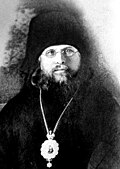 Seraphim SamoylovichHieromartyr · Archbishop of UglichOct 22
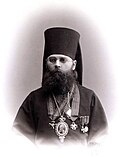 Nicodemus KononovHieromartyr · Bishop of BelgorodOct 22
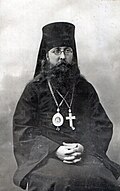 Gregory LebedevHieromartyr · Bishop of ShlisselburgOct 22
- Solarius of LuniHieromartyr · Bishop of LuniOct 22
- Symmachus of CapuaSaint · Bishop of CapuaOct 22
- Alexander AndreyevHieromartyr · ArchpriestOct 22
- Nicholas BogoslovskyHieromartyr · ArchpriestOct 22