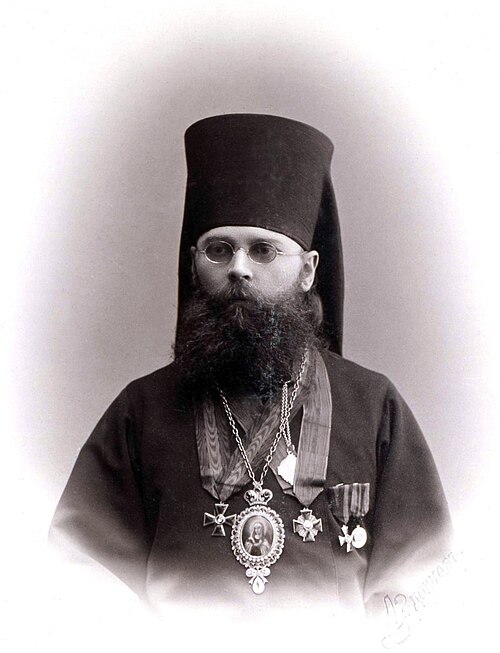
Hieromartyr
Nicodemus Kononov
Bishop of Belgorod
Bishop of Belgorod, vicar of the Kursk diocese and author of lives of the saints of the Russian North, killed in 1919.
- Feast
- October 22old style November 4
- Reposed
- 191920th century
- Place
- Belgorod
- Order
- Martyrs
Life
Saint Nikodim Kononov, Hieromartyr, was Bishop of Belgorod, vicar of the Kursk diocese, a spiritual writer and the author of lives of the saints of the Russian North and of a work on Saint Joasaph of Belgorod. Born in 1871 in the Arkhangelsk region, he was killed by the Cheka at Belgorod on 10 January 1919. The Russian Church numbered him among the New Martyrs and Confessors in the year 2000. His relics were found in 2012.
Youth and writing
Born Alexander Mikhailovich Kononov in the village of Telviska, Mezen district, Arkhangelsk governorate, into the family of Fr Mikhail and Claudia Kononov, he graduated from the Arkhangelsk seminary (1892) and the St Petersburg Theological Academy (1896), as candidate of theology. In the fourth year, on 10 February 1896, he received monasticism with the name Nikodim, after Venerable Nikodim of Kozheozero. He was ordained hierodeacon, then hieromonk, and became master of theology. From 1896 he was superintendent of the Alexander Nevsky ecclesiastical school in Petersburg, and in 1901 was raised to archimandrite. From 1904 he was rector of the Kaluga seminary, where he met economic difficulties, so that in 1909 a deficit of 18,643 roubles was discovered. In 1909 and 1910 he was rector of the Olonets seminary at Petrozavodsk, where he worked for enlightenment and mission among the Karelians and Finns.
He wrote books on the ascetics of the Arkhangelsk and Olonets lands, lives of Venerable Job of Ushchelye and Venerable Tryphon of Pechenga, and was one of the main compilers of the multi-volume "Lives of the Pious Ascetics of the Fatherland of the Eighteenth and Nineteenth Centuries". In 1910 he published the book "Elder Father Naum of Solovki, a Karelian Ascetic", and then several collections of lives of the saints of the Petersburg and Vologda dioceses and of the ascetics of the Solovki monastery. He studied the history of eldership and wrote an akathist to Saint John Chrysostom.
Bishop
From 9 January 1911 he was Bishop of Rylsk, second vicar of the Kursk diocese, and from 15 November 1913 Bishop of Belgorod, its first vicar. He laboured much in connection with the finding of the relics of Saint Joasaph of Belgorod: he composed two prayers to him and the work "Life, Glorification and Miracles of Saint Joasaph", oversaw the printing of three volumes of consistory records relating to Saint Joasaph's work and, at the Holy Trinity monastery, restored his cells and a museum of the saint, with a large fund of documents. After the revolution of 1917 he did not fear to defend Orthodoxy in public and did not hide his negative attitude to the new power. In 1918 he took part in the congress of bishops of southern Russia at Kyiv, then returned through the front to Belgorod. In his sermons he condemned the violence and killings done by the Bolsheviks.
Martyrdom
On 7 January 1919, on Christmas, he was arrested by the Cheka in the very sanctuary of the church. At the request of the faithful he was released for a day, and those who interceded for him were arrested. One of the groups that protested, led by a priest's wife, the head of girls' high school no. 2, Maria Kiyanovskaya, was at once arrested as the "leader of a counter-revolutionary demonstration" and shot. On the next day the bishop was arrested a second time and soon shot.
There are several versions of the shooting. According to one, before being shot he blessed the Chinese soldiers who were to shoot him and who categorically refused, despite threats; other executioners were called, to whom he was brought out in a soldier's greatcoat, to hide his clerical rank. His body was thrown into a common grave, beside which memorial services were held daily. When the White Army entered Belgorod, after half a year, the grave was opened; besides a non-fatal bullet wound in the chest, a fracture of the skull from a blow with a heavy blunt object, an enormous bruise at the top of the head and a crushing of the laryngeal cartilage by strangulation with the hands were found. The relics were moved to the Holy Trinity monastery and buried near the shrine of Saint Joasaph of Belgorod.
Canonization and veneration
His name was entered in the provisional list of the new martyrs in preparing the canonization made by the Russian Church Outside Russia in 1981, and on 13 to 16 August 2000 the Council of Bishops of the Russian Church numbered him among the New Martyrs and Confessors of Russia. The possibility of finding his relics had been spoken of since the 1990s. The place of burial, in the north side-chapel of the Holy Trinity cathedral, was indicated in writing by Protopresbyter Mikhail Polsky in his book "The New Martyrs of Russia" (1949). On 2 November 2012, during construction of the Belgorod metropolis building on Holy Trinity boulevard, a crypt with the remains of an Orthodox hierarch, presumed to be Nikodim, was opened, and after identification Patriarch Kirill decided that they be recognized as relics of the Hieromartyr Nikodim Kononov and that the date of their finding, 20 October (2 November) 2012, be entered in the calendar of the Russian Church. The shrine lies in the church of his name in the metropolis building, consecrated on 29 October 2017 by Metropolitan John, a hundred years after the beginning of the persecution and five years after the finding of the relics. In 2020 Patriarch Kirill established in his honour, at the twenty-fifth anniversary of the revival of the Belgorod and Stary Oskol diocese, a jubilee medal with three grades. On 16 May 2023 he was included in the synaxis of the saints of the Arkhangelsk metropolis.
Commemorated the same day October 22
 Abercius of HierapolisSaint · Bishop of HierapolisOct 22
- Marcus of JerusalemSaint · Bishop of JerusalemOct 22
 Paul of RostovVenerable · Abbot of Boris and Gleb MonasteryOct 22
- Theodore of RostovVenerable · First abbot of Boris and Gleb MonasteryOct 22
 Abib and ApolloHoly Martyrs · Ascetics of AkhmimOct 22
 Seraphim SamoylovichHieromartyr · Archbishop of UglichOct 22
 Gregory LebedevHieromartyr · Bishop of ShlisselburgOct 22
- Solarius of LuniHieromartyr · Bishop of LuniOct 22
- Symmachus of CapuaSaint · Bishop of CapuaOct 22
- Alexander AndreyevHieromartyr · ArchpriestOct 22
- Mina ShelaevVenerable Martyr · ArchimandriteOct 22
- Nicholas BogoslovskyHieromartyr · ArchpriestOct 22