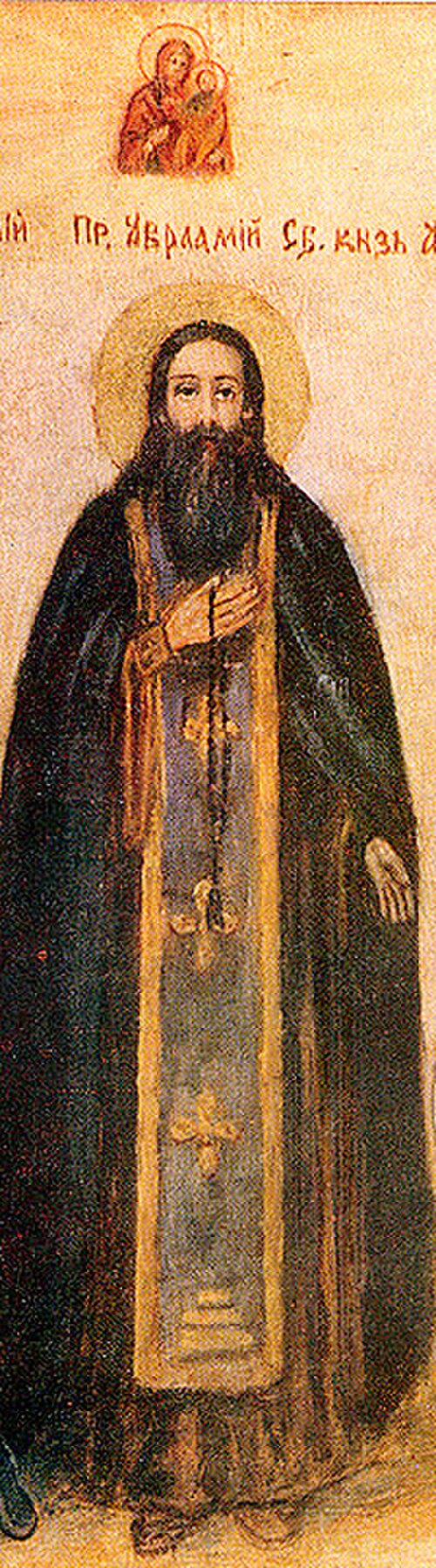
Venerable
Abraham of Smolensk
Monk of Smolensk
Russian monk and priest at the Bogoroditsa convent in Smolensk, a preacher regarded as a wonderworker; died around 1222.
- Feast
- August 21old style September 3
- Reposed
- 122113th century
- Place
- Smolensk
- Order
- Venerables
Life
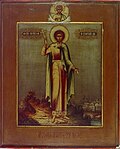
The Venerable Abraham of Smolensk was a Russian monk and priest of the twelfth and early thirteenth centuries, a preacher and ascetic, regarded as a wonderworker, and also known as an icon painter. The Russian Church honours him as one of the most notable figures of pre-Mongol Rus.
The place and year of his birth are not known for certain; sources give about 1150 or 1172. He is said to have come of noble parents, to have been orphaned early and to have decided to leave his fortune to follow the austere and poor life of the monks. After his parents' death he was tonsured at the Dormition monastery at Selishche near Smolensk, now called Bogoroditsky. Ordained priest, he preached with great success; crowds gathered at his sermons, for he was well read and knew not only how to read but how to interpret. He was a man of stern and militant spirit, who kept the thought of the Last Judgment before himself and others, but gentle with those who came to him for help and counsel, especially the sick and troubled.
His success stirred the envy of other clergy. The abbot of the monastery forbade him to preach, and Abraham withdrew to a poor monastery of the Holy Cross on Pokrovskaya hill, which he soon improved, adorning it with new icons, perhaps painted by himself. The envy of the clergy grew: he was accused before Bishop Ignatius, among other things of reading apocryphal books, and, although the prince found him innocent, he was forbidden to serve. His life tells that, driven out, he worked a miracle: he brought rain after a drought (about 1218-1220). This miracle, and the deaths of many of his opponents, led to his return to Smolensk as abbot of the monastery of the Deposition of the Robe of the Mother of God, which later took his name (the Abraham monastery). The life also mentions two icons painted by him, the Last Judgment and the Toll-houses of the air, which have not survived.
He died about 1221-1222, at about fifty years of age according to some sources. His life, written by his disciple Ephraim and preserved in copies of the sixteenth and seventeenth centuries, is among the most important works of old Russian literature. He was canonised at the Makaryev council of 1549. His feast is on 21 August.
Commemorated the same day August 21
 Addai of EdessaApostle · Apostle of EdessaAug 21
 LuxoriusMartyr · Roman official of SardiniaAug 21
 Abraham the LaboriousVenerable · Monk of the Kiev Caves LavraAug 21
- Abraham of PaleostrovVenerable · Abbot of Paleostrov MonasteryAug 21
 Martha of DiveevoVenerable · Schemanun at DiveevoAug 21
- Euprepius of VeronaSaint · First bishop of VeronaAug 21
 Vassa of EdessaMartyrAug 21
 Avitus of ClermontSaint · Bishop of ClermontAug 21
 Rafailo MomčilovićHieromartyr · Abbot of Šišatovac MonasteryAug 21
 Anastasius of SalonaMartyrAug 21
- Bassa of CyzicusMartyrAug 21
- Agapius of EdessaMartyrAug 21