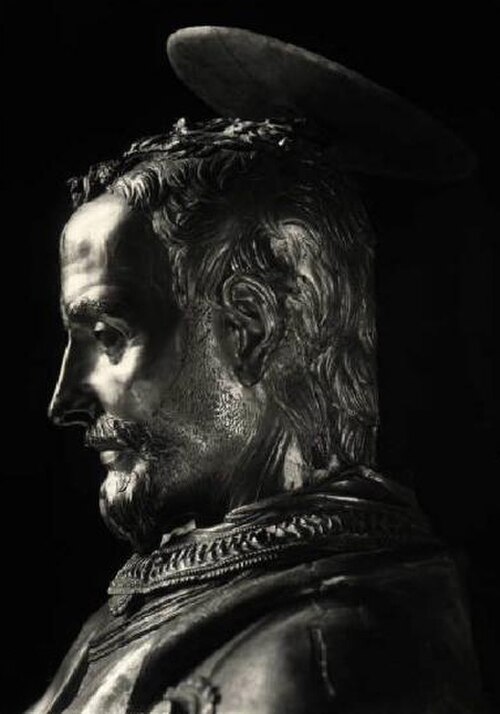
Martyr
Luxorius
Roman official of Sardinia
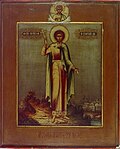
Roman official on Sardinia, aide to the governor Delphius, who converted to Christianity and died a martyr.
Life
Saint Luxorius (Luxurius, in Italian Lussorio, in the Pisan dialect Rossore), martyr, was a Roman official on Sardinia at the end of the third and the beginning of the fourth century, an aide to the governor of the island, Delphius, who became a Christian by reading the Psalms. He was beheaded, perhaps on 21 August, in the city of Forum Traiani (today Fordongianus), probably in 304, in the fourth persecution of Diocletian. He is commemorated on 21 August. Our sources call him mostly a saint and martyr of the Roman Catholic Church; they show no Orthodox canonization, but his martyrdom is mentioned in ancient sources.
The story
In the time of the emperors Diocletian and Maximian, Luxorius was apparitor (assistant) to Delphius, governor of the province of Sardinia, and through his office came to possess the Holy Scriptures. Driven by the desire to know the Psalms, he began to leaf through them and, reading them, was so moved that he became a Christian. He began to pray, to deny the idols and to give himself to the study of the Sacred Text. Arrested after a complaint and brought in chains before the governor, he was rebuked by the Roman magistrate, who accused him of betraying trust, of despising the orders of the emperors and of regarding the sacrifices to the gods as blasphemy. A heated dispute against idolatry followed, in which Luxorius answered every question firmly, and the magistrate gave him the irrevocable choice between sacrifice to the gods and death. At his refusal, Delphius ordered him chained in heavy irons and taken to prison.
Some days later Delphius ordered him brought again before the tribunal. A new dispute followed, at the end of which the magistrate, convinced that not even the worst torments would move him, gave the sentence of death. The guards took him to a pagan temple near the city of Forum Traiani, where he was beheaded, twelve days before the Kalends of September (21 August), and buried in a crypt. The Russian source adds that with him suffered the recently baptized youths Camerinus and Cisellus, also beheaded, and calls him a soldier.
Veneration and relics
A Latin marble inscription of the sixth century, set in the south side of the church of San Lussorio, a kilometre and a half from Fordongianus, attests his veneration at that date: "Here was shed the blood of the most blessed martyr Luxurius. His birthday is celebrated twelve days before the Kalends of September, renewed in the time of Bishop Elias". His martyrdom is also in the Hieronymian Martyrology, of the first half of the fifth century. In 599 Pope Gregory the Great wrote to Bishop Januarius of Cagliari about a monastery dedicated to Saints Gavinus and Luxurius, which shows the spread of the veneration. He is patron of several Italian cities, among them Pisa, where he is venerated under the name Rossore, and of the town of Borore in Sardinia, where he is celebrated twice a year. According to tradition, the relics were carried from Sardinia to Pavia in 722, with those of Saint Augustine, by the Lombard king Liutprand; according to another tradition they are kept at Pisa, brought in 1088; in 1796, at the restoration of the archbishopric of Pisa, a marble coffin with bones and three sheets of lead with inscriptions was found, so part of the relics may be kept in both cities. In 1422 the Humiliati friars of Florence moved the relics from Pisa to Florence, to the church of Ognissanti, and in 1427 asked Donatello for a gilded bronze bust for the saint's head, kept today in the National Museum of San Matteo at Pisa.
Commemorated the same day August 21
 Addai of EdessaApostle · Apostle of EdessaAug 21
 Abraham of SmolenskVenerable · Monk of SmolenskAug 21
 Abraham the LaboriousVenerable · Monk of the Kiev Caves LavraAug 21
- Abraham of PaleostrovVenerable · Abbot of Paleostrov MonasteryAug 21
 Martha of DiveevoVenerable · Schemanun at DiveevoAug 21
- Euprepius of VeronaSaint · First bishop of VeronaAug 21
 Vassa of EdessaMartyrAug 21
 Avitus of ClermontSaint · Bishop of ClermontAug 21
 Rafailo MomčilovićHieromartyr · Abbot of Šišatovac MonasteryAug 21
 Anastasius of SalonaMartyrAug 21
- Bassa of CyzicusMartyrAug 21
- Agapius of EdessaMartyrAug 21