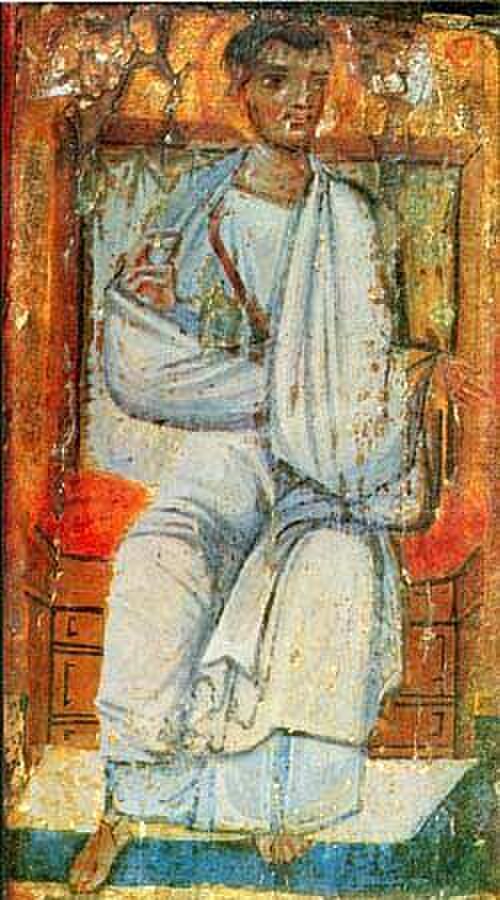
Apostle
Addai of Edessa
Apostle of Edessa
One of the Seventy Apostles, according to tradition the preacher of the Gospel at Edessa.
Life
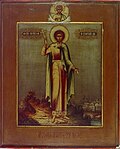
Saint Thaddeus of Edessa (Addai), apostle, was one of the Seventy apostles, not one of the Twelve, and, according to tradition, the one who preached the Gospel at Edessa in northern Mesopotamia. The Church commemorates him on 21 August and, in synaxis, on 4 January, the day of the Synaxis of the Seventy Apostles.
Beginnings
According to the eastern Christian traditions, Thaddeus was born at Edessa, into a Jewish family. Coming to Jerusalem for a feast, he listened to the preaching of Saint John the Baptist and was baptized in the Jordan. He remained in Palestine, saw Jesus and became His disciple, being chosen among the Seventy whom the Lord sent two by two to preach in the cities and places where He would go.
Edessa and King Abgar
After the descent of the Holy Spirit, Thaddeus preached in Syria and Mesopotamia. According to the tradition from the second century, he came to Edessa, sent, in the Orthodox tradition, by Saint Thomas the Apostle, to heal King Abgar V, who was ill. The historian Eusebius of Caesarea tells, in the fourth century, of the exchange of letters between Abgar and Christ, and says that he read the documents at Edessa. Abgar, according to the story, had received from the Lord a cloth bearing His image, by the kissing of which he was partly healed of leprosy; when he was baptized by the apostle, he came out of the water wholly healthy. The king brought the inhabitants of the city to the faith, and Edessa received the light of Christ. Abgar wished to reward the apostle with rich gifts, but Thaddeus refused, saying that if they had left their own, they could not take what belonged to others.
Thaddeus baptized, appointed priests and founded the church of Edessa, the first Christian church in the city. Saint Aggai and Saint Mari are counted among his disciples. Research says that the story of the healing and his preaching led to the spread of Christianity in southern Armenia, northern Mesopotamia and Syria east of Antioch; it is contained in the Syriac writing the Doctrine of Addai.
Preaching and end
Thaddeus then preached in Syria and Phoenicia, and reached Beirut (Berytus), where he is believed to have founded a church. The Slavic Menaion says that he died in peace at Berytus, in the year 44. According to other sources he fell asleep at Edessa, and according to an ancient Armenian tradition, he was put to the sword, after many torments, on 21 December in the region of Artaz, in the year 50.
The Liturgy of Addai and Mari
Thaddeus and Mari are regarded as authors of one of the three Liturgies of the East Syriac rite, the Liturgy of Addai and Mari, which has its beginnings around the year 200 and is still used in the Assyrian Church of the East and the Chaldean Catholic Church.
Commemorated the same day August 21
 Abraham of SmolenskVenerable · Monk of SmolenskAug 21
 LuxoriusMartyr · Roman official of SardiniaAug 21
 Abraham the LaboriousVenerable · Monk of the Kiev Caves LavraAug 21
- Abraham of PaleostrovVenerable · Abbot of Paleostrov MonasteryAug 21
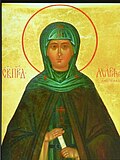 Martha of DiveevoVenerable · Schemanun at DiveevoAug 21
- Euprepius of VeronaSaint · First bishop of VeronaAug 21
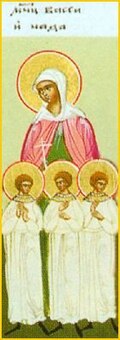 Vassa of EdessaMartyrAug 21
 Avitus of ClermontSaint · Bishop of ClermontAug 21
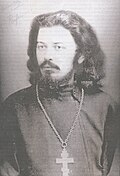 Rafailo MomčilovićHieromartyr · Abbot of Šišatovac MonasteryAug 21
 Anastasius of SalonaMartyrAug 21
- Bassa of CyzicusMartyrAug 21
- Agapius of EdessaMartyrAug 21