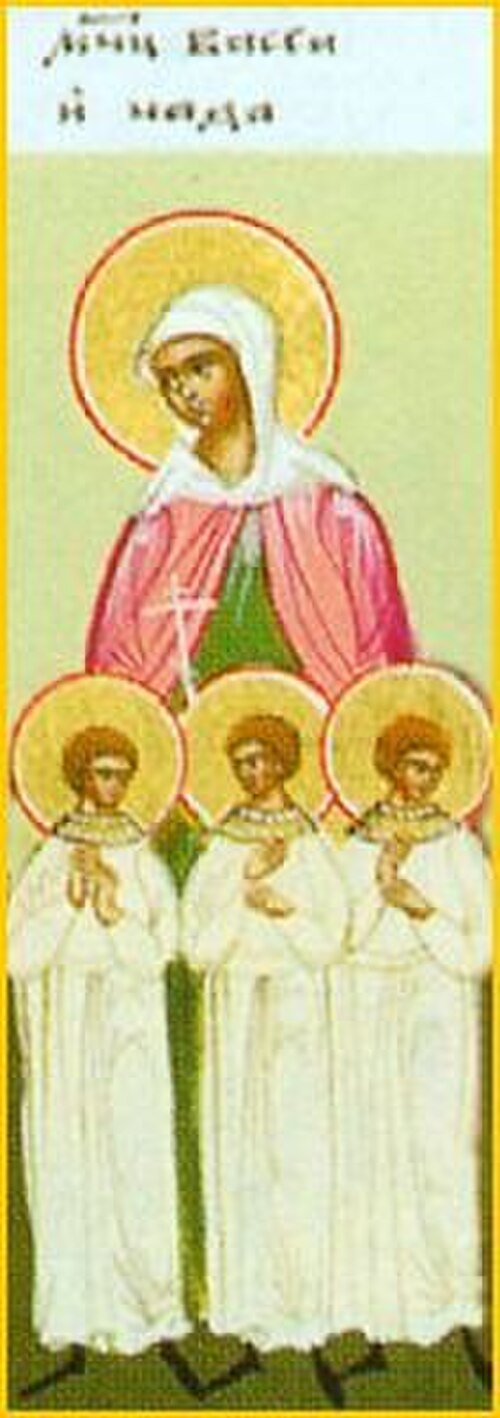
Martyr
Vassa of Edessa
Martyr of Edessa in Macedonia, tortured to death with her three sons in the fourth century.
Life
Holy Martyr Vassa of Edessa was a Christian martyr who was tortured to death together with her three sons, Theognius, Agapius and Pistus. She is remembered on 21 August, on the old calendar (3 September), by the Greek Church and the Serbian Church. Our sources do not agree on the age: one says in the time of the emperor Maximian (305 to 311), others in the third century, between 280 and 290, nor on the place: Edessa in Macedonia (Voden), Edessa in Syria or Larissa.
Life
She lived in the Roman Empire, in a Christian family, and was married to a pagan priest, by a Bulgarian source Valerius, by whom she had three sons: Theognius, Agapius and Pistus. Since she was herself a Christian, she raised her sons in the Christian faith. In the time of the persecution under Maximian and Galerius, her husband denounced her and the children to the court as Christians, and she was shut in prison together with them. Despite the threats, they refused to offer sacrifice to the idols. Before Vassa's eyes, Theognius was hung head down and scraped with iron files. From Agapius the skin was torn from the head to the chest, but he did not say a word. Pistus was tortured too. Then the three sons were put to death by beheading, and Vassa, throughout the torments, encouraged them to bear the sufferings for the faith.
Vassa was shut in prison again and left without food, to die of hunger, but, according to the story, angels gave her food in the prison, and so she did not die. After that she was forced in Macedonia to offer sacrifice to the idols, but she refused. She was tortured with fire, with water and with beasts, and endured. After she smashed the statue of Zeus in a pagan temple, she was thrown into the sea. Then a miracle happened: three men appeared, shining brighter than the sun, and set her in a ship. After eight days Vassa came ashore on a small island on the other side of the Sea of Marmara, not far from the city of Cyzicus (by other sources, Alone, near Cyzicus, or Alonnisos in the Aegean). When she reached the island, she showed herself to the soldiers. Learning of it, the Macedonian governor Philip wrote to the governor of the Hellespont region, with his seat at Cyzicus, to seize her. When she again refused to offer sacrifice to the idols, they crushed her hands and feet with rods and in the end her head was cut off with a sword.
Veneration
It is known that about the year 450 there was at Chalcedon a church dedicated to Saint Vassa. She was painted by Zacharias Zograf in 1848, in the katholikon of the Troyan monastery, in the niche of the south window of the narthex, and in 1849 again among the Bulgarian saints on the south wall of the katholikon of the Transfiguration monastery. Much later a schematic image of Saint Vassa appears in the church of Saint Nicholas at Topolnitsa. Since Voden is in the Thessaloniki region, in Bulgaria the martyr is called Vassa of Thessaloniki. A Maronite synaxarion was dedicated to her.
Commemorated the same day August 21
 Addai of EdessaApostle · Apostle of EdessaAug 21
 Abraham of SmolenskVenerable · Monk of SmolenskAug 21
 LuxoriusMartyr · Roman official of SardiniaAug 21
 Abraham the LaboriousVenerable · Monk of the Kiev Caves LavraAug 21
- Abraham of PaleostrovVenerable · Abbot of Paleostrov MonasteryAug 21
 Martha of DiveevoVenerable · Schemanun at DiveevoAug 21
- Euprepius of VeronaSaint · First bishop of VeronaAug 21
 Avitus of ClermontSaint · Bishop of ClermontAug 21
 Rafailo MomčilovićHieromartyr · Abbot of Šišatovac MonasteryAug 21
 Anastasius of SalonaMartyrAug 21
- Bassa of CyzicusMartyrAug 21
- Agapius of EdessaMartyrAug 21