Martyr
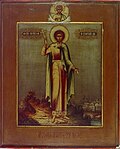
Agapius of Edessa
A martyr of Edessa, put to death for his faith in Christ.
Life
Saint Agapius of Edessa suffered at the beginning of the fourth century, together with his mother, the holy martyr Bassa, and his brothers, the holy martyrs Theognius and Pistus. They are commemorated on 3 September.
Bassa and her sons lived in the city of Edessa in Macedonia, in the time of the emperor Maximian. The emperor issued a law ordering all his subjects to offer sacrifice to the pagan gods on the occasion of his birthday. Many Christians, seized by fear, obeyed, but those firm in the faith offered heroic resistance. Among them was Saint Bassa with her sons. She came of the senatorial class, had received the Christian faith from her parents and brought up her children in it. Her husband, Valerian, one of the leading men of the city, had become a priest of the idols. He was the first to offer sacrifice and pour a libation before the idols. Then Bassa took her sons aside and told them that it was not fitting to follow their father's example; she told them that if they ran to Christ and despised passing things, they would receive from the Lord incorruptible eternal goods.
Theognius, Agapius and Pistus listened to their mother's words and refused to sacrifice to the idols. Then Valerian denounced his wife and children to the governor. Before their mother's eyes the children were tortured. The eldest, Theognius, was hung up and scraped with iron claws. From the youth Agapius they flayed the skin from the head to the chest, but the martyr did not utter a sound. At last they tortured the youngest, Pistus, as well. Their mother never ceased to encourage them to endure suffering for Christ. Then the boys were beheaded.
Saint Bassa was put in prison. The pagans brought her food and advised her to obey the emperor's order. She answered them nothing and refused all the food. After seven days an angel strengthened her with heavenly food. In the tortures that followed she remained unharmed by fire, water and beasts. The grace of God protected her equally from the heated furnace and from the blows of stones. When she was brought into the idols' temple, she broke the statue of Zeus. Then the martyr was thrown into the depths of the sea. But unexpectedly a ship came up, and the saint was taken aboard by three men shining with light (Saint Nicodemus the Hagiorite thought they were her children, killed before).
After eight days Saint Bassa herself came down from the ship to the governor of the island of Alon, near Cyzicus, in the Propontis or Sea of Marmara. First the governor tempted her with rich gifts and garments, then, after thorough tortures, forced her to sacrifice to the gods, frightening her with torments. At last he asked her why she was not afraid to die. Bassa answered: "I hasten to be rid of death and to inherit eternal life." After a beating with rods, her head was cut off. Later a church was built in her honour on a high place, visible from everywhere to sailors, who regarded her as their protectress. It is known that about the year 450 a church dedicated to the holy martyr Bassa already existed at Chalcedon.
Prayer to Saint Bassa delivers from despondency, helps sailors on their journeys, parents in raising children, in healing and in standing firm in the faith, and in difficult circumstances of life.
Commemorated the same day August 21
 Addai of EdessaApostle · Apostle of EdessaAug 21
 Abraham of SmolenskVenerable · Monk of SmolenskAug 21
 LuxoriusMartyr · Roman official of SardiniaAug 21
 Abraham the LaboriousVenerable · Monk of the Kiev Caves LavraAug 21
- Abraham of PaleostrovVenerable · Abbot of Paleostrov MonasteryAug 21
 Martha of DiveevoVenerable · Schemanun at DiveevoAug 21
- Euprepius of VeronaSaint · First bishop of VeronaAug 21
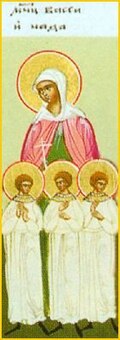 Vassa of EdessaMartyrAug 21
 Avitus of ClermontSaint · Bishop of ClermontAug 21
 Rafailo MomčilovićHieromartyr · Abbot of Šišatovac MonasteryAug 21
 Anastasius of SalonaMartyrAug 21
- Bassa of CyzicusMartyrAug 21