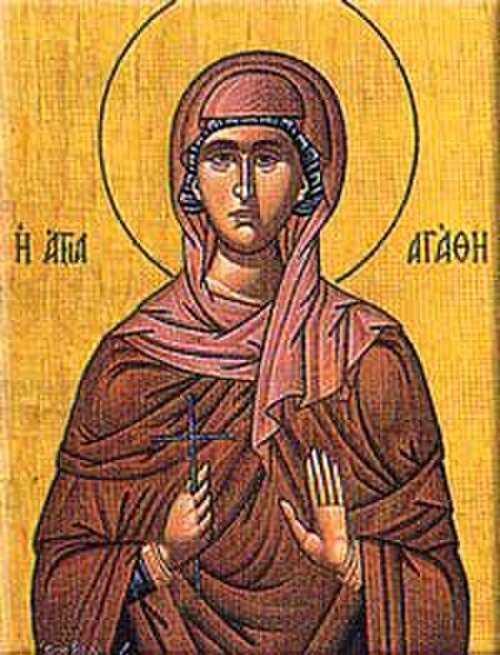
Martyr
Agatha
of Catania
Maiden of Catania in Sicily who suffered torment and death for her faith in Christ in the third century.
- Feast
- February 5old style February 18
- Reposed
- 2513rd century
- Place
- Catania
- Order
- Martyrs
Life
The Holy Martyr Agatha was a virgin of Sicily who suffered for Christ in the persecution of Decius, around 251. She is among the most honoured women martyrs of the early Church. Orthodox tradition calls her Agatha of Palermo (Panormos), while Western tradition calls her Agatha of Catania, the city where she suffered death. The Church commemorates her on 5 February.
Life
Orthodox sources say that she was the daughter of rich and respected Christian parents who raised her in piety, and that she was fifteen years old. Her birth is placed at Palermo or at Catania. No sure information about her life survives: the oldest accounts, one Latin, whose surviving form is later, and one Greek, were written long after her time.
When the persecution of Decius (249-251) began, Quintian, the governor of Catania, having heard of her wealth and beauty, sent soldiers to bring her to trial as a Christian. At Catania she was given into the care of a rich woman who had five daughters, and all tried to lure her with fine clothes and entertainment into offering sacrifice to the gods. The more they urged her, the firmer Agatha grew, and she prayed to reach martyrdom sooner.
Martyrdom
At her trial she was moved neither by flattery nor by threats. The martyr said that the idols are not gods but senseless blocks of wood. Quintian put her to cruel torments and ordered her breasts cut off, first with tongs and then with a knife. Agatha rebuked the torturer, reminding him that he himself had been nursed at his mother's breast.
In prison the holy Apostle Peter appeared to her and healed her wounds, and an unusual light filled the cell. On the fifth day she was brought to trial again, and Quintian was astonished to see her whole. She was tortured again, rolled on burning coals and heated shards. Then an earthquake struck, in which two of his counsellors perished. The inhabitants rushed to Quintian and demanded that the torments cease. Fearing a revolt, he sent her back to prison. There Saint Agatha, thanking God for judging her worthy to suffer for His name, gave up her soul into the hands of the Lord.
The lives tell that Quintian soon died: going to Palermo to seize her property, he fell at a river crossing and drowned.
Relics and veneration
Christians built a church over her tomb. Her relics are kept at Catania, in the Badia di Sant'Agata. According to a tradition, in 1040 the Byzantine general George Maniakes took them to Constantinople, and in 1126 two soldiers brought them back to Catania; these details are not confirmed in our Orthodox sources. A part of the relics is also at Bistrița Monastery in Neamț county, Romania.
It is told that when Mount Etna began to erupt, the inhabitants of Sicily took the veil from her tomb and held it before the fire, and the eruption stopped. For this reason she is called on for help against fire. Her day is celebrated at Catania from 3 to 5 February, and Malta also honours her, showing a crypt at Rabat where she is said to have hidden.
Her name was entered early in the old martyrologies, among them the Hieronymian and the calendar of Carthage of about 530. Pope Gregory the Great rededicated a church in Rome that bears her name (Sant'Agata dei Goti), and her image can be seen in the mosaics of Sant'Apollinare Nuovo at Ravenna. The troparion puts on her lips the words: You, my Bridegroom, I love. The Roman Catholic Church enters her name in the Canon of the Mass.
Commemorated the same day February 5
 Avitus of VienneSaint · Archbishop of VienneFeb 5
 Polyeuctus of ConstantinopleSaint · Patriarch of ConstantinopleFeb 5
 Domitian of CarantaniaRight-Believing · Slavic nobleman of CarantaniaFeb 5
 Ingenuin of SäbenSaint · Bishop of SabionaFeb 5
 Theodosius of ChernigovSaint · Archbishop of ChernigovFeb 5
 Theodula of AnazarbusMartyrFeb 5
 Adelaide of VilichVenerable · Abbess of VilichFeb 5
- Agatha HildegardRight-BelievingFeb 5
- Agricola of TongresSaint · Bishop of TongresFeb 5
 AlbuinSaint · Bishop of Säben and BrixenFeb 5
- Alexandra KasparovaVenerable MartyrFeb 5
- Alfred the AthelingMartyrFeb 5