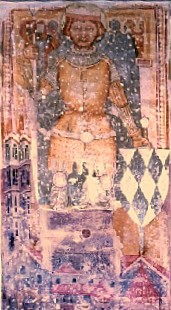
Right-Believing
Domitian of Carantania
Slavic nobleman of Carantania
Slavic nobleman of the principality of Carantania (modern Carinthia) in the time of Charlemagne; died around 802.
- Feast
- February 5old style February 18
- Reposed
- 9009th century
- Place
- Millstatt am See
Life
Domitian was a Slavic nobleman of the principality of Carantania, in what is now Carinthia in Austria, in the time of Charlemagne, and the legendary founder of the church of Millstatt Abbey. He was also called Domislav or Tuitianus. According to tradition he died about 802, and the Church commemorates him on 5 February.
Tradition
His life is preserved in a parchment manuscript of the early fifteenth century, a copy of accounts written in several stages between 1170 and 1306. According to it, he succeeded the third Christian prince of Carantania, Valtunk, who ruled from 772 under the overlordship of Duke Tassilo III of Bavaria. In the Conversio Bagoariorum et Carantanorum, a Latin work of the later ninth century, Valtunk's successors are Pribislav, Semika, Stojmir and Etgar, and Domitian's name does not appear.
According to the legend, Lake Millstatt in the eighth century was much larger than today and reached to the surrounding mountains. On Mount Hochgosch, across from present-day Millstatt, stood a Slavic fortress, the residence of Prince Domitian, still a pagan. The prince had a son who one day, against his father's wish and in bad weather, went out onto the lake in a boat. The young man did not return by the next morning, and the prince found his capsized boat. He ordered his subjects to drain the lake until they found his son's body and made a vow: where the body was found, there he would build a church and become a Christian. His men cut through the hill west of the lake, which separated it from the river Lieser, and the water fell. After some days they found the body.
Domitian was baptized and built the first Christian church beside his son's tomb. After his baptism he ordered a thousand statues of pagan gods and goddesses to be gathered and thrown into the lake. Later a settlement arose around the church, now called Millstatt (Milštat). Tradition derives the name from the Latin mille statuae, "a thousand statues". The meaning of the name is not settled, however: it has also been traced to the word for a mill, to a Celtic stream-name Mils, or to the Slovene milost, "grace".
Truth or legend
In 1907 the cultural historian Robert Eisler argued that Domitian was an invention of the Benedictine monks of Millstatt, used to shake off the rule of the nobles of Gorizia. Many historians followed him, but later research showed that Domitian's Life names the Bavarian count palatine Aribo II (died 1102) as the actual founder and first owner of the abbey. A calendar of about 1160 already lists the commemoration of Domitian on 5 February, and a twelfth-century obituary calls him "duke, founder of this church". For this reason historians today think the legend may rest on true events: a Carantanian chieftain, his conversion, the dedication of a pagan temple, perhaps of Roman origin, to the Christian church, and his burial there.
According to the oldest testimony, Duke Domitian lived, was baptized, destroyed the worship of idols in the Millstatt area, and had the cleansed temple dedicated to the glory of All Saints. He lived virtuously and was buried in the church at Millstatt. As a Slavic nobleman he may have lived around 788, when Charlemagne deposed his Bavarian overlord Tassilo III.
Commemorated the same day February 5
 AgathaMartyr · of CataniaFeb 5
 Avitus of VienneSaint · Archbishop of VienneFeb 5
 Polyeuctus of ConstantinopleSaint · Patriarch of ConstantinopleFeb 5
 Ingenuin of SäbenSaint · Bishop of SabionaFeb 5
 Theodosius of ChernigovSaint · Archbishop of ChernigovFeb 5
 Theodula of AnazarbusMartyrFeb 5
 Adelaide of VilichVenerable · Abbess of VilichFeb 5
- Agatha HildegardRight-BelievingFeb 5
- Agricola of TongresSaint · Bishop of TongresFeb 5
 AlbuinSaint · Bishop of Säben and BrixenFeb 5
- Alexandra KasparovaVenerable MartyrFeb 5
- Alfred the AthelingMartyrFeb 5