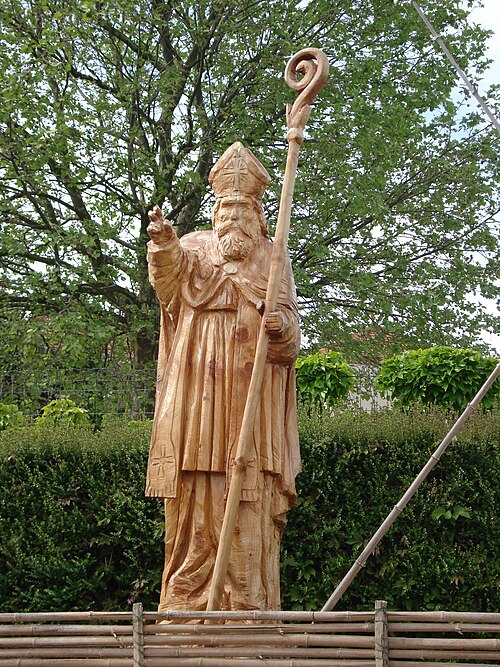
Saint
Avitus of Vienne
Archbishop of Vienne
Latin poet and bishop of Vienne, secretary to the Burgundian kings, who died around 518.
- Feast
- February 5old style February 18
- Reposed
- 5186th century
- Place
- Vienne
- Order
- Hierarchs
Life
Saint Avitus of Vienne, hierarch, was a Latin poet and bishop of Vienne, in Gaul, counsellor and secretary of the Burgundian kings. He fell asleep around 518. He is commemorated on 5 February.
His life
Alcimus Ecdicius Avitus was born around 450, in a prominent Gallo-Roman senatorial family, related to the emperor Avitus. His father, Hesychius, was bishop of Vienne, where the episcopal honour was in fact hereditary in the family; his younger brother, Apollinaris, became bishop of Valence, and their sister, Fuscina, was a nun. He received baptism from Bishop Mamertus. About 490 he was ordained bishop of Vienne. In 499 Vienne was captured by Gundobad, king of the Burgundians, who was at war with Clovis, king of the Franks, and Avitus thus came to the king’s notice. As metropolitan of southern and eastern Gaul he led a conference between Catholic and Arian bishops held before Gundobad at Sardiniacum, near Lyon. He won the king’s confidence, and brought his son, Sigismund, to the Orthodox faith. He also fought successfully against the Semi-Pelagians.
In the service of the Church
A letter of Pope Hormisdas shows that he made him apostolic vicar in Gaul, and in 517 he presided in this capacity at the council of Epaon, for the restoration of church discipline. It seems he also worked to end the dispute between Rome and Constantinople arising from the excommunication of Acacius; his later letters show that this was accomplished before his death. He fell asleep on 5 February 517, 518 or 519 and was buried in the monastery of Saints Peter and Paul at Vienne.
His writings
His literary fame rests on his surviving letters, about ninety-six according to the latest editors, and on a long poem, On the Deeds of Spiritual History, in five books in classical hexameters, on original sin, the expulsion from paradise, the Flood and the crossing of the Red Sea, the last two understood as figures of baptism. He also wrote a poem for his sister, the nun Fuscina, on the praise of chastity. He is one of the last masters of the art of rhetoric in the schools of Gaul. His letters are important for the history of the Church and of politics in the years 499-518; among them is the famous letter to Clovis on the occasion of his baptism. They show the close ties between the Catholic bishop of Vienne and the Arian king Gundobad, then his son, Sigismund. Of his homilies only two survive and a few fragments.
Commemorated the same day February 5
 AgathaMartyr · of CataniaFeb 5
 Polyeuctus of ConstantinopleSaint · Patriarch of ConstantinopleFeb 5
 Domitian of CarantaniaRight-Believing · Slavic nobleman of CarantaniaFeb 5
 Ingenuin of SäbenSaint · Bishop of SabionaFeb 5
 Theodosius of ChernigovSaint · Archbishop of ChernigovFeb 5
 Theodula of AnazarbusMartyrFeb 5
 Adelaide of VilichVenerable · Abbess of VilichFeb 5
- Agatha HildegardRight-BelievingFeb 5
- Agricola of TongresSaint · Bishop of TongresFeb 5
 AlbuinSaint · Bishop of Säben and BrixenFeb 5
- Alexandra KasparovaVenerable MartyrFeb 5
- Alfred the AthelingMartyrFeb 5