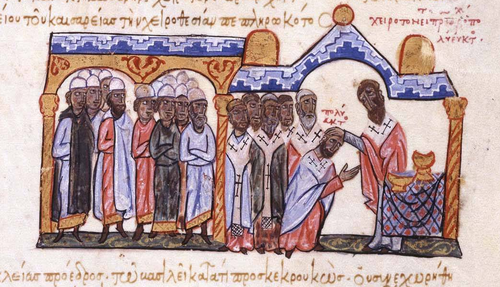
Saint
Polyeuctus of Constantinople
Patriarch of Constantinople
Ecumenical Patriarch of Constantinople from 956 until his death in 970.
- Feast
- February 5old style February 18
- Reposed
- 97010th century
- Place
- Constantinople
- Order
- Hierarchs
Life
Saint Polyeuctus of Constantinople was Ecumenical Patriarch of Constantinople from 956 until his death on 5 February 970. Raised from simple monk to the patriarchal throne, he was called a second Chrysostom for his keen mind, his zeal for the true faith and his gift of oratory. The Church commemorates him on 5 February.
Beginnings
He came from Constantinople and lived as a monk. According to some sources he dwelt at a monastery on the mountain of Saint Elias near Chrysopolis, according to others on the island of Prote, where he was known for his theological learning, humility and self-restraint. Little is known of his youth. On 3 April 956, after the death of Patriarch Theophylact, the son of Emperor Romanus I Lekapenos, he was chosen patriarch with the support of Emperor Constantine VII.
Patriarchate
Among his first acts was the restoration of the name of Patriarch Euthymius I to the diptychs, which met opposition from some bishops. Although the emperor had given him the throne, Polyeuctus did not show him much deference. He even questioned the legitimacy of the marriage of Constantine's parents, which Euthymius had condemned.
In his time, in 957, Princess Olga of Kiev came to Constantinople. The Russian chronicles say that she was baptized by the patriarch, with the emperor as godfather, but historians consider the patriarch's personal part uncertain and even debate whether Olga was already Christian on arrival. In his time too the Great Lavra and the Iviron Monastery were founded on Mount Athos. In 958 he raised Bishop Peter of Otranto to metropolitan, charging him to establish the Greek rite in the province.
The death of Romanus II in 963 left the throne to his young sons Basil and Constantine, and the patriarch and the senate upheld their rights. On 16 August 963 Polyeuctus crowned Nikephoros II Phokas. In time he came into conflict with him as well, over the emperor's interference in church affairs and in the choice of bishops. The chronicles tell differently of the marriage of Nikephoros to Theophano, the widow of Romanus II: some say the patriarch kept him from Holy Communion, others that the issue was a bond of godparenthood with her children. In the end communion was restored.
A courageous word
After the murder of Nikephoros in December 969, the patriarch would not crown John Tzimiskes until he removed Theophano from the palace, sending her to the island of Prote, and pointed out the emperor's killer. Only then, on 25 December 969, did he crown him. On 23 January 970 he anointed Theodore II as patriarch of Antioch.
He died on 5 February 970, after nearly thirteen years as patriarch. The Church honours him as a shepherd who defended the freedom of the Church before imperial power.
Commemorated the same day February 5
 AgathaMartyr · of CataniaFeb 5
 Avitus of VienneSaint · Archbishop of VienneFeb 5
 Domitian of CarantaniaRight-Believing · Slavic nobleman of CarantaniaFeb 5
 Ingenuin of SäbenSaint · Bishop of SabionaFeb 5
 Theodosius of ChernigovSaint · Archbishop of ChernigovFeb 5
 Theodula of AnazarbusMartyrFeb 5
 Adelaide of VilichVenerable · Abbess of VilichFeb 5
- Agatha HildegardRight-BelievingFeb 5
- Agricola of TongresSaint · Bishop of TongresFeb 5
 AlbuinSaint · Bishop of Säben and BrixenFeb 5
- Alexandra KasparovaVenerable MartyrFeb 5
- Alfred the AthelingMartyrFeb 5