Saint
Amand of Maastricht
Bishop of Maastricht
A bishop and missionary in Flanders who founded monasteries and died around 679.
- Feast
- February 6old style February 19
- Reposed
- 6767th century
- Place
- Saint-Amand Abbey
- Order
- Hierarchs
Life
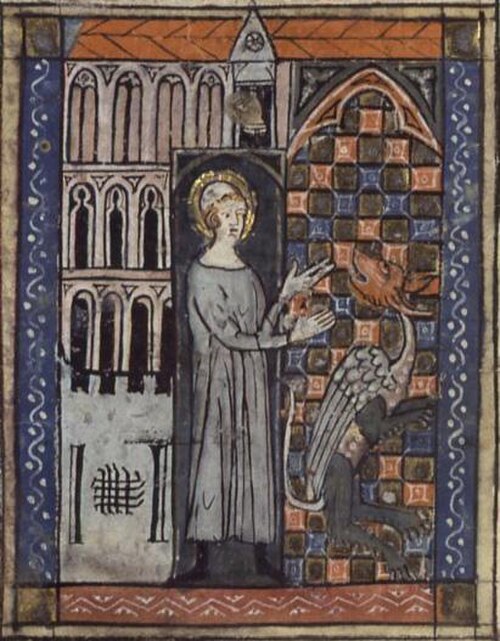
Saint Amand (Amandus) of Maastricht was a bishop and missionary in Flanders, founder of monasteries, born around 584 (according to other sources, around 600) and died between 675 and 684. Our sources show him venerated as a saint, especially in France and Belgium, as a Benedictine monk, enlightener of Belgium and baptizer of the Flemish lands; they show no separate Orthodox glorification. He is commemorated on 6 February. Being patron of winegrowers and brewers, he is also remembered in this way by people.
The information about his life is found only in lives, of which the oldest is the Vita Sancti Amandi, of the eighth century. The date of birth varies in the sources between 584 and the beginning of the seventh century, and the date of death between the years 675 and 684. According to the life, Amand was born in Aquitaine into a wealthy noble family. Against the will of the family, at about 20 he became a monk on the island of Yeu; first he lived near Tours, then moved to Bourges, where he was ordained and lived as a hermit for 15 years. He was consecrated bishop in 628, without a particular diocese, receiving a general commission to preach the faith to pagans. He preached the Gospel in Flanders. After a pilgrimage to Rome he resolved to be a missionary. At the call of Clotaire II he went on mission to the north of the Frankish kingdom, on the territory of present-day Belgium. At first his preaching had no success, but then he managed to found the first monasteries, at Ghent and Mont-Blandin, and to convert some pagans. In Flanders he built many institutions dedicated to the service of God. One of the best known is the great monastery at Elnon, situated nine miles from Tournai (the monastery, the nearby town and the mineral springs were later renamed Saint-Amand).
Tradition, which does not quite deserve trust, says that in 649 he was elected bishop of Maastricht, but three years later gave up the leading position in favour of Saint Remaclus and returned to missionary work. He worked among the pagans until the age of eighty. In the course of his activity he also preached at Utrecht and built there a small chapel dedicated to Saint Martin. After he left to continue his mission elsewhere, Dagobert gave the fortification at Utrecht to the bishop of Cologne, Cunibert, on the condition that he undertake the conversion of the Frisians, but the diocese of Cologne did no missionary work among the Frisians. Returning to France, he came into conflict with King Dagobert I and was expelled from the kingdom. A brief mission to the Slavs of the Danube had no success and, after a visit to Rome, where Amand reported to the Holy See on the results of his work, he returned to Flanders, where Christianity had already taken root. For a time he was bishop of Maastricht, founded a further series of monasteries, among them the one at Elnon, near Tournai. In this monastery Saint Amand died.
Commemorated the same day February 6
 Photios the GreatSaint · Patriarch of ConstantinopleFeb 6
 Dorothea of CaesareaMartyrFeb 6
 Barsanuphius the GreatVenerable · Hermit near GazaFeb 6
 Fausta of CyzicusMartyrFeb 6
 Julian of EmesaMartyr · Physician and martyr of EmesaFeb 6
 Relindis of MaaseikVenerable · Nun of MaaseikFeb 6
 Arsenius of IqaltoVenerable · Georgian scholar and calligrapherFeb 6
 Bucolus of SmyrnaSaint · Bishop of SmyrnaFeb 6
 Valentina of MinskFool-for-Christ · Fool for ChristFeb 6
 Basil NadezhdinHieromartyr · Priest in MoscowFeb 6
- Anatoly RozhdestvenskyMartyrFeb 6
- Andrew of ElnonSaintFeb 6