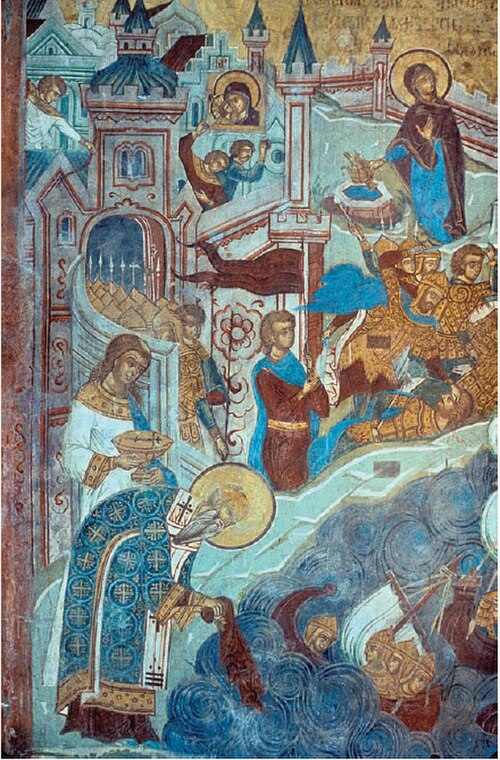
Saint
Photios the Great
Patriarch of Constantinople
Patriarch of Constantinople 858 to 867 and 877 to 886, a great scholar and supporter of the Slavic mission.
- Feast
- February 6old style February 19
- Reposed
- 8939th century
- Place
- Armenia
- Order
- Hierarchs
Life
The Holy Hierarch Photios the Great was patriarch of Constantinople from 858 to 867 and from 877 to 886, the most learned man of his age, a defender of the right faith against papal claims and a supporter of the mission among the Slavs and the Bulgarians. He is counted the most important patriarch of Constantinople after Saint John Chrysostom. The Orthodox Church commemorates him on 6 February (the Menaion date; by the civil calendar of Churches on the old calendar it falls on 19 February).
Family and learning
He was born at Constantinople, into a distinguished family, about 815. He was related to Saint Patriarch Tarasios, and his father, Sergios, was a defender of the holy icons. The family was persecuted in the second iconoclasm, and by the Church's tradition his father died for the icons. It was restored to favour only after the icons were restored in 842.
The sources do not say how he was educated, but his library shows immense learning: theology, history, grammar, philosophy, law, natural science and medicine. He became captain of the imperial guard and first secretary of state, and at one point took part in an embassy to the Abbasids of Baghdad. A friend of the learned Leo the Mathematician, he gave lessons at home to young men eager for books; tradition adds that Cyril, the future enlightener of the Slavs, was among his pupils. His devout mind kept him from the temptations of court life, and he longed for the monastic life.
Patriarch
In 858 Caesar Bardas, who ruled alongside the young Emperor Michael III, set aside Patriarch Ignatios. The bishops, knowing Photios's piety and learning, pointed him out to the emperor as a man worthy of the throne. He accepted with humility. In six days he passed through all the clerical ranks: he was tonsured a monk on 20 December, and on Christmas Day he was consecrated bishop and enthroned as patriarch.
The removal of Ignatios caused unrest. A synod in 861, attended also by the envoys of Pope Nicholas I, confirmed the deposition of Ignatios and the election of Photios. The pope, who had hoped to have him submissive, saw that the patriarch would not bend, and anathematized him at a council in Rome. From then to the end of his life, Photios resisted papal claims over the Church of the East. Historians add that the legitimacy of his election was disputed even then.
The mission to the Slavs and the Bulgarians
Photios supported the Orthodox mission. In 863, on the commission of Emperor Michael and the patriarch, the brothers Cyril and Methodius went to Moravia, where they began to proclaim the Gospel to the Slavs in their own language. In 864 Bulgaria received Christianity, and Prince Boris was baptized, according to tradition by the patriarch himself. Photios sent an archbishop and priests there to baptize the people.
But a German invasion forced Boris to seek help in the West and to ask the pope for bishops. The papal legates began to replace Orthodox practice and teaching with Latin ones. Photios then wrote an encyclical letter to the bishops of the East, showing that Rome's departure from Orthodoxy was not only a difference of customs but of faith, above all through the Filioque added to the Creed. A council condemned the boldness of the West.
Exile and return
In 867 Basil the Macedonian took the throne after murdering Emperor Michael. According to the saint's life, Photios rebuked him and would not let him receive Communion. Historians add that Basil wanted an alliance with the pope. Photios was removed from the throne and confined in a monastery, and Ignatios was restored. The council of 869 to 870, with papal legates, demanded the signing of a document recognizing the primacy of the pope. The Eastern bishops refused, but in the end his opponents prevailed and anathematized Photios. The Orthodox Church does not accept that council, while the Roman Catholic Church counts it as the eighth ecumenical. The saint received the sentence in silence and spent seven years in exile and prison, giving thanks to God.
Later he was reconciled with Emperor Basil and became tutor to his children. After the death of Ignatios on 23 October 877, he returned to the throne three days later. A council of 879 to 880, attended by the envoys of Pope John VIII, recognized Photios as the lawful patriarch. It declared the Creed of Nicaea and Constantinople unalterable and rejected the Latin addition. Many count it as the eighth ecumenical council. The pope annulled the earlier decisions. Bulgaria kept its Church of the Byzantine rite, in practice autocephalous.
Writings
Photios left a large body of work. The Library (Myriobiblon), made for his brother Tarasios, holds summaries and judgments of nearly three hundred books he had read, many of them lost today. The Amphilochia answers more than three hundred questions on hard passages of Scripture. The Mystagogy of the Holy Spirit defends the teaching that the Spirit proceeds from the Father. He also wrote against the Manichaeans and the Paulicians, a long letter of counsel to Boris of Bulgaria, homilies and letters, and a Lexicon, which was probably in large part the work of his pupils.
Repose and veneration
After the death of Emperor Basil, in 886, the new emperor Leo VI, his former pupil, deposed him, and Photios was exiled to a monastery in Armenia. A trial for treason in 887 did not end in conviction. He went on writing in exile. He fell asleep in peace, according to the Synaxarion in 891, and according to some historians on 6 February 893. The sources also differ on the place: the monastery of Eremia, Bordi or Gordon. Some chronicles say his body was brought to Constantinople; our sources mention no preserved relics.
He was venerated as a saint soon after his death, around Constantinople. A manuscript of the Typikon of the Great Church from the middle of the tenth century places him on 6 February, and one historian holds that he was venerated as a saint by the second half of the tenth century at the latest. The Church calls him a pillar and foundation of the Church and a wise teacher. The name Photios means luminous.
Commemorated the same day February 6
 Dorothea of CaesareaMartyrFeb 6
 Barsanuphius the GreatVenerable · Hermit near GazaFeb 6
 Fausta of CyzicusMartyrFeb 6
 Julian of EmesaMartyr · Physician and martyr of EmesaFeb 6
 Relindis of MaaseikVenerable · Nun of MaaseikFeb 6
 Arsenius of IqaltoVenerable · Georgian scholar and calligrapherFeb 6
 Bucolus of SmyrnaSaint · Bishop of SmyrnaFeb 6
 Valentina of MinskFool-for-Christ · Fool for ChristFeb 6
 Basil NadezhdinHieromartyr · Priest in MoscowFeb 6
 Amand of MaastrichtSaint · Bishop of MaastrichtFeb 6
- Anatoly RozhdestvenskyMartyrFeb 6
- Andrew of ElnonSaintFeb 6