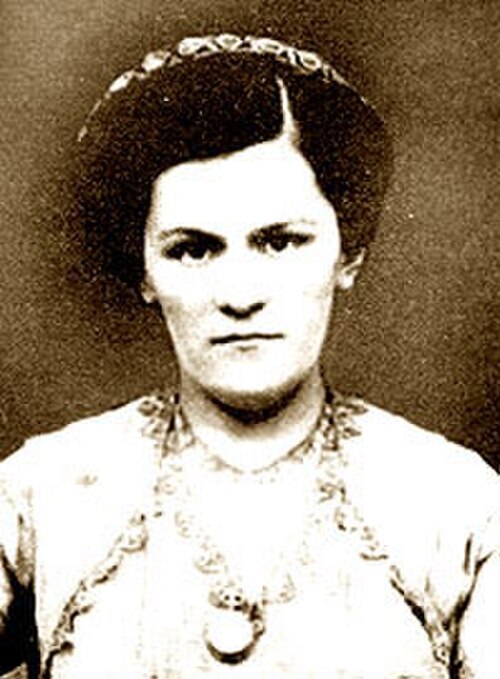
Fool-for-Christ
Valentina of Minsk
Fool for Christ
A priest's daughter and ascetic fool for Christ, venerated as a local saint of the Belarusian Orthodox Church.
- Feast
- February 6old style February 19
- Reposed
- 196620th century
- Place
- Dziaržynsk District
- Order
- Fools-for-Christ
Life
The Blessed Valentina of Minsk (born Valentina Feodorovna Sulkovskaya, née Chernyavskaya) was a priest's daughter of Belarus, a fool for Christ and an invalid bedridden for 33 years, venerated as a local saint of the Belarusian Orthodox Church. Born on 7 (21) April 1888 in the village of Koski near Stankovo, she fell asleep on 6 February 1966. She was loved for her kindness, her gift of foresight and her prayer, which kept faith alive in the time of persecution.
Family and childhood
Her father, Fr Feodor Iosifovich Chernyavsky, of a priestly line, a graduate of the Minsk seminary (1873), served at the church of Saint Nicholas at Stankovo and lived in the neighbouring village of Koski, where he had a house and land, near the filial church of Saint Anna. Her mother, Sofia Petrovna, of a princely family, a strong and strict woman, raised in the Orthodox spirit Valentina and her three other daughters, Anna (1882), Xenia (1886) and Olga (1892). The family's large house was built in 1888, and the church of Saint Anna at Koski was renewed in 1889, with money from the clergy, the parishioners and Count Karl Hutten-Czapski, just at the time of Valentina's birth. Valentina was born in Koski, was baptized at the church of Saint Nicholas and grew up in a beautiful region, by the river Usa, in a united family. It is told that at five she brought a little fir from the forest, planted it near the church at Koski, watered it with care and prayed that it grow; the fir grew in the shape of a cross. She studied, like her father, at the ecclesiastical school in Minsk and, after graduating, sometimes took her father's place at the religion lessons for children. In youth she received the blessing and talked with Saint John of Kronstadt; once, when on the ship to Kronstadt it was about to collide with another, Saint Panteleimon appeared to her and said: "Pray without ceasing", she prayed, and the ships parted as by a miracle.
Marriage and trials
Shortly before the First World War she married Feodor Vasilievich Sulkovsky, also of the clergy class, a collegiate councillor in the Minsk district administration. Her parents blessed them with the Vladimir icon of the Mother of God, kept to this day, together with an image of the Saviour, the blessing of the groom's mother; the two icons were always beside her. In the war her husband served as a military official, and she followed him to Poland. In February 1917 she took a three-month typing course at Minsk, to earn a living; at Minsk she prayed at the churches of the Kazan icon, of Saint Mary Magdalene and of the Protection at Krupets, where a holy spring flowed. In August 1917 she went to Orsha, where she stayed until the Germans withdrew, then returned to Stankovo. Her father, by then ill, died on 27 December 1919 and was buried beside the priest's house. Her husband, unable to remain in office under Soviet power, worked a farm, and she helped him.
In 1930 the collective farm "Awakening" was set up in Koski, to which the Sulkovskys were forced to enrol. In 1931 her husband was arrested on a false denunciation and sent to a camp near Potma station; he was there until April 1933, received leave to settle at Astrakhan, but was arrested again and sent to the Far East, where he died. Other relatives also suffered: the husband of her sister Anna, Fr Vasily Stepura, was arrested in 1933 and sent to Kazakhstan, and the husband of her sister Xenia, Fr Sergei Rodakovsky, was sentenced to death the same year (glorified in 1999 as a hieromartyr of the Minsk diocese). Valentina remained in Koski, caring for her aged mother; a kidney illness began to weaken her health.
Foolishness for Christ and the bed of suffering
Once she visited a sick, clairvoyant woman who could no longer walk and had lain forty years in bed; she said to her: "You will take my place." Another time, when she went to a stream to wash her feet, a woman of unspeakable beauty appeared to her and said: "Go and lie down." Valentina lay down and from then on remained in bed, though at first she could still move a little with a stick, for 33 years, until her death, without bedsores or the usual consequences of such illness. Her husband's nephew, Alexander Sulkovsky, sent a hundred roubles each month by post, and she kept the coupons all her life; her sisters also helped, among them Olga, unmarried, headmistress of a school in Minsk. At the start of 1937 her mother died, the house was taken for a school, and the neighbours Anton and Euphrosyne Loiko cared for her until the end of their lives. In July 1937 the last clergy of the diocese, gathered around Bishop Philaret Ramensky, were arrested at Minsk, among them Archpriests Stefan Kulchitsky and Antony Kirkevich, Frs Mikhail Rubanovich and Sergei Sadovsky and Deacon Vladimir Lobach, all shot on 1 November 1937. The loss of her husband, the death of her mother and the killing of the last clergy only strengthened her.
The first testimonies of miracles through her prayer date from before the war. She foresaw the Second World War and told the villagers: "You will see iron birds." During the war the wives, mothers and sisters of those taken to the front came to her, bringing their kerchiefs, which she blessed with prayer; the men kept them under their tunics and came home. Her ministry went on in a hard time for the Church, at the end of the 1950s and the start of the 1960s, when it was said that in twenty years the Church would be finished and on television "the last priest" would be shown.
In the last year of her life she was in the care of her sister Olga. She lived very poorly, on a plain mattress, not changing her clothes too often nor washing, sometimes once a month or three; she ate little and, if food was brought, tasted nothing, saying: "You eat, for us the sick it is easier to lie." She did her prayer labour for the strengthening in faith of those who were witnesses and sharers of the Church's resistance to the atheist state. With her enlightened gaze she saw the world from its spiritual side and, without asking who had come and why, answered even unspoken questions. Her teachings were parables and riddles, understood only by the one who asked. She saw past and future, rebuked the unrepentant sinners and comforted the sorrowing, and by God's mercy the sick regained health. To those who came to her without hope in God and thought her a sorceress-healer she never helped, for she taught them to trust in the Lord's mercy, in the help of His Mother and in the intercession of the saints.
She fell asleep on 6 February 1966 and was buried in the local cemetery, near her native village. The funeral alarmed the authorities, who sent an observer, and the priest had to be present secretly, in civilian clothes. For a long time only a metal cross stood on the grave; since 2012 a metal canopy with a small dome and cross has been raised above it, adorned with a forged grapevine.
Commemorated the same day February 6
 Photios the GreatSaint · Patriarch of ConstantinopleFeb 6
 Dorothea of CaesareaMartyrFeb 6
 Barsanuphius the GreatVenerable · Hermit near GazaFeb 6
 Fausta of CyzicusMartyrFeb 6
 Julian of EmesaMartyr · Physician and martyr of EmesaFeb 6
 Relindis of MaaseikVenerable · Nun of MaaseikFeb 6
 Arsenius of IqaltoVenerable · Georgian scholar and calligrapherFeb 6
 Bucolus of SmyrnaSaint · Bishop of SmyrnaFeb 6
 Basil NadezhdinHieromartyr · Priest in MoscowFeb 6
 Amand of MaastrichtSaint · Bishop of MaastrichtFeb 6
- Anatoly RozhdestvenskyMartyrFeb 6
- Andrew of ElnonSaintFeb 6