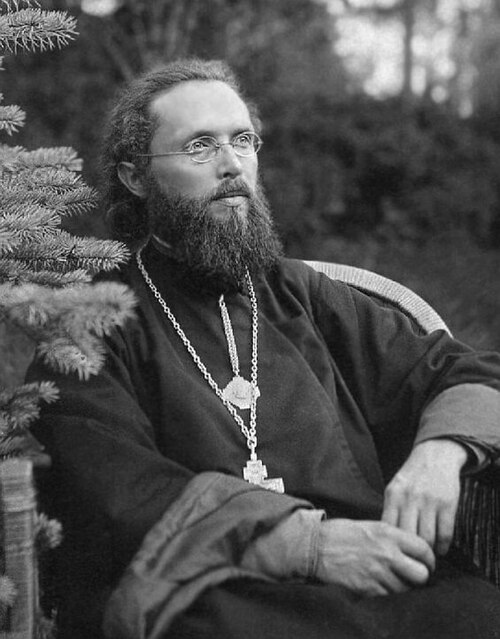
Hieromartyr
Basil Nadezhdin
Priest in Moscow
Priest of Saint Nicholas Church in Moscow, born in 1895, who died a martyr at Kem in Karelia in 1930.
- Feast
- February 6old style February 19
- Reposed
- 193020th century
- Place
- Kem
- Order
- Martyrs
Life
Saint Basil Nadezhdin, the Hieromartyr (1895 to 1930), was a priest at the church of Saint Nicholas at Solomennaya Storozhka, in Moscow, father of five children, teacher and instructor of youth, a beloved preacher. Arrested in 1929, he was sent toward Solovki but stayed at Kem, in Karelia, where he died of typhus and gangrene on 19 February 1930, aged 35. The Bishops' Council of the Russian Church canonized him in 2000. He is commemorated on 6 February (old style) and in the Synaxis of the New Martyrs.
Family and studies
He was born on 12 January 1895 in Moscow, to the family of an official of the Palace Administration, Feodor Nadezhdin, and his wife, Sofia Pavlovna, the fifth child, and was given the name Basil, in honour of Saint Basil the Great. The family belonged to the parish of the church of the Protection in Bolshoi Levshinsky Lane, of which the father was warden for many years. From fourteen Basil sang in the church choir, then was regent and formed a choir of parishioners. He often served a relative: his paternal grandmother was aunt of Bishop Anastasy (Gribanovsky).
After the Zaikonospassky theological school he entered the Moscow seminary in 1910. In 1916 he graduated from the seminary and resolved to enter the Moscow Theological Academy. In June 1916 he went to Chişinău, where Bishop Anastasy had been transferred, and prepared there for the entrance examinations. At the Academy he enrolled in the first year in the group studying the history and refutation of Western confessions. In November 1916 he was invited by the family of Count Alexander Medem, to his estate Alexandria in the Khvalynsk district, Saratov province, to teach the children religion. In February 1917 he returned to Sergiev Posad, where Archimandrite Hilarion (Troitsky) taught the New Testament. In spring 1919 the Academy was closed. In summer 1920 he took the graduation examinations in a teacher's flat and received the degree of candidate in theology.
His family
At the start of 1918 he became engaged to Elena Borisoglebskaya, daughter of the Bolshoi Theatre singer Sergei Borisoglebsky, whom he had seen some years before at a charity concert. The wedding took place on 27 April 1919, on Thomas Sunday, at the church of Saint Nicholas at Solomennaya Storozhka. Right after the wedding they left for Nikolsky Poim, in Penza province, where he taught mathematics and she music. At Poim, in 1920, their first son, Daniil, was born. At his arrest, in 1929, the family had four children. The fifth was born after the father's death, in May 1930, and named Basil. There were also sons Pavel and Sergei and a daughter, Marina. In 1933 Elena Nadezhdina was arrested and sent into exile at Saratov, but through her mother's efforts ended at Kashira, where she was teacher of music and singing. She died on 22 November 1974.
The priest
In March 1921 he moved closer to Moscow and took a job as accountant in the Construction Administration of the narrow-gauge railway of Orekhovo-Zuyevo. Soon he settled with his wife and son Daniil at Petrovsko-Razumovskoe, with his father-in-law Borisoglebsky. On 3 July 1921, on the Sunday of All Saints who shone in the Russian land, Basil Feodorovich was ordained deacon by Patriarch Tikhon, and on 7 July, the feast of the Nativity of Saint John the Baptist, priest at the church of the Holy Hierarch and Wonderworker Nicholas at Solomennaya Storozhka. This was the only place of Father Basil's priestly service until the day of his arrest, in 1929.
After the revolution of 1917, when teaching religion in schools was forbidden and the academy at Petrovsko-Razumovskoe lost its church, a group of its professors asked him to take on the religious and moral education of their children. Father Basil responded with spirit. He formed a youth choir on the right choir of the church, taught girls and boys not only church singing but the service, explained with them basic questions of the faith, went with them to concerts of classical music, read and discussed literary works. For small children Christmas trees, then forbidden, were held in his house. He was a wonderful preacher. He spoke vividly and with conviction, often against unbelief. He ran a school in the Klushantsev house on Mikhalkovskaya Street, where he taught religion and general subjects. Because of weak health (tuberculosis) he sometimes went to rest and take treatment at Nikolsky Poim and in Bashkiria, for the koumiss cure.
Exile and death
On 28 October 1929 Father Basil was arrested and held in Butyrka, where he met Father Sergius Mechev, whom he knew well. On 1 November he was interrogated by the senior authorized officer of the sixth section of the Secret Department of the OGPU, A. V. Kazansky. He was sent for three years to the Solovki Special Purpose Camp but, since navigation had closed, was kept until spring at Kem. In December 1929 a prisoner sick with typhus was moved to the camp infirmary, and Father Basil was moved to his place in the barracks. Soon he too fell ill with typhus. In the infirmary an infection was introduced by an injection and gangrene began. With a presentiment of death, on 24 December 1929, as soon as he was put in the typhus patient's place, he wrote his letter-testament.
In it he blesses his wife, Elena, for her faithful love, her friendship, her inexhaustible tenderness, her labour of five-fold motherhood, all the hardships tied to marriage and the tears of parting since his arrest. He thanks her for ten years of cloudless happiness. He asks that the children be raised in the Church and taught in the European and Russian way. He says one son should be a priest, to continue his service. He confesses that it was easy for him to love and how sweet it was to be a priest. He ends with the words: "I love you for ever, eternally". The priest's wife was allowed to come to her dying husband. Before death, on 19 February 1930, on his wife's birthday, Father Basil was found worthy to receive the Holy Mysteries of Christ. The head of the camp allowed Elena to pray at night beside her dead husband and to bury his body. In time the place of the grave was lost and is unknown today.
Canonization
He was numbered among the saints, the New Martyrs and Confessors of Russia, for veneration throughout the Church, by the Jubilee Bishops' Council of the Russian Church of 13 to 16 August 2000 at Moscow. His sermons, among them the word for the Meeting of the Lord, are preserved. His troparion and kontakion are in the second tone.
Commemorated the same day February 6
 Photios the GreatSaint · Patriarch of ConstantinopleFeb 6
 Dorothea of CaesareaMartyrFeb 6
 Barsanuphius the GreatVenerable · Hermit near GazaFeb 6
 Fausta of CyzicusMartyrFeb 6
 Julian of EmesaMartyr · Physician and martyr of EmesaFeb 6
 Relindis of MaaseikVenerable · Nun of MaaseikFeb 6
 Arsenius of IqaltoVenerable · Georgian scholar and calligrapherFeb 6
 Bucolus of SmyrnaSaint · Bishop of SmyrnaFeb 6
 Valentina of MinskFool-for-Christ · Fool for ChristFeb 6
 Amand of MaastrichtSaint · Bishop of MaastrichtFeb 6
- Anatoly RozhdestvenskyMartyrFeb 6
- Andrew of ElnonSaintFeb 6