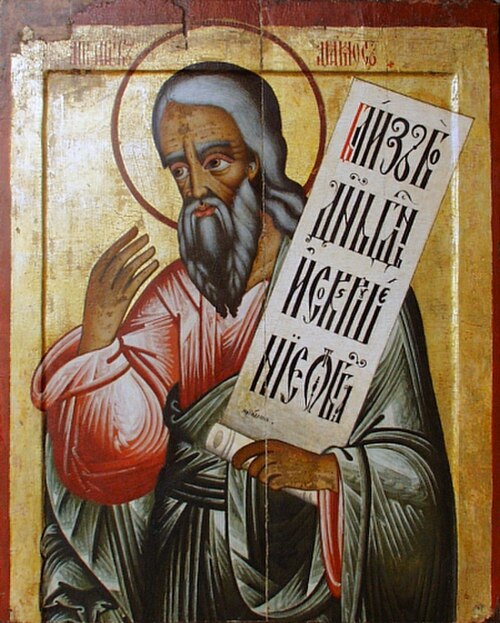
Prophet
Amos
The Prophet
One of the twelve minor prophets, a shepherd of Tekoa who preached justice in Israel in the eighth century BC.
Life
The Holy Prophet Amos is the third of the twelve minor prophets of the Old Testament. A former shepherd and dresser of sycamore figs, he was sent by God to proclaim justice and judgment in the kingdom of Israel in the eighth century before Christ. The book that bears his name is the first prophecy to be set down in writing. The Church commemorates him on 15 June (the Menaion date; by the civil calendar of Churches on the old calendar it falls on 28 June).
The shepherd of Tekoa
Amos came from Tekoa, a village a few kilometres from Bethlehem. Church tradition counts him of the tribe of Zebulun, and Doxologia says he was poor and lived on wild fruit. He himself testifies: I was no prophet, nor a prophet's son, but a herdsman and a dresser of sycamore figs, and the Lord took me from following the flock and told me to go and prophesy to His people Israel (Amos 7:14-15).
The book places his ministry in the days of Uzziah, king of Judah, and Jeroboam II, king of Israel, two years before an earthquake that the prophet Zechariah also recalls. Amos was an older contemporary of Hosea and Isaiah. Since he came from Judah, he spoke chiefly in Israel, at Bethel and in Samaria.
The prophecy
Jeroboam ruled a wealthy and quiet kingdom, but the people worshipped idols and the powerful oppressed the poor. Amos first pronounced God's judgment on the surrounding nations, Damascus, Gaza, Tyre, Edom, Ammon and Moab, then on Judah and, last of all, on Israel. He rebukes those who sell the righteous for silver and the needy for a pair of sandals.
Through him the Lord says that He hates feasts and sacrifices where justice is lacking: let justice roll down like waters and righteousness like an ever-flowing stream (Amos 5:24). The prophet sees in visions the locusts, the fire, the plumb line and the basket of summer fruit, signs that the end is coming upon the people. He also announces a famine of hearing the word of the Lord.
Amaziah, the priest of Bethel, accused him before the king and ordered him to leave. Amos foretold that Israel would be led into exile and that Amaziah's own house would suffer a hard fate. Near the end of the book the Lord promises to raise up again the fallen booth of David. Saint James quotes these words at the Council of Jerusalem as proof that the nations too are called to God (Acts 15:16-17).
His end
The Synaxarion says that Amos was beaten several times for his rebukes. According to a later tradition, the son of Amaziah struck him on the head with a club, and the prophet reached his native village of Tekoa wounded and died there after two days. The sources give no certain year for his death.
He is not to be confused with Amoz, the father of the prophet Isaiah. On icons Amos is shown as an old man with a pointed beard, holding a scroll with the words of Amos 9:6 about the One who builds His ascent up to heaven. His troparion and kontakion praise him for the gift of prophecy received from on high and for his witness that there is no God beside the Lord.
Commemorated the same day June 15
 AugustineSaint · Bishop of HippoJun 15
 JeromeVenerable · Translator of the ScripturesJun 15
 Lazar of SerbiaGreat Martyr · Prince of SerbiaJun 15
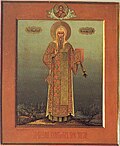 Michael I of KyivSaint · First Metropolitan of KyivJun 15
 Eadburh of WinchesterVenerable · Nun of WinchesterJun 15
 Landelin of CrespinVenerable · Abbot of CrespinJun 15
 Cassian of AvnezhVenerable Martyr · Monk on the Sukhona RiverJun 15
- Gregory of AvnezhVenerable Martyr · Monk on the Sukhona RiverJun 15
 Doulas of EgyptPassion-Bearer · Monk in EgyptJun 15
- OrsisiusVenerableJun 15
 Ephrem of SerbiaSaint · Patriarch of SerbiaJun 15
 Simeon of NovgorodSaint · Archbishop of NovgorodJun 15