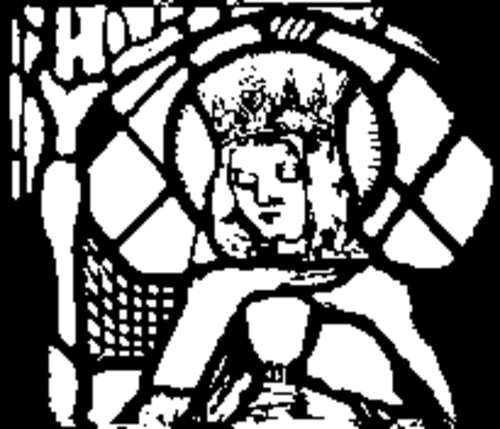
Venerable
Eadburh of Winchester
Nun of Winchester
Daughter of King Edward the Elder of England, a nun in the tenth century known for her gift of singing.
- Feast
- June 15old style June 28
- Reposed
- 96010th century
- Order
- Venerables
Life
Saint Eadburh was the daughter of King Edward the Elder of England and his third wife, Eadgifu of Kent, a nun at Winchester in the tenth century, known for her gift of singing. She fell asleep on 15 June, around 951 or 960, before the age of forty. She was canonized only twelve years after her death. The Church remembers her on 15 June.
Most of the information comes from lives written many years after her death. In the twelfth century Osbert of Clare wrote her Life in Latin, at the request of the monks of Pershore, who wanted to put their accounts of her in order. According to him, at three she was given to the abbey of Saint Mary at Winchester (Nunnaminster), founded by her grandmother, the queen mother Ealhswith. There she received her education and remained a nun all her life. She was regarded as an excellent singer and, according to Osbert, was given the role of precentrix. It is said she remained in the oratory for hours after the service to pray in private, and the prioress punished her for this, thinking it idleness, but asked pardon on learning that she was the king's daughter. An anonymous Life of the fourteenth century speaks of her "strict discipline of psalmody".
Osbert relates that at a banquet her father attended he commanded her to sing, and she resisted, but agreed when he promised a reward. The listeners were "held captive by the beauty of her singing", and she won more support for the convent from the king. In another story she insisted on cleaning the shoes of her high-born companions, who were so astonished that they told the king of his daughter's unseemly behaviour. Eadburh and Edith of Wilton were praised by the historian William of Malmesbury for their prayers and intercessions. In a Winchester charter of 939 she receives land at Droxford in Hampshire from her half-brother King Æthelstan. It is told that at three her father set rings and bracelets on one side and a chalice and gospel book on the other, and she chose the latter.
Her veneration appears in the Salisbury Psalter of the early 970s. In 972 part of her relics was taken to Pershore Abbey, dedicated to Saints Mary, Peter, Paul and, from then on, Eadburh. A few churches bear her name, mostly in Worcestershire.
Commemorated the same day June 15
 AugustineSaint · Bishop of HippoJun 15
 JeromeVenerable · Translator of the ScripturesJun 15
 AmosProphet · The ProphetJun 15
 Lazar of SerbiaGreat Martyr · Prince of SerbiaJun 15
 Michael I of KyivSaint · First Metropolitan of KyivJun 15
 Landelin of CrespinVenerable · Abbot of CrespinJun 15
 Cassian of AvnezhVenerable Martyr · Monk on the Sukhona RiverJun 15
- Gregory of AvnezhVenerable Martyr · Monk on the Sukhona RiverJun 15
 Doulas of EgyptPassion-Bearer · Monk in EgyptJun 15
- OrsisiusVenerableJun 15
 Ephrem of SerbiaSaint · Patriarch of SerbiaJun 15
 Simeon of NovgorodSaint · Archbishop of NovgorodJun 15