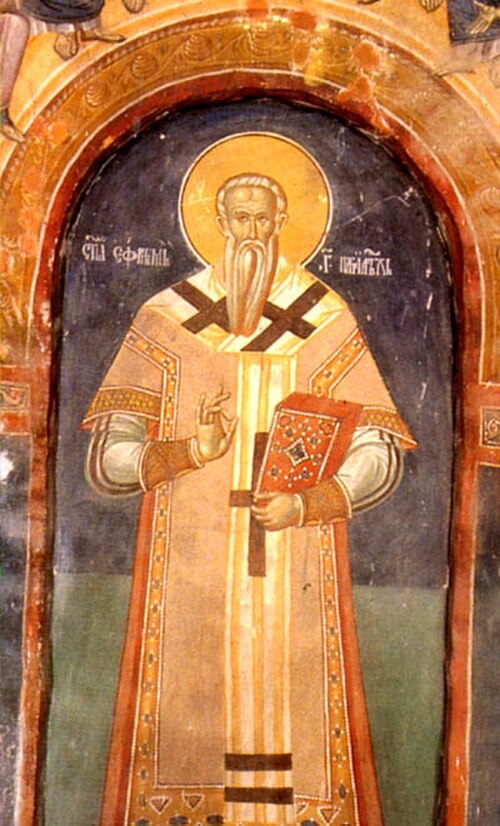
Saint
Ephrem of Serbia
Patriarch of Serbia
Twice Patriarch of Peć, in 1375-1379 and 1389-1392, also known as a poet; he died around the year 1400.
Life
Saint Ephrem (Jefrem) of Serbia was twice Serbian patriarch of Peć, in 1375-1379 and from 1389 until 1390 or 1392 (according to the sources), and a writer of hymns. He was born around 1311 (one source says 1312) near Tarnovo and died in 1399 or 1400. The Serbian Orthodox Church commemorates him on 15 June (28 June in the new calendar). He was proclaimed a saint by Patriarch Sava V, in 1406 or 1407, after signs of holiness appeared.
Beginnings and life as a hermit
He was born into a priestly family, of Bulgarian stock, near the Bulgarian town of Tarnovo; historiography treats him as of Bulgarian origin, while another source says he was from Thessaly. The Bulgarian sources stress his Bulgarian descent, but note that in the Middle Ages, in the usual Christian outlook, this fact had a different meaning; many Serbian archpastors are also known to have been of Bulgarian stock. From childhood he longed for the spiritual and ascetic life. When his parents wanted to marry him, he fled to Mount Athos at the age of twenty-three, around 1335, and became a monk. His life says that he dreamed God showed him that his wish to be a monk would be fulfilled, and set out for the place shown in the dream, where he found a hermit named Basil, with whom he prayed and fasted. When his parents learned where he was and tried to persuade him to come home, he fled again to Athos. He lived first at Hilandar, then at Zograf, then in the mountains, as a hesychast hermit.
Around 1347 he left Athos and became hegumen on an island of the river Maritsa near Plovdiv (the Serbian source says he went with some disciples to a monastery near Plovdiv because of the Turkish invasion). According to other sources he returned to Serbia and settled for a short time in the Ibar Gorge. Then he came to Serbia, to the Monastery of the Patriarchate of Peć, from where, after the Easter council at Skopje, he received the blessing of Patriarch Joanikije II to settle in the "Dečani hermitage", in a skete above the Visoki Dečani monastery, in a cave church. After the death of Tsar Stefan Dušan, Patriarch Sava IV built him a cell at Ždrelo (Rugova), not far from the Patriarchate of Peć.
Patriarch
When unrest began in the state and the Church, at the request of Prince Lazar and of Đurađ Balšić, the Synod met at Peć in 1375 and, after long deliberation, on Wednesday, 3 October 1375, elected the hermit Ephrem patriarch, in place of the late Sava. When the election was announced, he wept, because he did not want to be patriarch, and tried to refuse, but the Synod did not change its decision. The times were hard: the quarrels in the state were reflected in the Church. As some great lords did not obey Prince Lazar gladly, so some hierarchs and clergy did not submit to Patriarch Ephrem, despite his high ascetic life. Burdened by difficulties, and accustomed to solitude, he left the throne in 1379 and gave it to Spyridon, the newly elected patriarch (the English source says he did so to protect the Church from interference by feudal lords), and he retired to the Monastery of the Holy Archangel Michael in Prizren, Dušan's foundation, or, according to the Bulgarian source, had his patriarchal seat there and then returned to the hermit life.
After Spyridon's death in 1389, Prince Lazar begged him to take up the office again. He governed the Serbian Church in the hard time after the defeat at Kosovo until the Synod could meet again and elect Danilo III as patriarch (the English source says he renounced the throne in 1392; the Serbian one that he governed until 1390, and in some accounts until the new patriarch was elected), and then retired to Ždrelo. The Bulgarian source considers his great merit to be that he succeeded, with the help of Isaiah of Serres and Nicodemus of Tismana, in lifting the schism laid by the Church of Constantinople on the Serbian patriarchate, raised to that rank at the church and popular council of Skopje.
Death and veneration
The sources do not agree on the date of his death: the evening of 14 June 1400, buried the next day at the Patriarchate of Peć in the presence of Patriarch Sava V, according to the English source; 15 June 1399 near Peć according to the Serbian; 1399 or 1400 according to the Bulgarian. His relics are kept at the Patriarchate of Peć. Bishop Marko of Peć wrote the Service and the Life of Saint Ephrem. His commemoration is kept together with Saints Lazar and Spyridon.
His hymns
Known in the history of literature as the monk Ephrem, he wrote the Prayer Canon to Jesus Christ, the Prayer Canon to the Most Pure Mother of God, prayer stichera to the Most Pure Mother of God and to the Lord, the Cross-Theotokion stichera, and Stichera without acrostic (between 1355 and 1371). In hard times of Turkish danger, the monk Ephrem wrote dramatic verses full of hesychast themes, with a penitential, prayerful tone and firm faith in the help of Christ and the Mother of God, hoping for light after the darkness that had settled over Serbia. His work, preserved in a fourteenth-century manuscript from Hilandar, was discovered in full and edited by D. Bogdanović in 1970. Independently of him, P. Matejić, in 1975, held that the author is not the Serbian patriarch but a monk-writer of Tarnovo, who belongs to Bulgarian literature.
Commemorated the same day June 15
 AugustineSaint · Bishop of HippoJun 15
 JeromeVenerable · Translator of the ScripturesJun 15
 AmosProphet · The ProphetJun 15
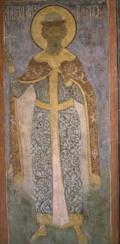 Lazar of SerbiaGreat Martyr · Prince of SerbiaJun 15
 Michael I of KyivSaint · First Metropolitan of KyivJun 15
 Eadburh of WinchesterVenerable · Nun of WinchesterJun 15
 Landelin of CrespinVenerable · Abbot of CrespinJun 15
 Cassian of AvnezhVenerable Martyr · Monk on the Sukhona RiverJun 15
- Gregory of AvnezhVenerable Martyr · Monk on the Sukhona RiverJun 15
 Doulas of EgyptPassion-Bearer · Monk in EgyptJun 15
- OrsisiusVenerableJun 15
 Simeon of NovgorodSaint · Archbishop of NovgorodJun 15