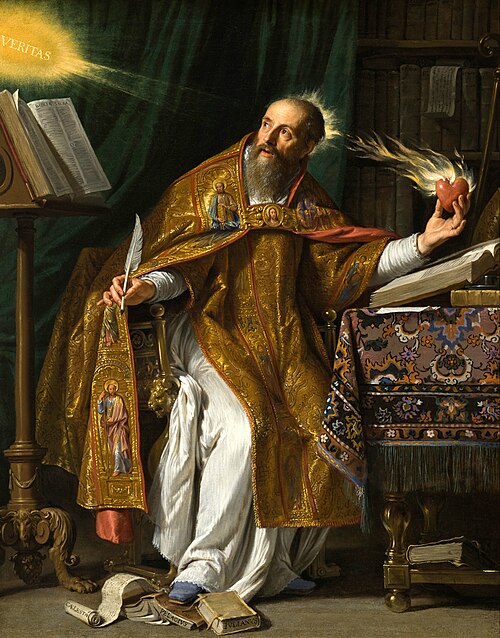
Saint
Augustine
Bishop of Hippo
Great Church Father of North Africa, author of the Confessions and The City of God.
Life
Blessed Augustine (13 November 354 to 28 August 430) was bishop of Hippo in North Africa and one of the great teachers of the Latin-speaking Church. The Church remembers him for his long road from error to repentance, for thirty-five years of service as a bishop, and for the writings in which he defended the faith against the Donatists, the Manichaeans and the Pelagians. The best known are the Confessions and The City of God.
Youth and searching
He was born at Thagaste in Numidia. His mother, Saint Monica, was a Christian, while his father, Patricius, was still a pagan. He studied rhetoric at Carthage, where reading Cicero's dialogue Hortensius awoke in him a love of wisdom. Scripture, by contrast, seemed to him plain, and he set it aside.
For about nine years he stayed among the Manichaeans as a hearer, the lowest rank in that sect. From a relationship with a woman in Carthage a son was born to him, Adeodatus. He taught rhetoric at Thagaste and Carthage and then in Rome, and in late 384 he won the chair of rhetoric at Milan, one of the most prominent academic posts in the Latin world. Disappointed by the Manichaean bishop Faustus, he turned first to scepticism and then to Neoplatonism.
Return to Christ
At Milan he listened to the sermons of Bishop Ambrose and, under his guidance, began to read the Holy Scriptures. The devotion of his mother and his friend Simplicianus urged him toward the faith. The decision came at the end of the summer of 386, after he heard the story of Saint Anthony the Great. In the Confessions he recounts that he heard a child's voice saying "take up and read" and opened the epistles of the Apostle Paul.
Saint Ambrose baptized him on the night of Pascha, 24 to 25 April 387, together with his son Adeodatus. On the journey home Saint Monica reposed at Ostia. Back in Africa, Augustine sold his inheritance, gave the money to the poor, and turned the family house into a monastic community for himself and a few friends. The Orthodox Church in America adds that he was tonsured a monk.
Priest and bishop
In 391 Bishop Valerius ordained him a priest at Hippo. In 395 he became coadjutor bishop, and after Valerius died he remained bishop of the city. Even as bishop he kept a monastic way of life in the episcopal residence. More than three hundred and fifty sermons are believed to be authentic, and tradition holds that he preached thousands; stenographers took them down.
His friend Possidius, bishop of Calama, wrote his life. He portrays a man who ate sparingly, worked tirelessly, disliked gossip, and managed the property of his see with care. Possidius counts about a thousand works.
Writings and struggle for the faith
The Confessions, written in 397 and 398, are an outpouring of thanksgiving and penitence which also takes up questions of time, free will and evil. The City of God, in twenty-two books, was written after the Visigoths sacked Rome in 410, to restore the confidence of Christians shaken by that event. Also well known are the Enchiridion, the seventeen books against the Pelagians, and many treatises and letters.
Against the Donatists, who had divided the Church in Africa, he held that the mysteries are valid whatever the worthiness of the minister. Against Pelagius he defended the necessity of grace. He is said to have remarked that it is better for people to condemn his grammar than not to understand him.
Repose
The Vandals besieged Hippo in the spring of 430, and Augustine fell ill. In his last days he asked that the penitential psalms be hung on his walls so that he could read them, and he wept much. He also directed that the church library be preserved with care. He reposed on 28 August 430. The Vandals lifted the siege, returned soon after, and burned the city, but left his cathedral and library standing.
Relics and veneration
According to Bede's martyrology, his body was taken to Cagliari in Sardinia by Catholic bishops exiled by Huneric. Around 720 Bishop Peter of Pavia, uncle of the Lombard king Liutprand, moved it to the church of San Pietro in Ciel d'Oro at Pavia, where the relics remain. A small part is kept in the monastery of Saint Meletios in Attica, Greece.
The Orthodox Church commemorates him on 15 June together with Blessed Jerome, while the West keeps 28 August. In the Orthodox tradition he is called Blessed rather than Saint.
Commemorated the same day June 15
 JeromeVenerable · Translator of the ScripturesJun 15
 AmosProphet · The ProphetJun 15
 Lazar of SerbiaGreat Martyr · Prince of SerbiaJun 15
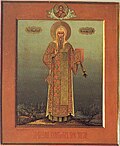 Michael I of KyivSaint · First Metropolitan of KyivJun 15
 Eadburh of WinchesterVenerable · Nun of WinchesterJun 15
 Landelin of CrespinVenerable · Abbot of CrespinJun 15
 Cassian of AvnezhVenerable Martyr · Monk on the Sukhona RiverJun 15
- Gregory of AvnezhVenerable Martyr · Monk on the Sukhona RiverJun 15
 Doulas of EgyptPassion-Bearer · Monk in EgyptJun 15
- OrsisiusVenerableJun 15
 Ephrem of SerbiaSaint · Patriarch of SerbiaJun 15
 Simeon of NovgorodSaint · Archbishop of NovgorodJun 15