Venerable
Jerome
Translator of the Scriptures
Church Father who translated the Bible into Latin, known as the Vulgate, and lived in Bethlehem.
- Feast
- June 15old style June 28
- Reposed
- 4205th century
- Place
- Bethlehem
- Order
- Venerables
Life
Blessed Jerome was a priest, monk and great scholar of Holy Scripture, the translator of the Bible into Latin. He lived in the fourth and fifth centuries, and his translation, later called the Vulgate, remained for centuries the text of Scripture for Christians in the West. He is counted among the four great Fathers of the Latin Church, and the Orthodox Church honours him for his ascetic life and his service to Scripture. His full name was Eusebius Sophronius Hieronymus.
Youth and search
He was born at Stridon, a city on the border between Dalmatia and Pannonia, into a Christian family. The year of his birth is uncertain, between 342 and 347. His parents sent him to Rome, where he studied grammar and rhetoric under the teacher Donatus and read the classical authors widely. He was baptized at about the age of twenty, after being drawn to the pleasures of the world in the capital. He then travelled to Gaul, and on returning home he found that his parents had passed away and that he had to care for his younger brother and sisters.
Wishing for the monastic life, he left for the East and around 374 settled in the desert of Chalcis, southeast of Antioch, where he remained almost five years. There he worked on Scripture and began to learn Hebrew under the guidance of a converted Jew. The disputes between the partisans of the bishops Meletius, Paulinus and Vitalis reached his monastery, so he went to Antioch, where Bishop Paulinus ordained him priest. At Constantinople he conversed with Saints Gregory the Theologian and Gregory of Nyssa.
At Rome
In 381 he went to Rome. Pope Damasus I, who devoted much time to the study of Scripture, made him his secretary and asked him to revise the old Latin text of the Gospels. Jerome also revised the Psalter on the basis of the Septuagint. He gave spiritual guidance to a circle of devout women, among them Paula, Marcella and Eustochium, Paula's daughter. Because he rebuked the manner of life of those who lived in the world, many spoke ill of him, and after three years at Rome he decided to leave.
At Bethlehem
With his brother Paulinian and some friends he visited the Holy Land and the monks of the Nitrian desert. In 386 he settled in a cave at Bethlehem, near the place of the Lord's Nativity, where Paula built two monasteries, one for monks and one for nuns. He lived there for almost thirty-four years in prayer, ascetic struggle and ceaseless labour.
Here his work bore its richest fruit. From about 390 he began to translate the Old Testament directly from the Hebrew instead of the Septuagint. He wrote commentaries on the books of Scripture, especially the prophets, the work On Illustrious Men, on Christian writers, and some one hundred and twenty authentic letters survive, according to the OCA. He lived through the sack of Rome by the Goths in 410, and in 411 Bedouin Arabs invaded Bethlehem, though the community of the aged ascetic was spared.
Disputes for the faith
Jerome carried on many disputes. He wrote against Jovinian, against Vigilantius, against the Pelagians, and an apology against Rufinus, once his friend, concerning the teaching of Origen. His tone was at times too harsh.
Repose and veneration
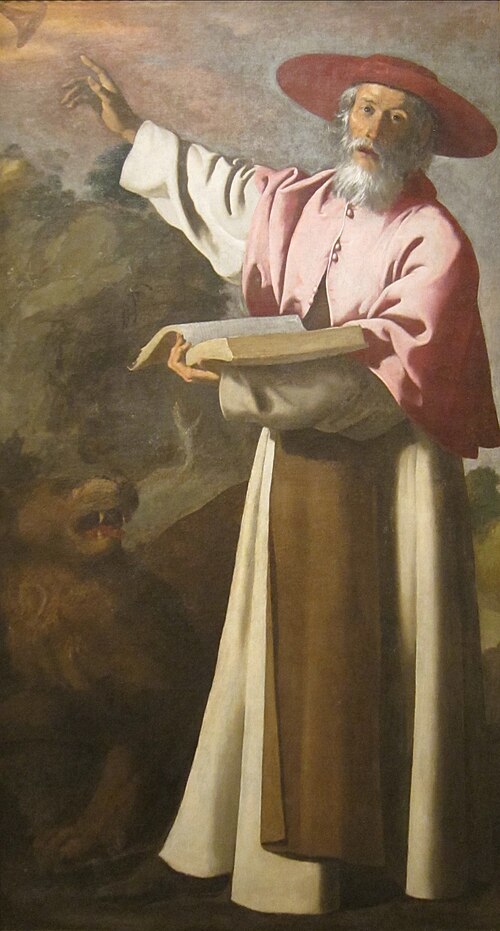
Blessed Jerome reposed in the Lord at Bethlehem on 30 September 420. His relics were later moved to Rome, to the basilica of Santa Maria Maggiore according to the Greek synaxarion, while the OCA says they were brought in 642 and that his hand is kept in a church near the Piazza Farnese. In the Romanian Orthodox Church he is commemorated on 15 June, together with Blessed Augustine. In the West his day is 30 September. In Western art he is shown with a lion, according to a late legend that may come from older tales about other figures.
Commemorated the same day June 15
 AugustineSaint · Bishop of HippoJun 15
 AmosProphet · The ProphetJun 15
 Lazar of SerbiaGreat Martyr · Prince of SerbiaJun 15
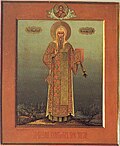 Michael I of KyivSaint · First Metropolitan of KyivJun 15
 Eadburh of WinchesterVenerable · Nun of WinchesterJun 15
 Landelin of CrespinVenerable · Abbot of CrespinJun 15
 Cassian of AvnezhVenerable Martyr · Monk on the Sukhona RiverJun 15
- Gregory of AvnezhVenerable Martyr · Monk on the Sukhona RiverJun 15
 Doulas of EgyptPassion-Bearer · Monk in EgyptJun 15
- OrsisiusVenerableJun 15
 Ephrem of SerbiaSaint · Patriarch of SerbiaJun 15
 Simeon of NovgorodSaint · Archbishop of NovgorodJun 15