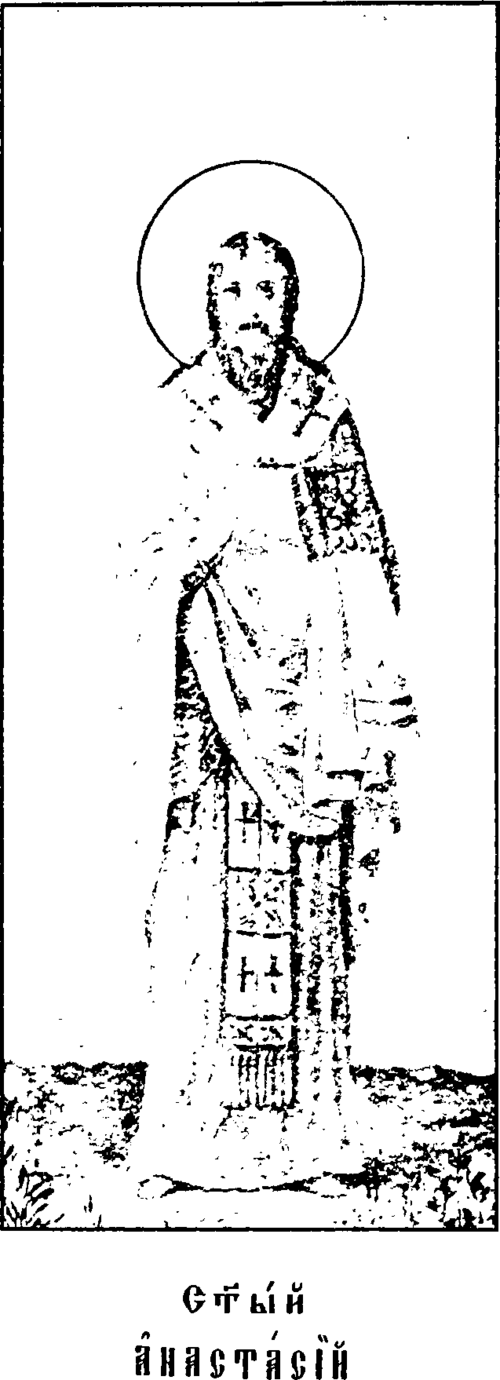
Saint
Anastasius I of Antioch
Patriarch of Antioch
Patriarch of Antioch from 561 to 571 and from 593 to 599, a friend of Pope Gregory I.
Life
Saint Anastasius I the Sinaite was patriarch of Antioch twice, between 561 and 571 (in other sources 559-570) and between 593 and 599. He was a friend of Pope Gregory the Great and a defender of the right faith against the church policy of Justinian. His feast is on 20 April, and in the Coptic Synaxarion also 19 January.
He was born in Palestine and became a monk on Mount Sinai, hence the name the Sinaite. He was then apocrisiarius of the patriarch of Alexandria at Antioch, and after the death of Patriarch Domnus III the clergy and people asked for him and chose him patriarch. It is said that he came to the throne through his virtues, purity of life, spiritual learning and firm faith. At that time the Monophysite heresy was spreading in the empire; Justinian began to support the Aphthartodocetae, a branch of Monophysitism, who taught that the body of Christ was incorruptible. Anastasius opposed this, sent letters to the churches and expounded daily in his church the Orthodox teaching on the two natures of Christ. Justinian wanted to remove him from the throne, found no fault in his life, and the emperor's illness stopped him; the patriarch of Constantinople, Eutychius, was exiled. After Justinian's death, his nephew and successor, Justin II, carried out his uncle's will: in 570 or 571, on the ground of a charge of squandering church property (which the Serbian synaxarion calls slander), he drove him to Jerusalem and put Gregory in his place. In exile Anastasius wrote several dogmatic and moral works: a homily on the Annunciation, on the usefulness of reading Holy Scripture, and others. Pope Gregory wrote to him several times, and asked the emperor Maurice and his son Theodosius that he be sent to Rome if he could not be restored to Antioch. In the end, after Gregory's death in 593, Anastasius was restored to his see and shepherded six more years. From some of the pope's letters it is thought that he was not firm enough in condemning the claim of the patriarch of Constantinople to be universal bishop.
About his end there is disagreement: according to Theophanes, in 599 he was disembowelled by the Jews of Antioch, who forced him to eat his entrails; according to another version, he died in 598 and was followed by another Anastasius, to whom the translation of Gregory's Pastoral Rule is attributed, killed in an uprising of the Jews; Nikephoros says, however, that they are one and the same. The synaxaria call him hieromartyr, but have no precise news of his death. At the Second Council of Nicaea a letter of his was read, in which he distinguished the worship due to God from the respect due to men and angels. Several works attributed to him were, it seems, by his successor of the same name.
Commemorated the same day April 20
 AnicetusSaint · Bishop of RomeApr 20
 ZacchaeusApostle · Tax Collector of JerichoApr 20
 Anastasius II of AntiochHieromartyr · Patriarch of AntiochApr 20
 Joasaph of MeteoraVenerable · Former ruler of ThessalyApr 20
 Gabriel of ZabłudówMartyr · Child martyrApr 20
 Beuno of Clynnog FawrVenerable · Abbot of Clynnog FawrApr 20
 Gregory of AntiochSaint · Patriarch of AntiochApr 20
- Athanasios the MeteoriteVenerable · Founder of the Meteora monasteriesApr 20
 Prokopios of IconiumHieromartyr · Metropolitan of IconiumApr 20
 Alexander of OshevenskVenerable · Founder of Oshevensk MonasteryApr 20
- Mar AwginVenerableApr 20
Theodosius GanitskyConfessor · Bishop of KolomnaApr 20