Venerable
Athanasios the Meteorite
Founder of the Meteora monasteries
14th-century monk, founder of the Great Meteoron, the first Meteora monastery; commemorated April 20.
- Feast
- April 20old style May 3
- Reposed
- 138014th century
- Place
- Meteora
- Order
- Venerables
Life
Saint Athanasios the Meteorite (in the world Andronikos, 1302-1380) the venerable was a monk of the fourteenth century, the founder of the monastery of the Great Meteoron, the first monastery of the Meteora complex in Thessaly. He is commemorated on 20 April (3 May in the new style). The date of his death is given by some sources as 1380 and by others as 1383.
Youth
He was born in 1302 or 1303 at Neai Patrai (now the village of Ypati in Phthiotis), of a noble and wealthy family, as is believed, though he never spoke of his origin. At baptism he received the name Andronikos. Orphaned young, he was taken in by an uncle. Around 1319 the city was taken by the Catalan troops of Alfonso Fadrique of Aragon and fell into the hands of the Duchy of Athens (the Russian source says he was taken prisoner, the Ukrainian one that the region was occupied by the Franks). Andronikos went to Thessalonica. Although his family had few means, the teachers there were impressed by his zeal for study and gave him lessons in philosophy and classical literature without pay. After some years he went to Mount Athos and asked to become a monk, but was refused for being too young.
The start of monastic life
He then made a pilgrimage to Constantinople, where he met Saint Gregory of Sinai and Isidore Boucheir (the future Patriarch Isidore I), who encouraged him in his quest for monastic life. He then went to Crete, where he began an ascetic life and became known as an ascetic. To avoid falling into pride, he left Crete and returned to Athos, where he settled in an isolated skete with a harsh climate, a disciple of two very experienced monks. There, at thirty, he was tonsured a monk. The sources do not agree on the name: according to some he first received the name Anthony and later, with the great schema, Athanasios; according to others he received the name Athanasios from the start. The Ukrainian account says he settled at the skete of Iviron.
To Meteora
At that time Athos was often attacked by Turkish pirates, and the monks were forced to leave their skete and scatter. Athanasios left with two other monks in search of an isolated place for asceticism. After several attempts, a disciple of Gregory of Sinai, who had become a bishop, advised them to go to Thessaly, to the region of Meteora, where hermits had lived since the eleventh century. The Russian source places his leaving Athos in 1334, with his spiritual guide Gregory, and the Ukrainian one puts him beside Gregory Palamas. Athanasios saw that the peaks of Meteora were suited to monastic life, and they decided to settle on the top of a rock where a rock-carved chapel already existed (according to the Russian source, an abandoned church of the Archangels, on the "Pillar of Drops", near the city of Stagi, now Kalambaka). The monk Gregory became abbot of the small community, which was soon joined by other monks.
Athanasios led a very strict life there, of asceticism and hesychasm. Five days a week he withdrew into a cave, in unceasing prayer, fasting and little sleep. He is said to have acquired clairvoyance and experienced spiritual ecstasy, of which he did not speak to the monks. Later he asked Gregory for leave to move to the highest rock of Meteora. Gregory hesitated, because he wanted to make him his successor, but in the end agreed.
The monastery of the Transfiguration
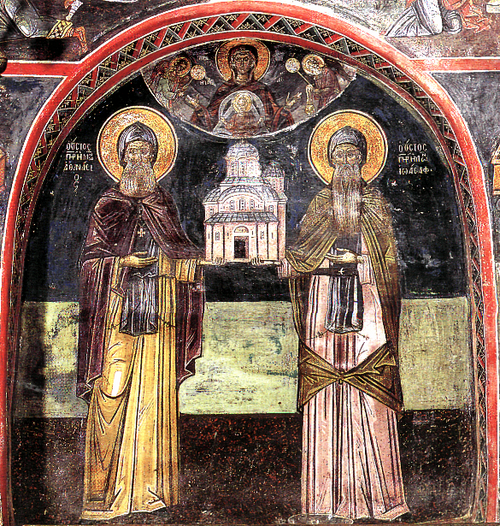
Athanasios left for the highest rock, called the "Meteoron", and took with him only the monks most capable of leading a very austere life (according to the Russian source, he gathered fourteen monks from the neighbourhood and climbed "Platys Lithos", "the broad stone", 613 metres high, beginning the building of the Great Meteoron monastery; he is thought to have given the rocks the name "Meteora"). In 1356 he organized the community, giving it a coenobitic rule after the typikon of the monasteries of Athos. A church was built and dedicated to the Transfiguration of the Lord; first, according to the Russian source, a church of the Mother of God. The foundation of the community was protected and sponsored by the local lord Simeon Uroš, based at Trikala, who in the same year proclaimed himself emperor of the Serbs and Greeks after the death of Stefan Dušan. The monastery was later called the Great Meteoron. It drew many monks, and its fame spread among the Christians of the region. It was also said that Athanasios had acquired the gift of prophecy and foretold the failure of the Ottoman siege of Thessalonica in 1372. He died in 1380 (according to other sources on 20 April 1383), at the age of seventy-eight, without ever leaving the monastery. The anonymous Life of the venerable was written by a monk of Meteora or Athos at the end of the fourteenth century. His relics are in the northern part of the cathedral of the Transfiguration, together with those of Joasaph the Meteorite (before monasticism John Uroš Palaiologos, ruler of Epirus), who took part in building the monastery. Nearby are sixteenth-century frescoes of the two venerable fathers holding the monastery in their hands. The ruins of a hermitage said to be St Athanasios's lie at the south-western end of the Holy Spirit Rock in Meteora, and his cave next to the monastery, midway between the monastery of Varlaam and Saint Nicholas Anapausas.
Commemorated the same day April 20
 AnicetusSaint · Bishop of RomeApr 20
 ZacchaeusApostle · Tax Collector of JerichoApr 20
 Anastasius I of AntiochSaint · Patriarch of AntiochApr 20
 Anastasius II of AntiochHieromartyr · Patriarch of AntiochApr 20
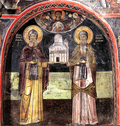 Joasaph of MeteoraVenerable · Former ruler of ThessalyApr 20
 Gabriel of ZabłudówMartyr · Child martyrApr 20
 Beuno of Clynnog FawrVenerable · Abbot of Clynnog FawrApr 20
 Gregory of AntiochSaint · Patriarch of AntiochApr 20
 Prokopios of IconiumHieromartyr · Metropolitan of IconiumApr 20
 Alexander of OshevenskVenerable · Founder of Oshevensk MonasteryApr 20
- Mar AwginVenerableApr 20
Theodosius GanitskyConfessor · Bishop of KolomnaApr 20