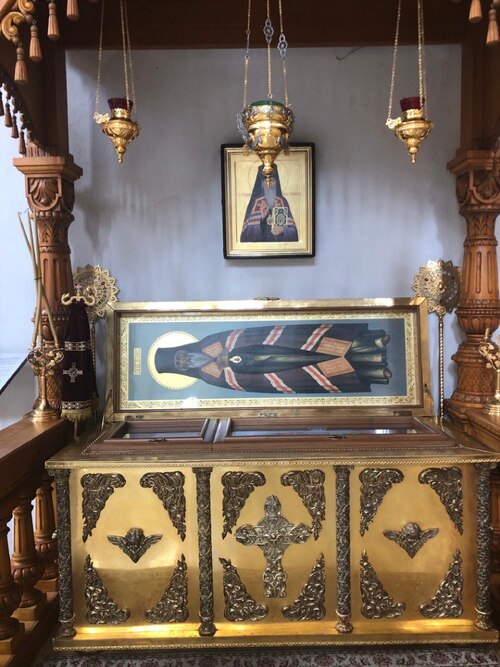
Confessor
Theodosius Ganitsky
Bishop of Kolomna
Bishop of Kolomna and Bronnitsy, canonized, who died in 1937 in the village of Sushkovo.
- Feast
- April 20old style May 3
- Reposed
- 193720th century
- Place
- Lukhovitsy
- Order
- Confessors
Life
Saint Theodosius Ganitsky, the Hieromartyr and Confessor (in the world Ivan Feodorovich Ganitsky, 1860 to 1937), was bishop of Kolomna and Bronnitsy, a monk and abbot of strict life, a field priest in the Russo-Japanese war, arrested in the years of persecution and ending in the village of Sushkovo as a simple praying believer, being forbidden to serve. The Russian Church numbered him among the saints in 2006. His relics rest in the Epiphany Cathedral of the Old Golutvin monastery at Kolomna.
Youth and service in Taurida
He was born on 30 July 1860 in the village of Ruda, in Kyiv province (today Skvyra district), to a deacon's family. He graduated from the Kyiv theological seminary. He served as teacher of religion at a people's school in the Perekop district, in Taurida province, then as accountant at the Treasury Chamber.
He was tonsured a monk. On 19 April 1899 he was ordained hierodeacon, and on 20 April hieromonk, and named rector of the church beside the Taurida diocesan candle factory. From 5 May 1899 he was steward of the bishop's house of the same diocese, and from 15 August 1899 abbot of the Dormition skete at Bakhchysarai. From 13 October 1899 he was dean of the second deanery of the Taurida diocese, and on 7 November 1900 he was temporarily named dean of all the monasteries of the diocese. From 17 December 1900 he was hegumen, and from 28 December head of the monastery of Saint George at Balaklava, of the first class. On 1 February 1901 he was relieved of the post of dean of the convents, and on 29 July 1903 of the monasteries for men too.
At Moscow
On 11 August 1903 he was moved to the brotherhood of the Protection missionary monastery at Moscow. In the Russo-Japanese war he was in the active army. On 10 April 1904 he left for the Far East as rector of the field church of a Red Cross detachment, from the brotherhood of Saint Eugenia. He returned to Moscow on 10 November 1905. For his merits in the war he received the Order of Saint Anna, second and third class, the Order of Saint Vladimir, fourth class, and the medals "In Memory of the Russo-Japanese War".
From 12 July 1906 he was steward of the Chudov monastery. From 1909 to 1920 he was abbot of the Zlatoust monastery in Moscow. After the closing of the Zlatoust monastery he was consecrated, on 18 May 1920, bishop of Kolomna and Bronnitsy. The Kolomna parishioner Zinaida Ivanovna Ilyina recalled that there was no church in their town where Bishop Theodosius had not served at the patronal feasts. The believers of Kolomna, and especially the monks, loved him greatly, seeing in him not only a talented administrator but a man of strict life, with sincere love for each person who came. Those with sorrows asked him for help and prayer.
The first arrests
On 13 July 1921 the bishop was arrested on the charge of having commemorated members of the tsar's family during a procession (the Tsarevich Nikolai Alexandrovich, who died in 1865, had been commemorated by mistake, by the old text of the service). At the believers' request he was released, but in 1922 he was arrested again, in connection with the confiscation of church valuables. He was under investigation at Butyrka until the case was dropped in 1924.
After release he returned to Kolomna, where he did much to restore parish and monastic life. The authorities sought in his work signs of political disloyalty but could not find them. He ended each sermon with the words: "I have finished, and I hope each of you will testify that there is nothing political in my sermon". He lived at Kolomna, on Voskresenskaya street, in the house of the cathedral archpriest Vasily Probatov. Today the street is called Kremlevskaya, no. 12.
The second arrest and exile, 1929 to 1933
In December 1929 he was arrested on the charge of leading an anti-Soviet group of monks of the Golutvin monastery, whose members were said to have carried on hidden and open counter-revolutionary agitation, using the pulpit for sermons and church councils for individual agitation. He did not plead guilty, but several priests in the investigation criticized their archpastor for conservatism, for his unwillingness to commemorate the Soviet power and for his good relations with the monks. On 3 February 1930, by decision of the OGPU collegium, he was sentenced to five years in camp, replaced by exile to the Northern Region for the same term. In May 1933 the case was reviewed and the bishop was released.
Last years
He returned to Kolomna, then lived in the village of Sushkovo, in the Lukhovitsy district, over 101 kilometres from Moscow. He was forbidden to serve and could only be present and pray as an ordinary parishioner at services. In this village his earthly life ended on 3 May 1937. He was buried there, beside the altar of the Kazan church. The funeral service was performed by the priest of this church, Sergius Lyubomudrov, a future holy martyr. He was rehabilitated by a decision of the Moscow Prosecutor's Office in October 2003.
Glorification
By decision of the Holy Synod of the Russian Church of 11 April 2006, Bishop Theodosius's name was entered in the Synaxis of the New Martyrs and Confessors of Russia of the twentieth century. On 16 May 2006 the saint's relics were found. They rest in a shrine in the Epiphany Cathedral of the Old Golutvin monastery at Kolomna. The memory of the Holy Confessor Theodosius is kept on 20 April (3 May by the new calendar), the day of his repose, and on 3 (16) May, the day of the finding of the relics. According to the commandant of the Kolomna garrison, Major Roman Nikolaevich Novikov, since 2019 he has been honoured by servicemen as heavenly patron of the local Kolomna garrison.
Commemorated the same day April 20
 AnicetusSaint · Bishop of RomeApr 20
 ZacchaeusApostle · Tax Collector of JerichoApr 20
 Anastasius I of AntiochSaint · Patriarch of AntiochApr 20
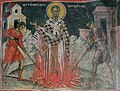 Anastasius II of AntiochHieromartyr · Patriarch of AntiochApr 20
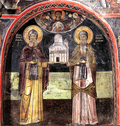 Joasaph of MeteoraVenerable · Former ruler of ThessalyApr 20
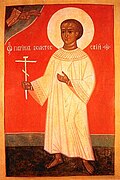 Gabriel of ZabłudówMartyr · Child martyrApr 20
 Beuno of Clynnog FawrVenerable · Abbot of Clynnog FawrApr 20
 Gregory of AntiochSaint · Patriarch of AntiochApr 20
- Athanasios the MeteoriteVenerable · Founder of the Meteora monasteriesApr 20
 Prokopios of IconiumHieromartyr · Metropolitan of IconiumApr 20
 Alexander of OshevenskVenerable · Founder of Oshevensk MonasteryApr 20
- Mar AwginVenerableApr 20