
Hieromartyr
Anatoly Hrysiuk
Metropolitan of Odesa and Kherson
Metropolitan of Odesa and Kherson, born at Kovel in 1880, who died a martyr in the Komi Republic in 1938; glorified in 2000.
- Feast
- January 10old style January 23
- Reposed
- 193820th century
- Place
- Komi Republic
- Order
- Martyrs
Life
Saint Anatoly Hrysiuk, the Hieromartyr (in the world Andrei Grigorievich Hrysiuk, 1880 to 1938), was metropolitan of Odesa and Kherson, a scholar of the history of the early Church and rector of the Kazan Theological Academy. Arrested several times in the years of Soviet persecution, he died in the camp at Kyltovo, in the Komi Republic, sick and nearly blind, having refused to part with his cross. The Russian Church numbered him among the saints in the year 2000.
Youth and scholarship
He was born on 19 (31) August 1880 in the town of Kovel, in Volhynia province, to the family of an accountant. He graduated from the theological school at Kremenets (1894), the Volhynia seminary (1900) and the Kyiv Theological Academy (1904), with the degree of candidate in theology. In 1903 he was tonsured a monk, and in May 1904 ordained hieromonk. From August 1904 to August 1905 he was a professorial fellow of the academy in the chair of general church history, then lecturer in the same chair, and from 1910 in the chair of the history of the ancient Church. From August 1905 he carried out research at the Russian Archaeological Institute in Constantinople.
He was a member of the Church Archaeological Society attached to the academy (1906) and received the pectoral cross in 1908. In 1911 he took the degree of master of theology with the work "A Historical Outline of Syrian Monasticism to the Middle of the Sixth Century", which received the Metropolitan Macarius prize. On 29 August 1911, in Saint Michael's monastery in Kyiv, he was raised to archimandrite. From 1912 he was extraordinary professor at the Kyiv Academy, then inspector and professor at the Moscow Academy, and from 6 June 1913 rector of the Kazan Academy. He knew the classical languages and some oriental ones and studied the primary sources for the history of Christianity in the ancient East. He was known for a passionate desire to get to the bottom of the most tangled chronological date.
Bishop at Kazan
On 29 June 1913 he was consecrated bishop of Chistopol, second vicar of the diocese of Kazan, and from July 1914 he was first vicar. In 1914 he received the Order of Saint Vladimir, third class. He was chairman of the Kazan Historical and Archaeological Society, of the brotherhood of Saint Gurias of Kazan (1913) and of the committee for war needs (1914). In 1918 he took part in the Local Council as substitute for Metropolitan Jacob (Pyatnitsky), in its third session. In 1918 to 1920 he temporarily governed the diocese of Kazan.
After the official closing of the academy by the Soviet power, it went on working privately with the same curriculum. The building having been taken, lectures were held in the professors' homes, and the academy council met in the rector's flat. In early 1921 Chekists intercepted a package sent by Bishop Anatoly to Patriarch Tikhon with a report on the academy's activity. This led to a letter from the Cheka to the People's Commissariat of Justice demanding that the institution be stopped. In March 1921 the bishop was arrested and sentenced to a year of forced labour. He was taken to Moscow and held for several months in Butyrka prison, where he was cruelly beaten and his jaw and two ribs were broken.
Samara and exile in Turkmenistan
From 28 February 1922 he was bishop of Samara and Stavropol. In 1923 he wrote to Patriarch Tikhon that he had not joined any of the Renovationist groups, although representatives of the civil power had asked him about it. He kept loyalty toward the civil power, but had no official relations with the Renovationist Supreme Church Administration and did not commemorate it at services. Nor did he carry out its decrees of September 1922 on non-commemoration of the Patriarch and on monasteries. On 5 (18) December 1922 he was summoned to the GPU department in Samara and asked why he refused to obey. He answered that the Patriarch had been condemned neither by a church nor by a civil court. The GPU representative then told him that commemorating the Patriarch's name was an act of disloyalty toward the civil power, which regarded him as an "enemy of the people". When one of the Samara archpriests was arrested and questions began to arrive from the clergy, he took on himself the canonical and moral responsibility of suspending, until a ruling of the supreme Church authority, the commemoration of the Patriarch's name. He nevertheless prayed aloud for him as for a prisoner, and advised others to do the same.
On 24 February 1923 he was arrested again for opposing the Renovationist movement. The formal pretext was an anti-Soviet appeal found in his flat, written in his name, which he declared a forgery. On 4 August 1923 he was briefly released and Patriarch Tikhon raised him to archbishop. On 18 September 1923 he was arrested once more, accused of spreading anti-Soviet rumours, and exiled for three years by administrative order to Turkmenistan, to the town of Poltoratsk (now Ashgabat), and from 1925 to Krasnovodsk.
In exile he kept his interest in scholarly questions. He wrote to Professor A. I. Brilliantov that they were no longer studying early church history but were victims of the tragedy of recent Russian church history, far from libraries and even from his own small collection of books in his field, and asked with interest about the state of church history in Europe after the war. He returned from exile in 1927. He signed the so-called "Declaration" of Metropolitan Sergius (Stragorodsky). From 1927 he was a permanent member of the Provisional Holy Synod beside the Deputy Locum Tenens, dissolved in 1935.
Metropolitan of Odesa
From September 1928 he was archbishop of Odesa and Kherson. On 18 May 1932 all the members of the Synod who then held the rank of archbishop, among them Anatoly, were raised to metropolitan, with the right to wear the white klobuk and a cross on the mitre. In 1934 and 1935 he temporarily governed the diocese of Kharkov. In that time the authorities closed many churches of the diocese, some were blown up, and a large part of the clergy were arrested. The metropolitan was summoned several times for interrogation at the GPU, sometimes deep in the night, sometimes during services, in which case he first finished the service, despite the Chekists' displeasure.
According to the faithful and the clergy, he was a kind man, easy to approach and a fine preacher. In the recollection of Metropolitan Manuil (Lemeshevsky), he was short, thin, slightly stooped, always looking down, and gave the impression of a man absorbed in himself and his thoughts.
Last arrest and death
He was arrested in the night of 9 to 10 August 1936. He was accused of contact with a Catholic priest of Nikolaev, Christian Leontievich Znosko, with whom he supposedly negotiated an anti-Soviet bloc through union of the Eastern and Western Churches under the pope. He answered that he had not engaged in anti-Soviet agitation, had no ties with representatives of the Catholic Church and had held no negotiations on union of Orthodox and Catholics, declaring himself a convinced opponent of Catholicism. With the Catholic priest he had only a private conversation. He was sent to Moscow and held in Butyrka, already gravely ill, with his legs failing.
On 21 January 1937 the Special Council of the NKVD sentenced him to five years in a camp. Though ill, he was sent in a common convoy with criminals, who robbed him on the way. Part of the way they went by rail, then on foot through snow in a harsh winter close to polar. Bishop Anatoly could hardly move. When he fell he was allowed to ride in the back of a truck until he recovered, and was then driven again on foot.
In February 1937 he reached the agricultural colony at Kyltovo, and in May was sent to ordinary labour. In October, because of his failing health, he was moved to the invalids, but in November was taken out again to general work. By then he had almost lost his sight. A camp administration report says: "Fulfils the work at 62 percent. Works weakly because of age, but tries." In January 1938 he was placed in the camp hospital, where he died. One source gives the date as 23 January, another 10 February 1938. It is said that before his death he was ordered to hand over his Gospel and the pectoral cross he never parted with. The Gospel was torn from his hands by force, but he did not give up the cross.
Glorification
The Ukrainian Orthodox Church canonized him as a locally venerated saint of the Odesa diocese in 1997. The Jubilee Bishops' Council of the Russian Church in August 2000 numbered him among the New Martyrs and Confessors of Russia for veneration throughout the Church. In the investigative isolator of Odesa, where he was held in the 1930s, a church dedicated to the Hieromartyr Anatoly has been opened. The first Liturgy in the new church was served on 22 November 2016.
Commemorated the same day January 10
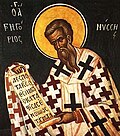 Gregory of NyssaSaint · Bishop of NyssaJan 10
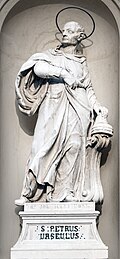 Peter I OrseoloVenerable · Doge of Venice, later a monkJan 10
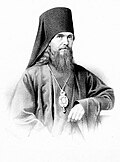 Theophan the RecluseSaint · Former bishop, recluse at VyshaJan 10
 Domitian of MeliteneSaint · Archbishop of MeliteneJan 10
- John II of JerusalemSaint · Bishop of JerusalemJan 10
 John the Good of MilanSaint · Archbishop of MilanJan 10
 Paul of ObnoraVenerable · Founder of Pavlo-Obnorsk MonasteryJan 10
- Arsenia DobronravovaVenerable Martyr · AbbessJan 10
- Marcian of ConstantinopleVenerableJan 10
- Macarius of PismaVenerableJan 10
- TheosebiaVenerable · DeaconessJan 10
- Ammon of EgyptVenerableJan 10