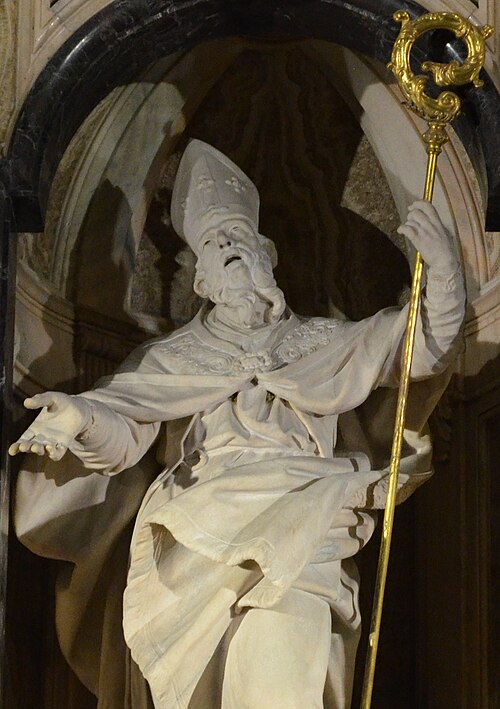
Saint
John the Good of Milan
Archbishop of Milan
Archbishop of Milan from about 641 to 669, honored in both the Orthodox and Catholic Church.
- Feast
- January 10old style January 23
- Reposed
- 6517th century
- Place
- Milan
- Order
- Hierarchs
Life
Saint John the Good was archbishop of Milan from about 641 to 669. He is honoured by both the Orthodox and the Catholic Church, and the Orthodox Church commemorates him on 10 January. His time as bishop is remembered above all for the return of the bishop to the city of Milan after an exile of more than seventy years.
His time
In 569 the Lombards invaded northern Italy and conquered Milan, which was just recovering from the terrible Gothic War. Bishop Honoratus fled to Genoa, and his successors stayed there. Genoa was then a suffragan see of Milan, but still under Byzantine rule.
John was born in the village of Recco, in the diocese of Genoa, although the nearby town of Camogli also claims him. It is not known exactly when he became bishop, but it is believed that his election followed the conquest of Genoa by the Lombard king Rothari. As bishop he returned to live in Milan. In 649 he was invited to the Lateran Council but arrived in Rome after it had ended; he nevertheless signed all its documents.
His life and relics
There are two main sources for his life: the Catalogue of the Bishops of Milan, from about the tenth century, and a poem in his honour written between the eleventh and thirteenth centuries. According to the poem, John was marked by generosity and charity, which gave him the name "the Good". The poem also recounts his miracles. It says that he moved some of the relics of Saint Syrus from Genoa to Desio, which he made an ecclesiastical centre, and that he died in 669, leaving all he had, including estates near Genoa, to the Church of Milan. The year 669 does not agree with the Catalogue, however, which gives him a ten-year reign, that is, a death no later than 659.
He fell asleep on 2 January according to the Catalogue, or on 10 January according to the poem. The second date became his original feast day, and it remains his feast in the Orthodox Church today. The Catholic Church keeps it on 2 January, and in the cathedral of Milan on 15 January.
His body was first buried in the little church of Saint Michael in Domo in Milan. The first survey of his relics was made by Archbishop Aribert (1018–1045). On 24 May 1582, shortly before the demolition of the church of Saint Michael, Cardinal Carlo Borromeo moved the body to the south transept of the cathedral of Milan, where it is still venerated.
Commemorated the same day January 10
 Gregory of NyssaSaint · Bishop of NyssaJan 10
 Peter I OrseoloVenerable · Doge of Venice, later a monkJan 10
 Theophan the RecluseSaint · Former bishop, recluse at VyshaJan 10
 Domitian of MeliteneSaint · Archbishop of MeliteneJan 10
- John II of JerusalemSaint · Bishop of JerusalemJan 10
 Paul of ObnoraVenerable · Founder of Pavlo-Obnorsk MonasteryJan 10
 Anatoly HrysiukHieromartyr · Metropolitan of Odesa and KhersonJan 10
- Arsenia DobronravovaVenerable Martyr · AbbessJan 10
- Marcian of ConstantinopleVenerableJan 10
- Macarius of PismaVenerableJan 10
- TheosebiaVenerable · DeaconessJan 10
- Ammon of EgyptVenerableJan 10