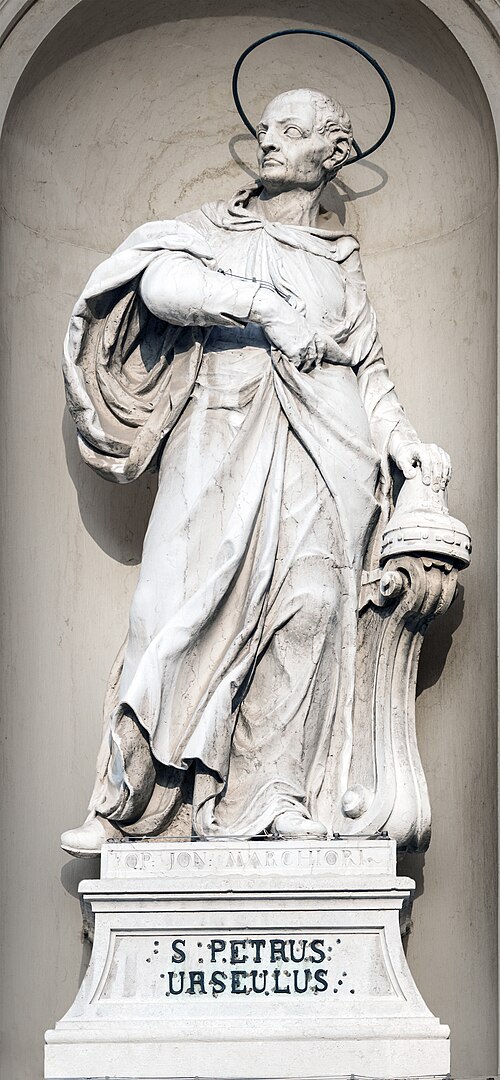
Venerable
Peter I Orseolo
Doge of Venice, later a monk
Doge of Venice from 976 to 978, who left office to become a monk; he died in 987.
- Feast
- January 10old style January 23
- Reposed
- 98710th century
- Place
- Saint-Michel-de-Cuxa
- Order
- Venerables
Life
Saint Peter I Orseolo, venerable, was doge of Venice between 976 and 978, then left everything to become a monk and died in 987 at the monastery of Saint-Michel-de-Cuxa. He is commemorated on 10 January.
Youth
He was born in 928, near Udine, in one of the most powerful families of Venice, descendants of the doges Teodato and Orso Ipato. At twenty he was made commander of the Venetian fleet and distinguished himself as a soldier in the campaigns against the Dalmatian pirates. He was devoted to the Church. From his marriage to Felicia Malipiero he had a son, Peter II Orseolo, who also became doge, and a daughter.
The doge
In 976 the doge Peter IV Candiano was killed in an uprising against his attempt to found a monarchy, and Peter Orseolo was elected in his place. Cardinal Peter Damian, a Camaldolese monk, says that he himself led the conspiracy against Candiano, but this cannot be proved. As doge he showed much talent in bringing order to unsettled Venice and showed great kindness toward the widow of his predecessor. He built hospitals and cared for widows, orphans and pilgrims. From his own means he began the rebuilding of the ducal chapel, now the basilica of Saint Mark, and of the Doge’s Palace, destroyed in the uprising, along with a great part of the city. He ordered from Constantinople the Golden Altar for Saint Mark’s.
The departure
On 1 September 978, without telling anyone, neither his wife nor his children, he left Venice in the middle of the night, with Abbot Guarin and three other Venetians, among them Saint Romuald, for the Benedictine monastery of Saint-Michel-de-Cuxa, in southern France. There he led a life of great asceticism, doing the most menial tasks. It seems he had long been thinking of this. His only contact with Venice was the counsel he gave his grandson, Otto, later doge, to live in Christian virtue. After some years, probably at the urging of Saint Romuald, he left the monastery to live as a hermit in the nearby forest, where he remained seven years, until his death.
Veneration
His body was buried in the church at Prades. Forty years after his death, in 1027, he was officially recognized as blessed by the local bishop. His veneration was confirmed in 1731 by Pope Clement XII. The Camaldolese order commemorates him on 19 January. His right hand was taken in 1732 to Venice, to the basilica of Saint Mark. His portrait is in the series of portraits of the doges in the Doge’s Palace. He is venerated as a saint also by the Orthodox Church.
Commemorated the same day January 10
 Gregory of NyssaSaint · Bishop of NyssaJan 10
 Theophan the RecluseSaint · Former bishop, recluse at VyshaJan 10
 Domitian of MeliteneSaint · Archbishop of MeliteneJan 10
- John II of JerusalemSaint · Bishop of JerusalemJan 10
 John the Good of MilanSaint · Archbishop of MilanJan 10
 Paul of ObnoraVenerable · Founder of Pavlo-Obnorsk MonasteryJan 10
 Anatoly HrysiukHieromartyr · Metropolitan of Odesa and KhersonJan 10
- Arsenia DobronravovaVenerable Martyr · AbbessJan 10
- Marcian of ConstantinopleVenerableJan 10
- Macarius of PismaVenerableJan 10
- TheosebiaVenerable · DeaconessJan 10
- Ammon of EgyptVenerableJan 10