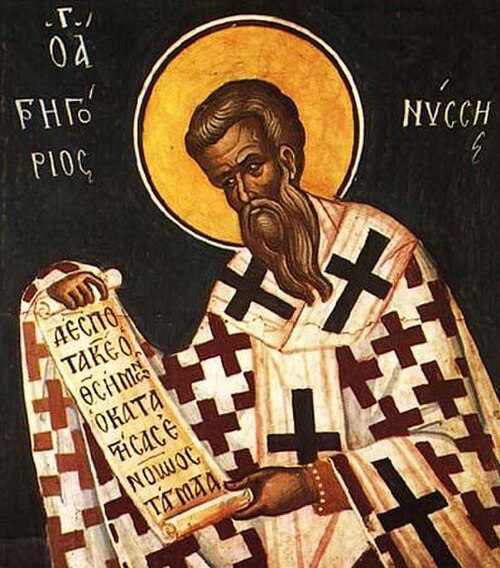
Saint
Gregory of Nyssa
Bishop of Nyssa
Bishop of Nyssa, brother of Basil the Great and great theologian of Cappadocia.
- Feast
- January 10old style January 23
- Reposed
- 3954th century
- Place
- Nyssa
- Order
- Hierarchs
Life
Saint Gregory of Nyssa was bishop of Nyssa in Cappadocia, the brother of Saint Basil the Great and one of the three great Cappadocians, together with Basil and Saint Gregory the Theologian. The Church calls him Father and Teacher, and he made a great contribution to the teaching on the Holy Trinity and to the Nicene Creed. His memory is kept on 10 January.
Family and youth
He was born around 335 in Cappadocia into a large Christian family whose members are honoured as saints, among them his brother Basil, his sister Macrina and his brother Peter of Sebaste. He was younger than Basil. Unlike his other brothers, he was at first drawn to a worldly life and loved hunting and feasts more than study and prayer. Urged by his brother and sister, he changed his way of life. He was first a reader in church, then taught rhetoric. He was married to Theosevia. After some time he gave up teaching and withdrew to the monastery founded by Basil on the bank of the river Iris, where for about ten years he devoted himself to the study of Scripture and the Fathers, reading Origen and Methodius. There he wrote his first work, On Virginity.
Bishop of Nyssa
In 372, after Emperor Valens divided Cappadocia into two provinces, Basil ordained him bishop of Nyssa, a small town in the diocese of Caesarea. He was a zealous defender of Orthodoxy, and the hostility of the Arians, who had the emperor's support, was soon turned against him. In 376 he was removed from his see and sent into exile, and after spending about two years away from his see he was recalled and restored, after the death of Valens. In 379 Saint Basil died, and Gregory mourned him greatly; in the same year he took part in the synod of Antioch, where he was sent to Arabia and Palestine to examine the Churches there, and passed also through Jerusalem. At the death of his sister Macrina, also in 379, he was present, and he wrote her life.
The Second Ecumenical Council and his writings
In 381 he was one of the leading figures of the Second Ecumenical Council at Constantinople. The fathers of the council, admiring his philosophical and theological learning, regarded him as a pillar of Orthodoxy, and tradition says he worked on the second part of the Creed. He left a rich body of work: exegetical and dogmatic homilies, funeral orations of literary skill, works against Eunomius, the treatise On Virginity, the Life of Moses, writings on the soul and the resurrection. Many scholars regard him as more a philosopher than a theologian, because he explained many theological notions philosophically, and in his writings he was influenced by Origen. He was the first to write against every form of slavery, holding it sinful in itself.
Repose and veneration
Saint Gregory fell asleep in deep old age, after 394, remaining for ever a great light of the Church. The Orthodox Church commemorates him on 10 January, and the Church of Rome on 9 March.
Commemorated the same day January 10
 Peter I OrseoloVenerable · Doge of Venice, later a monkJan 10
 Theophan the RecluseSaint · Former bishop, recluse at VyshaJan 10
 Domitian of MeliteneSaint · Archbishop of MeliteneJan 10
- John II of JerusalemSaint · Bishop of JerusalemJan 10
 John the Good of MilanSaint · Archbishop of MilanJan 10
 Paul of ObnoraVenerable · Founder of Pavlo-Obnorsk MonasteryJan 10
 Anatoly HrysiukHieromartyr · Metropolitan of Odesa and KhersonJan 10
- Arsenia DobronravovaVenerable Martyr · AbbessJan 10
- Marcian of ConstantinopleVenerableJan 10
- Macarius of PismaVenerableJan 10
- TheosebiaVenerable · DeaconessJan 10
- Ammon of EgyptVenerableJan 10