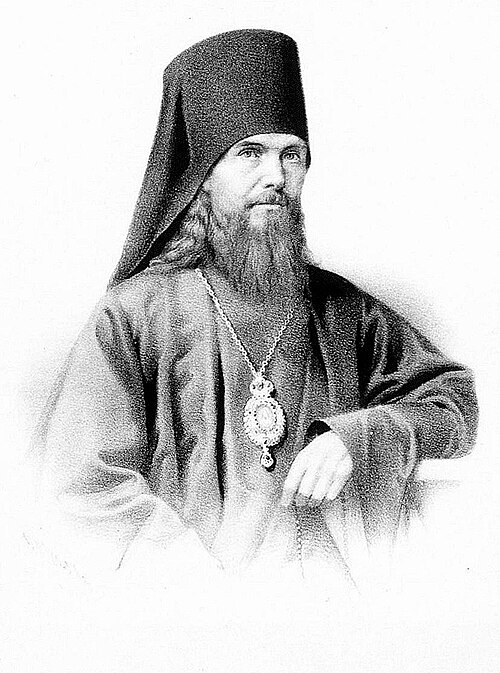
Saint
Theophan the Recluse
Former bishop, recluse at Vysha
Russian bishop, theologian and preacher, who withdrew into seclusion at Vysha and died in 1894.
- Feast
- January 10old style January 23
- Reposed
- 189419th century
- Place
- Vysha
- Order
- Hierarchs
Life
Saint Theophan the Recluse, born Georgy Vasilievich Govorov, was a Russian bishop and theologian, born on 10 January 1815 and fallen asleep on 6 January 1894 (Old Style), the feast of the Theophany. The Church remembers him as a great teacher of unceasing prayer, who left books and letters of spiritual guidance and gave the Russian people the Philokalia in their own language. He was canonized by the Russian Orthodox Church in 1988.
Childhood and studies
He was born in the village of Chernavsk in the Oryol region, into the family of a country priest. His mother also came from a priestly family, so he received a deeply religious upbringing from his earliest years. In 1823 he entered the theological school at Livny, and in 1829, among the best pupils, he was moved to the seminary at Oryol. The seminary's records noted that he loved solitude, that he was gentle and silent, and that he set an example of diligence and good conduct.
In 1837, as the best of his class, he was sent to the Theological Academy of Kiev. His mother died in 1838 and his father a year later, and these losses weighed on the choice of his path. He often went to the caves of the Kiev Caves Lavra, which seem to have drawn him toward monastic life.
Monk and teacher
In 1841, at twenty-six, he was tonsured by the rector of the academy, Archimandrite Jeremiah, and received the name Theophan, in honour of Saint Theophanes the Confessor. In the same year he was ordained hierodeacon and hieromonk. He graduated among the first with a master's degree in theology, and his course essay on the religion under the Law was sent to the Holy Synod and praised by Metropolitan Philaret of Moscow.
He then served as rector of the Saint Sophia theological school in Kiev, as inspector and teacher at the Novgorod seminary, and from 1844 as professor of moral and pastoral theology at the Saint Petersburg Academy. He felt more and more weighed down by the lecture hall, and in a letter to his spiritual father he said that he would rather simply sit in church.
At his own request he was appointed in 1847 to the Russian Ecclesiastical Mission in Jerusalem, led by Archimandrite Porphyrius Uspensky. There he learned iconography, Greek, French, Hebrew and Arabic, came to know the ancient monasticism of the East, and began to translate texts of the Greek Philokalia. The Crimean War brought him back to Russia in 1854.
Bishop
Raised to archimandrite, he was rector of the Olonets seminary, then priest of the Russian embassy church in Constantinople, and from 1857 rector of the Saint Petersburg Academy. In 1859 he was consecrated bishop of Tambov and Shatsk. There he taught his flock through simple and powerful sermons, opened parish schools and a school for girls, and began a diocesan journal. His Letters on the Christian Life date from those years.
In 1861 he was present at the uncovering of the relics of Saint Tikhon of Zadonsk, whom he had loved since childhood. In 1863 he was moved to Vladimir, where he again founded a diocesan school for girls.
Seclusion
In 1866 he asked the Holy Synod to release him from his see and withdrew to the hermitage of Vysha, in the diocese of Tambov, where he became head of the community. In 1872 he entered complete seclusion: he no longer appeared to people and no longer attended services in the monastery church, shutting himself in his cell. From this comes the name Recluse.
From his cell he went on serving the Church by writing. The post brought him between twenty and forty letters a day, and he answered each one. He translated and enlarged the Philokalia in Russian, wrote commentaries on Scripture, and wrote on the spiritual life and the raising of young people in the faith. The constant theme of his writings is the inner life of unbroken prayer, after the Apostle Paul's word to pray without ceasing.
He departed to the Lord on 6 January 1894, on the feast of the Theophany. In 1988, at the Local Council of the Russian Church marking a thousand years since the Baptism of Rus, he was numbered among the saints. He is commemorated on 10 January.
Commemorated the same day January 10
 Gregory of NyssaSaint · Bishop of NyssaJan 10
 Peter I OrseoloVenerable · Doge of Venice, later a monkJan 10
 Domitian of MeliteneSaint · Archbishop of MeliteneJan 10
- John II of JerusalemSaint · Bishop of JerusalemJan 10
 John the Good of MilanSaint · Archbishop of MilanJan 10
 Paul of ObnoraVenerable · Founder of Pavlo-Obnorsk MonasteryJan 10
 Anatoly HrysiukHieromartyr · Metropolitan of Odesa and KhersonJan 10
- Arsenia DobronravovaVenerable Martyr · AbbessJan 10
- Marcian of ConstantinopleVenerableJan 10
- Macarius of PismaVenerableJan 10
- TheosebiaVenerable · DeaconessJan 10
- Ammon of EgyptVenerableJan 10