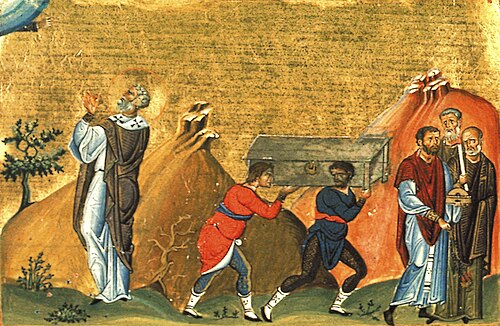
Saint
Domitian of Melitene
Archbishop of Melitene
Nephew of Emperor Maurice and archbishop of Melitene in Armenia, known as a diplomat; died in 602.
- Feast
- January 10old style January 23
- Reposed
- 6027th century
- Place
- Constantinople
- Order
- Hierarchs
Life
Saint Domitian was a nephew of the emperor Maurice and archbishop of Melitene in Roman Armenia from around 580 until his repose in 602. He was renowned as a diplomat and is regarded as a saint by the Chalcedonian Churches for enforcing orthodoxy in the northeast of the empire. The non-Chalcedonian Churches remember him instead for harsh persecutions. The Orthodox Church commemorates him on 10 January.
Early life
The Synaxarion of Constantinople and the Menologion of Basil II give him a short Life, written centuries after his death, so of doubtful reliability. According to the Synaxarion he was thirty when he became bishop, so was born around 550. According to the Chronicle of 1234 and Michael the Syrian, he was the son of Peter, brother of Maurice. The Synaxarion names his parents Theodore and Ecdicia, pious and wealthy, but no brother of Maurice named Theodore is known. He received both secular and biblical education. He was a friend of the future Pope Gregory the Great, when the latter was apocrisiarius at Constantinople between 579 and 585, and they apparently studied the Bible together. According to the Synaxarion he married, but his wife died soon after the wedding, and he renounced the world. He was renowned for the union of sagacity and asceticism.
Maurice's counsellor
According to John of Ephesus, Maurice had him elected bishop of Melitene some two years before he became emperor, that is around 580. The bishops of Melitene were metropolitans of their province, but Domitian was the first with the rank of archbishop, and Maurice raised the province, in his honour, from Armenia Tertia to Armenia Prima. John of Ephesus says he moved to Constantinople soon after Maurice's accession and was one of his closest advisers in the wars with the Persians, Avars and Slavs. He says he was imbued with the decisions of the Council of Chalcedon and Leo's Tome, and that he gave the poor the gifts he received from the emperor. He stayed mainly in Constantinople in 582 to 585 and 591 to 598. According to the Synaxarion Maurice sent him on missions to several pagan tribes. In 587 or 588 King Childebert II of Austrasia wrote to him seeking peace with the Romans. In Maurice's testament of 596 or 597 he was named guardian of the emperor's children.
Mission to Persia
In 590, during a Persian civil war, he was sent with Bishop Gregory of Antioch to Constantina, to join the exiled king Khosrow II, whom Maurice intended to restore. The two seem to have been chosen to make Khosrow a Christian. In August 593 he wrote to his old friend Gregory the Great, now pope. Gregory answered praising him for having "preached the Christian faith" to the Persian king and wrote him at least two more letters, in 595 and 598, the last about church affairs in Sicily. He obtained the end of the persecution of Christians in Persia and rights and privileges for them, even though he did not convert Khosrow. In the exile at the Persian court he met, at Circesium or Hierapolis, the noble Christian woman Golinduch, whose Life Eustratius of Melitene wrote after his death, from his recollections; she died on 13 July 591.
Persecutions and end
Being more a man of the state than of the Church, he remained in the memory of his contemporaries for harsh persecutions of the Monophysites, Jews and Samaritans. At Edessa, according to medieval Monophysite sources, he put to death four hundred Monophysite monks who refused to unite with the official Church. The Armenian and Coptic Churches therefore remember him as a "slayer". He also held a public dispute with Patriarch Eulogius of Alexandria, whom he accused of not fully understanding Chalcedonian dogma. He took part in the consecration of Patriarch Cyriacus of Constantinople. He fell asleep in 602 at Constantinople and was buried in the church of the Holy Apostles.
Commemorated the same day January 10
 Gregory of NyssaSaint · Bishop of NyssaJan 10
 Peter I OrseoloVenerable · Doge of Venice, later a monkJan 10
 Theophan the RecluseSaint · Former bishop, recluse at VyshaJan 10
- John II of JerusalemSaint · Bishop of JerusalemJan 10
 John the Good of MilanSaint · Archbishop of MilanJan 10
 Paul of ObnoraVenerable · Founder of Pavlo-Obnorsk MonasteryJan 10
 Anatoly HrysiukHieromartyr · Metropolitan of Odesa and KhersonJan 10
- Arsenia DobronravovaVenerable Martyr · AbbessJan 10
- Marcian of ConstantinopleVenerableJan 10
- Macarius of PismaVenerableJan 10
- TheosebiaVenerable · DeaconessJan 10
- Ammon of EgyptVenerableJan 10