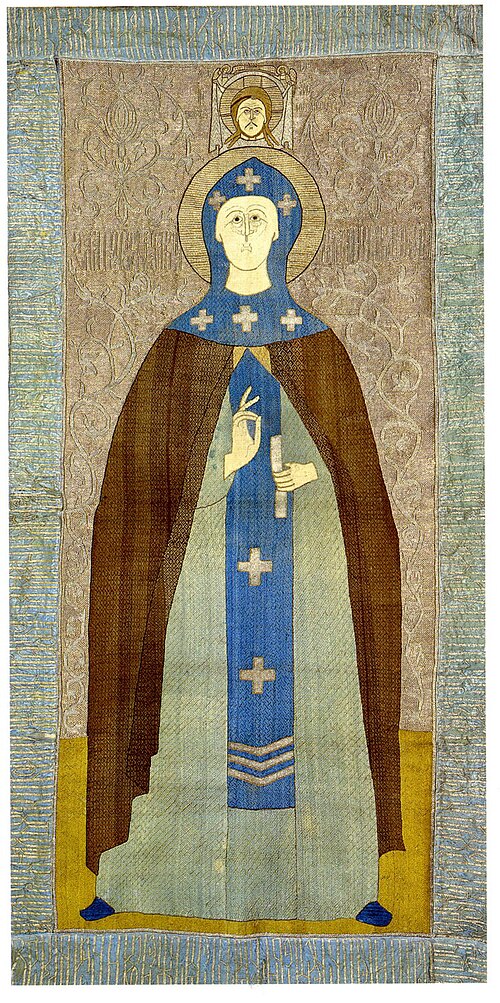
Right-Believing
Anna of Kashin
Princess of Tver
Wife of Mikhail of Tver, who lost almost all her relatives in princely strife; patron of Kashin and Tver.
- Feast
- June 12old style June 25
- Reposed
- 136814th century
- Place
- Kashin
Life
Saint Anna of Kashin, the Right-believing Princess, in monasticism Sophia, in the schema Anna, was the wife of Prince Mikhail of Tver, patroness of the cities of Kashin and Tver, known for her dramatic fate and for the troubled history of her veneration. She fell asleep on 2 October 1368. She is remembered on 12 June, 21 July and 2 October.
She was born around 1280, daughter of Prince Dmitry Borisovich of Rostov. From her earliest years she was brought up in a Christian way, taught humility and obedience. Her teacher was Ignatius, bishop of Rostov (died 1288), known for selflessness and peaceableness. Like all princes' daughters of her time, she learned various kinds of needlework. When she grew up, Princess Xenia of Tver sent ambassadors to Rostov with a request to marry Anna to her son Mikhail. The embassy succeeded, and the wedding took place on 8 November 1294 in the Transfiguration cathedral of Tver. They had five children: Feodora (died in infancy), Prince Dmitry of Tver (1299-1326), Alexander of Tver (1301-1339), Konstantin (1306-1346) and Vasily of Kashin (died after 1368).
Her father died in 1294, and in 1295 a terrible fire destroyed Tver. Soon their first daughter, Feodora, fell severely ill and died in infancy. In 1296 another fire destroyed the palace, and the prince and princess were barely rescued. In 1317 war began between Yury of Moscow and Anna's husband, Prince Mikhail. In 1318 the princess said farewell forever to her husband, summoned to the Horde, where he was brutally tortured and killed on 22 November 1318. Only in July of the following year did Anna learn of his martyrdom; hearing that his remains had been brought to Moscow, she sent an embassy there, and her husband's body was transferred to Tver and buried in the Transfiguration cathedral. In 1325 her eldest son, Dmitry, was tortured in the Horde. In 1327 her second son, Alexander, defeated the Tatar army that had devastated the principality; in revenge Uzbeg Khan gathered a new army and destroyed Tver; Alexander had to hide in Pskov. For ten years Anna did not see her son, and in 1339 Prince Alexander and his son Feodor were killed by the Horde. After the death of Prince Mikhail, Anna fulfilled an old desire “to labour in silence only for God”: she took vows at the Sophia monastery in Tver, with the name Sophia (in one source, Euphrosyne). In 1358, at eighty, she already appears as a nun, probably abbess of the convent of Saint Athanasius in Tver. In 1361 she gave several villages to the Otroch monastery in Tver, and took part in 1367 in the funeral of the holy bishop Theodore. In 1365-1367 her youngest son, Vasily, her only child then alive, begged her to move to his principality, at Kashin. The Dormition monastery was built there, and there she accepted the schema, with the name Anna. She fell asleep at a great age, on 2 October 1368, and was buried in the cathedral church of the Most Holy Mother of God.
Her name was forgotten for many centuries. During the siege of Kashin by the Lithuanians, in 1611, she appeared to Gerasim, sexton of the Dormition cathedral, and it is said that she prayed to the Saviour and Our Lady for the deliverance of her city from the foreigners. Her relics were reported to work miracles. In 1649 Tsar Alexei Mikhailovich ordered the examination of the relics, and Archbishop Jonah of Tver and Kashin, Archimandrite Sylvester and Abbot John went; the body was found incorrupt, with only slight traces of decay on the face and feet, and the right hand lay on the breast, “bent as if blessing,” that is, with the fingers in the old two-finger manner. On 12 June 1650, in the presence of the tsar and tsarina, the relics were moved from the old wooden Dormition church to the cathedral of the Resurrection, and the Council of Moscow numbered Anna among the saints, ordaining that she be remembered twice a year: on 2 October, the day of her repose, and on 21 July, the day of the finding of her relics. The service for the translation of the relics was composed by the hieromonk Epiphanius Slavinetsky.
Twenty-eight years later, in 1677, Patriarch Joachim proposed to the Council of Moscow that her canonization be withdrawn, because of the unusual veneration given to her by the schismatics, the Old Believers, who considered that her incorrupt body, with the hand in the old manner of the sign of the cross, vindicated their stance. It was a precedent in the history of the Russian Church. In 1908 Tsar Nicholas II officially restored her veneration, and in 1909 great celebrations were held at Kashin.
Commemorated the same day June 12
 Leo III of RomeSaint · Bishop of RomeJun 12
 Onuphrius the GreatVenerable · Hermit of the ThebaidJun 12
 John TornikeVenerable · Georgian general, monk at IvironJun 12
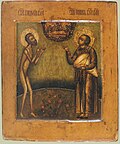 John of MoscowFool-for-Christ · Fool for ChristJun 12
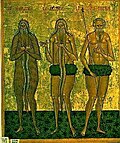 Peter the AthoniteVenerable · First hermit of Mount AthosJun 12
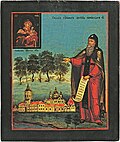 Arsenius of KonevetsVenerable · Founder of Konevets MonasteryJun 12
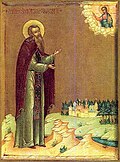 Stephen of KomelVenerable · Founder of Saint Nicholas MonasteryJun 12
- Auxentius of VologdaVenerableJun 12
- Onuphrius of MalskVenerableJun 12
- Onuphrius of VologdaVenerableJun 12
- Agatan of Disert AgatainSaintJun 12
- AmphionConfessor · Bishop and confessor of CiliciaJun 12