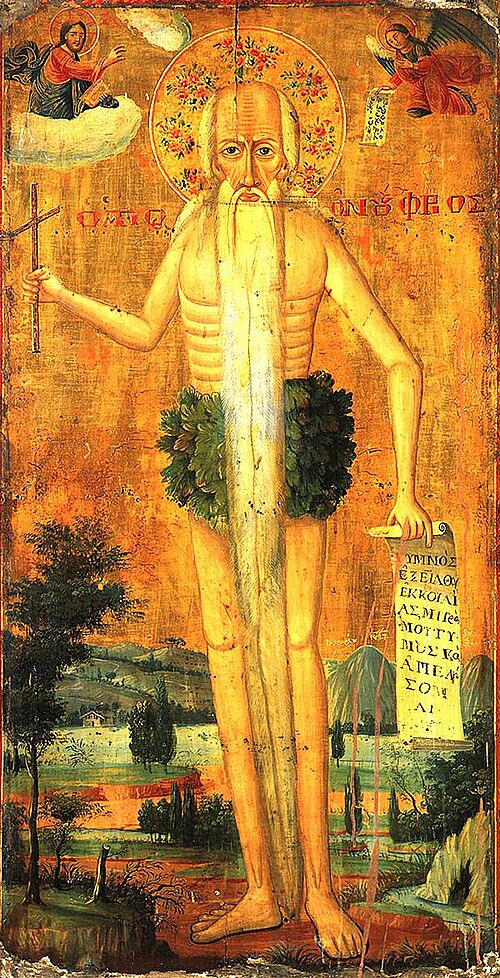
Venerable
Onuphrius the Great
Hermit of the Thebaid
Hermit in the desert of Upper Egypt in the fourth or fifth century.
- Feast
- June 12old style June 25
- Reposed
- 4004th century
- Place
- Lower Egypt
- Order
- Venerables
Life
Saint Onuphrius the Great was a hermit who lived in the desert of Upper Egypt in the fourth or fifth century. He is venerated as a saint in the Orthodox and Catholic Churches and in the ancient Eastern Churches. He is commemorated on 12 June. We know of his life only from the account of Paphnutius the Ascetic, who met him in the desert.
Who he was
Onuphrius was one of the Desert Fathers, who made a great impression on Eastern spirituality, at a time when many Christians went into the desert to live a life of prayer in great heat and cold, with little food and water, surrounded by wild beasts and robbers. It is not certain in what century he lived, and even the author of the account is uncertain: Paphnutius may be Paphnutius the Ascetic or Paphnutius of Scetis, a fourth-century abbot. The name Onuphrius is thought to be a Hellenized form of the Coptic name Unnufer, from the Egyptian wnn-nfr, “the perfect one”, “he who is continually good”. A tradition not found in Paphnutius says that Onuphrius studied law and philosophy before becoming a monk near Thebes and then a hermit. Some versions of the Life say he was born around 320 in Persia, a king’s son, given in infancy to a monastery of the Thebaid, from which he left secretly for the desert.
The meeting with Paphnutius
Abba Paphnutius set out on pilgrimage to learn the life of the hermits and see whether it suited him. After sixteen days of wandering in the desert, on the seventeenth he came upon a wild man, covered in hair, with a girdle of leaves. Frightened, he ran up the mountain, but the man called him: “Come down, man of God, for I too am a man, dwelling in the desert for love of God.” The one he met made himself known as Onuphrius and told how he had been a monk in a great monastery of the Thebaid, but for sixty or seventy years had lived as a hermit, enduring thirst, hunger and hardship; his guardian angel had brought him to that desolate place. His hair and beard were white as snow and reached the ground. For a long time he fed on the rare plants of the desert, then, after thirty years, God gave him a date palm with twelve branches, each bearing in a different month, and a spring. The angel also brought him bread, and on Saturdays and Sundays came to give him communion. Onuphrius took Paphnutius to his cell and they spoke until sunset, when bread and water appeared miraculously. They spent the night in prayer, and in the morning Onuphrius was near death. Paphnutius asked whether he should stay in his cell, but the hermit said his work was in Egypt, with the brethren; he asked him to keep a memorial with incense in his memory, then blessed him and fell asleep. Paphnutius saw light over the saint’s body and heard the singing of angels. The ground being hard and rocky, he could not dig a grave, so he covered him with his cloak and left him in a cleft of the rocks; the cell collapsed, a sign that he should not stay.
Veneration
The Orthodox and Catholic Churches commemorate him on 12 June, though a later Greek Life says he died on 11 June. His legend was painted in the camposanto of Pisa, and at Rome, in the fifteenth century, the church of Sant’Onofrio was built in his honour on the Janiculum. Anthony of Novgorod, around 1200, wrote that his head was kept in the church of Saint Acindynus in Constantinople. In icons he is shown with a long beard, naked, with a bundle of leaves around his waist. In Orthodox tradition, cemetery churches are often dedicated to him. In Poland, Orthodox seminarians begin their spiritual training at the monastery of Saint Onuphrius at Jabłeczna.
Commemorated the same day June 12
 Leo III of RomeSaint · Bishop of RomeJun 12
 John TornikeVenerable · Georgian general, monk at IvironJun 12
 Anna of KashinRight-Believing · Princess of TverJun 12
 John of MoscowFool-for-Christ · Fool for ChristJun 12
 Peter the AthoniteVenerable · First hermit of Mount AthosJun 12
 Arsenius of KonevetsVenerable · Founder of Konevets MonasteryJun 12
 Stephen of KomelVenerable · Founder of Saint Nicholas MonasteryJun 12
- Auxentius of VologdaVenerableJun 12
- Onuphrius of MalskVenerableJun 12
- Onuphrius of VologdaVenerableJun 12
- Agatan of Disert AgatainSaintJun 12
- AmphionConfessor · Bishop and confessor of CiliciaJun 12