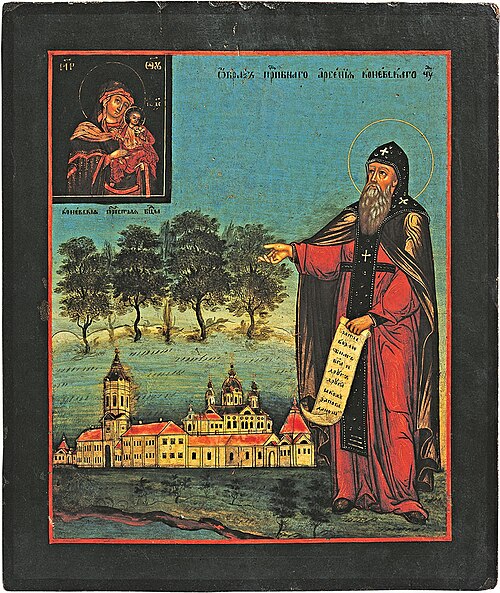
Venerable
Arsenius of Konevets
Founder of Konevets Monastery
Monk from Novgorod, founder of the Konevets monastery and wonderworker; died in 1447.
- Feast
- June 12old style June 25
- Reposed
- 144715th century
- Place
- Veliky Novgorod
- Order
- Venerables
Life
Venerable Arsenius of Konevets, the wonderworker of Novgorod, was a monk, a coppersmith, founder of the Konevets monastery on the island of that name in Lake Ladoga and is venerated as patron of sailors. He brought from Mount Athos to Russia the Konevets icon of the Mother of God. Born in the second half of the fourteenth century at Novgorod, he fell asleep on 12 June 1447 (by some sources 1444) at Konevets. He is commemorated on 12 (25) June.
Sources
The oldest account of him is the "Tale of Abba Arsenius", dated to the 1530s. In the second half of the sixteenth century Barlaam composed a new redaction of the life, with three miracles after death, and at the beginning of the nineteenth century a new redaction appeared, probably by Abbot Hilarion, adding data about his stay at Valaam, based on monastery tradition.
Life
He was born at Novgorod and was a craftsman, making things of copper. In 1373, still young, he entered the Lisa Gora monastery near Novgorod, in the time of the abbacy of Euthymius, the future Archbishop Euthymius II Vyazhitsky, and received tonsure with the name Arsenius. In 1384 to 1387, after eleven years in the monastery, he went to Athos with an Athonite monk who had come to Novgorod and spent three years there. At first he worked at carpentry, baking bread and other services, but when the abbot learned that he knew the craft, he ordered him to make vessels in silence. He visited many Athonite monasteries, for which he made vessels free of charge. The monks, seeing him labour like one bodiless or like a bought slave, marvelled at his patience and loved him all the more. On leaving, Abbot John gave him the "Rule of the Holy Mountain" and a wonder-working icon of the Mother of God, with the image of the Saviour Not Made by Hands on its back.
In 1393 he returned to Novgorod with the icon, later called the Konevets icon, and soon, with the blessing of Archbishop John II, set out on the Volkhov toward Lake Nevo the Great (Ladoga) seeking a place for a monastery. The printed life says that he passed by Valaam but, seeing the monastery very crowded, left. Reaching the island of Konevets, he wanted to sail on, but the wind drove back the boat in which he and his disciples were (by another tradition, twice). He landed on the island at the place later called Filippova Lakhta, and there in the nineteenth century a cross, a skete and a monastery were set up. Then he moved to the bay later called, after the visit of Archbishop Euthymius, probably in 1444, Vladychnaya Lakhta.
In 1394, according to the printed life, a year after his settling on Konevets, the monk Laurence came to him, sent by Abbot Sila of Valaam to call him to Valaam, but Arsenius did not agree, because he had come to love the quiet of Konevets. At first the monastery apparently did not have a strict communal life. In 1395 to 1396 among the first monks were Venerable Theophilus and Jacob of Omuche, who founded the Theophilus Hermitage in the Pskov land. In 1398, with the blessing of Archbishop John, the church of the Nativity of the Mother of God was built in the monastery. By tradition, one night a clairvoyant old man of the monastery heard two demons talking: one said that all Novgorodians praise the life of the abbot of Konevets, and the other admitted that the monastery's rule was blameless, but that, to the demons' comfort, Arsenius kept in his cell a meal for benefactors. Next day the old man told Arsenius, who ordered the cellarer to set up a common table and keep nothing in the cells. The venerable drove demons from the Horse Stone on the island, to which the pagans brought sacrifices; after Arsenius and the monastery priest sprinkled the stone with holy water, the fishermen saw a flock of ravens flying north and roaring like oxen. After the casting out of the demons, the monastery tradition says, he blessed the building of a chapel on the top of the Horse Stone, rebuilt at the end of the nineteenth century.
He went a second time to Athos and asked for prayers and blessing for his monastery. In his absence a great famine came, and the monks wished to disperse. The old man Joachim prayed in the forest to the Mother of God to protect the monastery, and the Most Pure Virgin appeared to him, saying that the venerable would soon return and bring what was needed. The next day Arsenius arrived, with two ships full. The place where Joachim prayed was called the Holy Mountain, and there a cross was put and in the nineteenth century a skete made, where on the day of commemoration a procession went from the monastery. In 1421 a flood of the lake destroyed the monastery buildings and Arsenius moved it to another place on the island. He fell asleep in 1447 and was buried in the monastery church. Dying, he left the brethren to keep the Rule of the Holy Mountain and "to keep the table equal". He was buried in the narthex of the church of the Nativity of the Mother of God, and above the grave a side chapel dedicated to Venerable Onuphrius the Great was later built.
Relics and miracles
In 1577 (or about 1573), at the threat of a Swedish attack, his relics were hidden under a wall, at the west wall of the church of the Nativity of the Mother of God. In 1672 to 1673 Russia negotiated with Sweden to bring the relics to the Derevyanitsky monastery; Patriarch Pitirim ordered Abbot Joasaph to go and receive them with honour. In November 1991 the relics were found, under the floor of the cathedral of the Nativity of the Mother of God, in a crypt two and a half metres deep. In 1996 archaeologists confirmed that a sixteenth-century tomb had been found, and in 1998 the relics were examined, a shrine of carved mahogany made and, in 2008, a carved canopy.
The first dated miracle after death is of 1573: a resident of Karelia, Athanasius Belay, taken prisoner and forced to work in a Swede's house, prayed before an icon of the Saviour, and the Lord commanded him in a dream to take the icon and go to Konevets. At sea, when all were asleep, Arsenius woke him: "Arise and look at the sea, for behold, the serpent hisses"; people saw the Swedish ship and managed to flee. Soon after his death three miracles described in the life took place: the deliverance of the monastery's fishermen from ice captivity, the healing of a blind man brought by his seven-year-old daughter from Vyazhishchi to Konevets, and of the paralyzed monk Leontius. Troparion, kontakion and prayer are known from the eighteenth century, and in 1819 the Holy Synod entered his commemoration in all calendars.
Veneration
He is commemorated on 12 (25) June, the day of repose, on the second Sunday after Pentecost, in the Synaxis of the Athonite saints, on the third Sunday, in the Synaxis of the Saints of Novgorod and of Saint Petersburg, and on the Saturday between 31 October and 6 November, in the Synaxis of the Saints of Karelia. The oldest surviving image is an embroidered cover of 1551 for his tomb. Iconography often shows him with a large beard, in monastic dress, with a scroll in his hand, or before the monastery, praying to the Konevets icon.
Commemorated the same day June 12
 Leo III of RomeSaint · Bishop of RomeJun 12
 Onuphrius the GreatVenerable · Hermit of the ThebaidJun 12
 John TornikeVenerable · Georgian general, monk at IvironJun 12
 Anna of KashinRight-Believing · Princess of TverJun 12
 John of MoscowFool-for-Christ · Fool for ChristJun 12
 Peter the AthoniteVenerable · First hermit of Mount AthosJun 12
 Stephen of KomelVenerable · Founder of Saint Nicholas MonasteryJun 12
- Auxentius of VologdaVenerableJun 12
- Onuphrius of MalskVenerableJun 12
- Onuphrius of VologdaVenerableJun 12
- Agatan of Disert AgatainSaintJun 12
- AmphionConfessor · Bishop and confessor of CiliciaJun 12