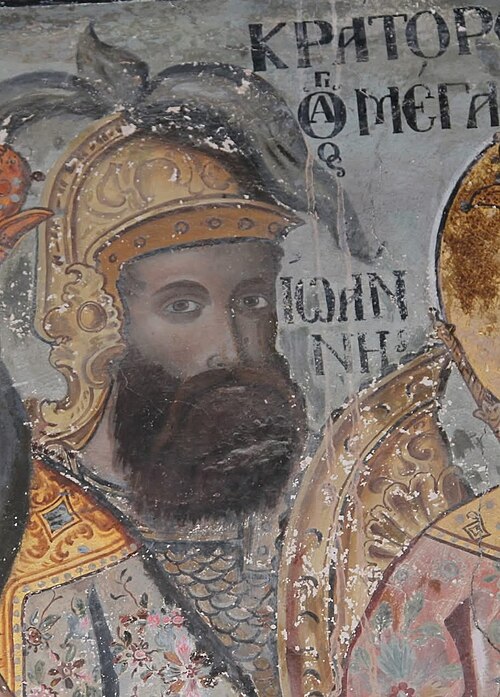
Venerable
John Tornike
Georgian general, monk at Iviron
Georgian general who retired as a monk, one of the founders of Iviron Monastery on Athos; died in 985.
- Feast
- June 12old style June 25
- Reposed
- 98510th century
- Place
- Mount Athos
- Order
- Venerables
Life
The Venerable John Tornike (Tornike Eristavi, John-Tornikios) was a Georgian general, then a monk and one of the founders of the Iviron monastery on Mount Athos. He fell asleep in 984 or 985. He is venerated as a saint in the Church of Georgia and commemorated on 12 June.
Beginnings
He came from a noble Georgian family close to the Bagrationi dynasty. His father, Chordvaneli, a protospatharios, had held a high place at the court of Ashot Kuropalates, who visited the Byzantine emperor Constantine Porphyrogenitus at Constantinople around 950. Tornike had a very successful military and court career as eristavi (a sort of strategos) under the Bagratids, in the service of David III of Tao, and received the Byzantine title of patrikios. He had four brothers and three nephews with military careers, one of whom, Varazvache, was katepano of Edessa in 1037-1038. He never married.
Monastic life
For a long time he hesitated about monastic life; when he learned that his relative John had become a monk in the 960s and gone to a monastery in Bithynia, he too took the monastic habit, with the name John, around 963 (according to one source, in the early 970s), went to Bithynia, then to Athos, to the Great Lavra of Saint Athanasius, where he found his relative. Soon word spread about the two Georgian monks and more and more Georgian monks came. The two Johns built a Georgian church of Saint John the Baptist, a kilometre and a half from the Great Lavra. In the early 970s, according to another source, another retired officer, John, and his son Euthymius joined them.
The war and the founding of Iviron
In 976 the revolt of Bardas Skleros against the emperor Basil II broke out, the greatest upheaval of the early part of his reign. Skleros won several battles against the loyal general Bardas Phokas and marched through Anatolia toward Constantinople. The empress-mother Theophano, as regent, wished to ask help of the Georgian king and turned to the Georgian monks of Athos. In the summer of 978 Tornike came to Constantinople and, although he asked to be excused, at her refusal he went to Georgia and persuaded David Kuropalates to send to the aid of the empire an army of some twelve thousand horsemen, the command of which was entrusted to him. On 24 March 979, in the second battle of Pankalia, near Caesarea, the revolt was crushed, the decisive part being played by the general Tornik, an Iberian by birth, a monk on the Holy Mountain.
As reward, David received for life the stewardship of extensive lands in north-eastern Anatolia, and Tornike was made synkellos and received at Constantinople with great honour. He was given the island of Hagios Eustratios, precious objects, sacred vessels, icons, books, vestments, a particle of the Holy Cross and twelve kentenaria (about 1,200 lb) of gold. Part of the gold he divided among the soldiers, the rest he sent to the Georgian king and to the Athonite monasteries. He returned to Athos with his nephew George and many Georgian monks, former soldiers, and with the money that remained he founded, with John the Iberian, the first Georgian monastery, Iviron (of the Iberians, that is Georgians). John was chosen abbot, and Tornike was steward. The emperor showered him with lands and privileges, subsidies and exemptions from taxes.
Repose and veneration
Tornike copied and translated many manuscripts from Greek; accounts survive of his great humility and obedience toward Abbot John, with whom he had a close friendship. Before his death he received the rank of archimandrite and fell asleep on 15 December 984 (in another source, 985); his friend John afterward left the monastery and returned to Athos only at the emperor's order. His veneration began at once; his relics were placed in the church of Saint John the Baptist and, between 1044 and 1065, moved, with those of other Georgian ascetics, to the church of the Dormition, the katholikon of Iviron. In the sacristy his armour and sabre were kept.
Commemorated the same day June 12
 Leo III of RomeSaint · Bishop of RomeJun 12
 Onuphrius the GreatVenerable · Hermit of the ThebaidJun 12
 Anna of KashinRight-Believing · Princess of TverJun 12
 John of MoscowFool-for-Christ · Fool for ChristJun 12
 Peter the AthoniteVenerable · First hermit of Mount AthosJun 12
 Arsenius of KonevetsVenerable · Founder of Konevets MonasteryJun 12
 Stephen of KomelVenerable · Founder of Saint Nicholas MonasteryJun 12
- Auxentius of VologdaVenerableJun 12
- Onuphrius of MalskVenerableJun 12
- Onuphrius of VologdaVenerableJun 12
- Agatan of Disert AgatainSaintJun 12
- AmphionConfessor · Bishop and confessor of CiliciaJun 12