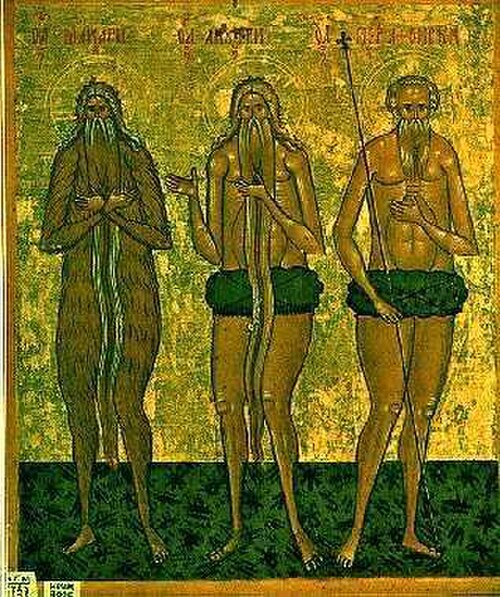
Venerable
Peter the Athonite
First hermit of Mount Athos
Reputed to be the first hermit to settle on Mount Athos; commemorated on 12 June.
- Feast
- June 12old style June 25
- Reposed
- 7348th century
- Place
- Byzantine Empire
- Order
- Venerables
Life
Venerable Peter the Athonite is held, according to tradition, to be the first hermit to settle on Mount Athos. He is venerated as a saint in the Orthodox, the Eastern Catholic and the Catholic Church and is remembered on 12 June, and also in the Synaxis of all the venerable Athonite fathers. By tradition he fell asleep in 734, but the sources are uncertain: some place him in the seventh and eighth centuries, others in the ninth.
The prisoner
His life is known mostly from legends. Peter was a Greek by birth and a commander in the imperial armies, living at Constantinople. In 667 (by some reckonings), in the time of a war with the Syrians or with the Abbasid caliphate, he was taken prisoner and imprisoned in the fortress of Samarra in Mesopotamia (in another source, Samara, on the Euphrates). For a long time in prison, he thought on what sins he had been punished by God. Then he remembered that once he had had the intention of leaving worldly life and entering a monastery, but had not fulfilled it. He began to fast strictly, to pray fervently and especially to ask for the help of Saint Nicholas the Wonderworker. One day Saint Nicholas himself appeared to him in a dream and advised him to call on Saint Symeon the God-Receiver for help. A little later Saint Nicholas appeared to him again in a dream, strengthening him in patience and hope. The third time he appeared together with Saint Symeon, while Peter was awake. Symeon touched Peter's chains with his staff, and the iron melted like wax, and the prison doors opened by themselves and Peter walked out free. Saint Symeon became invisible, and Saint Nicholas escorted Peter to the border where the Greek lands began, then, reminding him of his vow, he too became invisible.
Monk and hermit
Peter came to Rome, to be tonsured at the tomb of the Holy Apostle Peter. On the eve of his arrival Saint Nicholas appeared in a dream to the pope and told him the circumstances of Peter's release, bidding him tonsure him. The next day, at the Liturgy, before many people, the pope said aloud: “Peter, who came from the land of the Greeks, whom Saint Nicholas freed from prison at Samara, come to me.” Peter came and was tonsured a monk by the pope at the tomb of the Apostle. The pope taught him the rules of monastic life and kept him by him for a time, then let him go, with a blessing, wherever God would see fit. In 681 Peter boarded a ship sailing east, and then the Most Holy Mother of God appeared to him in a dream and showed him the place where he was to live to the end of his days: the Holy Mountain, Athos. When the ship passed by Athos it stopped by itself, and Peter went ashore there, into a cave “full of venomous creeping things.”
At first the demons tried to make him leave the cave: they appeared to him in the form of armed soldiers, wild beasts and reptiles ready to tear him apart. With fervent prayer to God and to the Mother of God Peter overcame all the attacks. Then the enemy began to appear to him in the form of a boy sent from home, who with tears begged him to leave the wilderness and return to his house. The venerable one wept but answered without hesitation: “The Lord and the Most Holy Mother brought me here, and without Her leave I will not go from here.” Hearing the name of the Mother of God, the devil vanished. After seven years the devil stood before him in the form of a bright angel and said that God commanded him to go into the world for the enlightenment and salvation of people who needed his guidance. The now experienced ascetic again answered that without the command of the Mother of God he would not leave the wilderness. The devil vanished and no longer dared approach, and the Mother of God appeared to him in a dream together with Saint Nicholas and told him that every forty days an angel would bring him heavenly manna. From that time Peter fasted forty days, and on the fortieth he was strengthened with heavenly manna.
Repose
Fifty-three years Venerable Peter spent in the deserted places of the Holy Mountain, meeting no one: his clothing turned to dust, and his hair and beard grew so long that they covered his whole body instead of clothing. Once a hunter chasing a deer saw a naked man, covered with hair and wearing a belt of leaves. He was frightened and fled, but Peter stopped him and told him of his life. The hunter asked to stay with him, but the venerable one sent him home and gave him a year of self-examination, forbidding him to tell anyone of the meeting. After a year the hunter returned with his brother, possessed by a demon, and other companions, and when they entered the cave they saw that the saint had passed to God. The hunter told with bitter weeping of Peter's life, and his brother, as soon as he touched the saint's body, was healed. His relics were on Athos at the monastery of Saint Clement, but in the time of iconoclasm they were hidden, and in 969 they were moved to the Thracian village of Photokami. According to some sources the monastery of Saint Clement was later absorbed by the monastery of Iviron. A life of him, in Greek, was written by an Athonite monk named Nicholas, in the late tenth or early eleventh century.
Commemorated the same day June 12
 Leo III of RomeSaint · Bishop of RomeJun 12
 Onuphrius the GreatVenerable · Hermit of the ThebaidJun 12
 John TornikeVenerable · Georgian general, monk at IvironJun 12
 Anna of KashinRight-Believing · Princess of TverJun 12
 John of MoscowFool-for-Christ · Fool for ChristJun 12
 Arsenius of KonevetsVenerable · Founder of Konevets MonasteryJun 12
 Stephen of KomelVenerable · Founder of Saint Nicholas MonasteryJun 12
- Auxentius of VologdaVenerableJun 12
- Onuphrius of MalskVenerableJun 12
- Onuphrius of VologdaVenerableJun 12
- Agatan of Disert AgatainSaintJun 12
- AmphionConfessor · Bishop and confessor of CiliciaJun 12